Hello! Welcome to your third lesson in our module on perception and attention.
In our last session, we explored the absolute and difference thresholds, which determine the limits of our perception—the minimum level at which we can detect a stimulus and the minimum change we can notice. We learned that for a marketing message to even have a chance, it must first cross these fundamental hurdles.
But what happens after a stimulus crosses that threshold? How does the brain turn a collection of shapes, colors, and sounds into a meaningful perception, like "that's a brand I trust" or "that product looks high-quality"?
This is where today's topic comes in. We will explore the two fundamental pathways the brain uses to interpret the world: bottom-up and top-down processing. By the end of this lesson, you will be able to differentiate between these two processes and provide a marketing example for each.
This distinction is at the heart of understanding perception. It explains how raw sensory data interacts with our existing knowledge and expectations to construct our reality—and our perception of brands.
Bottom-Up Processing: Building Perception from Sensory Data
Let's start with the most direct pathway. Bottom-up processing is perception that begins with the raw sensory information. It is data-driven, moving from the basic features of a stimulus up to the brain for a complete, integrated perception. In this mode, what you see is what you get, and your perception is built piece by piece from the stimulus itself.
Think of it like assembling a new piece of furniture without looking at the box or the instructions. You are relying solely on the individual parts—the screws, boards, and brackets—to figure out what you're building.
To see this in action, let's watch a segment of a video that defines and gives examples of this process.
Top Down Processing vs Bottom Up Processing (Examples!)
This video from the Practical Psychology channel provides a very clear introduction to bottom-up processing, defining it as 'data-driven' and starting with our senses.
Please watch from 00:42 to 02:48. Focus on how the process starts with individual sensory parts (like the shape of a machine or lights from a screen) and builds up to a whole. Note the example about road markings, which communicate directly through their physical form.
As the video explained, bottom-up processing is driven by the physical characteristics of the stimulus. For a more formal definition and a direct marketing example, please read the following excerpt.
Chapter 3: Consumer Perception from ...
This section from the 'Consumer Perception' textbook we've used before offers a concise definition and a perfect marketing example of bottom-up processing in action.
Please read the paragraph under the heading 'Bottom-Up and Top-Down Processing' that begins 'In the first pathway, which is known as bottom-up processing...'. Focus on the chocolate cake example and how the stimulus factors of the cake itself drove the consumer's action.
Bottom-Up Processing in Marketing
The textbook's example of the chocolate cake is perfect. The consumer's perception and subsequent purchase were driven entirely by the stimulus properties: the look, color, and imagined taste and smell of the cake. The product's sensory characteristics did all the work.
Here are some common marketing applications of bottom-up processing:
- Distinctive Packaging: A product in a uniquely shaped or brightly colored container that stands out on a crowded shelf (e.g., the original Method soap bottles or the triangular Toblerone box).
- Sensory Appeal in Ads: A food advertisement showing slow-motion shots of melting cheese or sizzling bacon. The visual data alone is designed to create a perception of deliciousness and trigger a desire to eat.
- Sound Design: The satisfying "click" of a luxury car door closing or the crisp "snap" of a Kit Kat bar. The sound itself creates a perception of quality and satisfaction.
In all these cases, the brand is relying on the raw sensory input to create a positive perception, with little to no prior knowledge required from the consumer.
Top-Down Processing: Perception Guided by the Mind
Now, let's look at the other side of the coin. If bottom-up is about building perception from scratch, top-down processing is about using what you already know to interpret the world. It is conceptually-driven, where your brain uses existing knowledge, experiences, expectations, and goals to make sense of sensory input.
Using our furniture analogy, this is like building the same item, but now you know it's a bookshelf, you've seen one before, and you're using that knowledge to guide how you interpret and assemble the pieces.
This image provides a great visual summary of the two concepts.
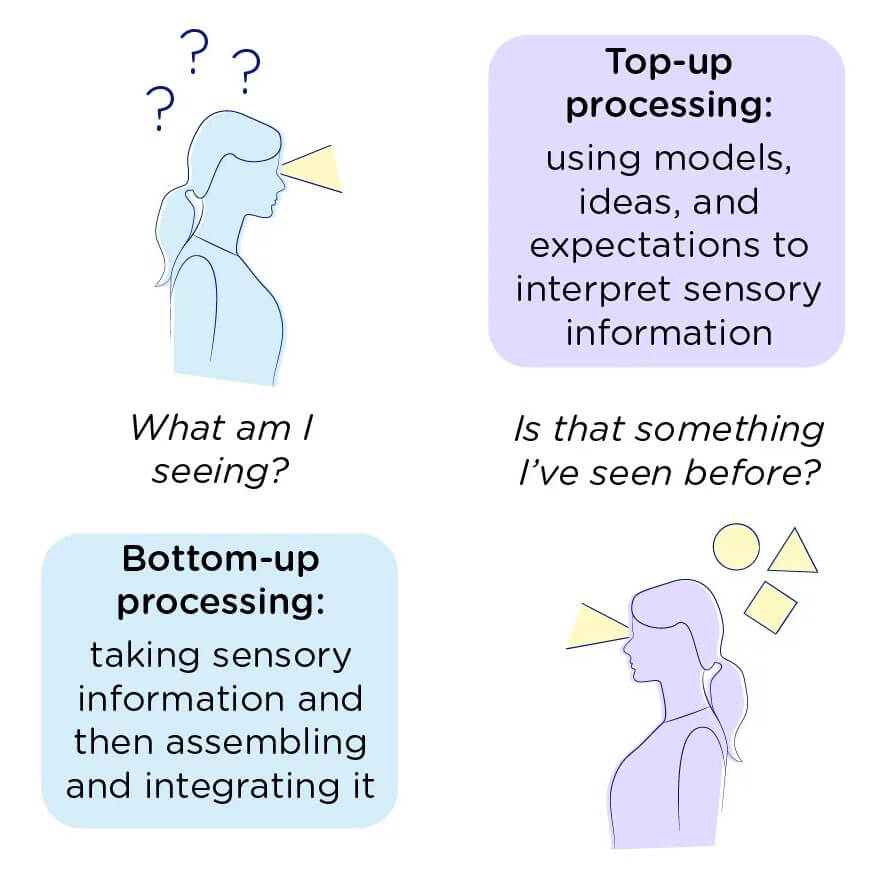
Our perception is rarely a blank slate. Your brain constantly makes predictions and uses context to interpret ambiguous information.
Let's return to the Practical Psychology video, which has a brilliant example of this.
Top Down Processing vs Bottom Up Processing (Examples!)
This part of the video explains top-down processing and uses the classic 'B or 13' illusion to show how context completely changes our perception of the exact same visual stimulus.
Please watch from 02:48 to 03:49 to see the 'B or 13' example. Then, continue from 04:22 to 07:27, where the video defines top-down processing and provides more examples, like our ability to read misspelled words.
The "B vs. 13" example is powerful because the raw sensory input (the bottom-up data) is identical in both cases. The only thing that changes is the context (A, C vs. 12, 14), which is interpreted by your brain's top-down expectations.
Now, let's look at a classic marketing example of this from our textbook.
Chapter 3: Consumer Perception from ...
Returning to the 'Consumer Perception' text, let's examine the definition and example for top-down processing. It demonstrates how preconceived beliefs can be more powerful than the physical product itself.
In the same section as before, please read the paragraph that begins 'In the second pathway, which is known as top-down processing...'. Focus on the Swiss watch example and how the consumer's choice was driven by her beliefs about quality, not the physical attributes of the watches.
Top-Down Processing in Marketing
The Swiss watch example is a masterclass in top-down processing. The bottom-up information was identical (two indistinguishable watches), but the consumer's pre-existing belief that "Swiss-made equals high quality" entirely dictated her perception and behavior. This is the essence of branding.
Here are some other marketing applications of top-down processing:
- Brand Logos: When you see the Apple logo on a laptop, you don't just see a piece of fruit (bottom-up). Your brain taps into a vast network of associations: "innovation," "design," "premium," "creativity" (top-down). The logo activates the brand's entire meaning.
- Celebrity Endorsements: An athlete promoting a sports drink. Your positive associations with the athlete's success and fitness are transferred to the product, shaping your perception of its effectiveness.
- Pricing: A high price tag often leads consumers to perceive a product as being of higher quality or more luxurious, even in the absence of any other information. Our expectation is "you get what you pay for."
This is where your goal of communicating neuromarketing becomes so powerful. When you explain top-down processing to a stakeholder, you are essentially explaining the scientific basis of building a strong brand.
A Constant Dance: How They Work Together
In the real world, bottom-up and top-down processing aren't an "either/or" choice. They are in a constant, dynamic interplay. Bottom-up processing provides the raw data, and top-down processing provides the interpretation.
Think about a can of Coca-Cola:
- Bottom-up: Your eyes detect a red cylinder with a white, flowing script. These are the basic visual features.
- Top-down: Your brain doesn't painstakingly analyze the shape and letters. It instantly recognizes the pattern from memory and activates all associated concepts: "Coke," "refreshment," "sweet," "carbonated," "happiness."
The bottom-up data is essential—if the can were blue, you wouldn't recognize it as Coke. But the top-down interpretation is what gives it meaning far beyond its physical properties.
Test your understanding!
Imagine a new, unknown brand of wine places its bottle on a supermarket shelf. The bottle has an elegant, minimalist label with sophisticated typography and is made of heavy glass. Next to it is a well-known, popular brand of wine in its familiar, standard packaging.
- Which type of processing is the new brand relying on most heavily to attract a first-time buyer? Why?
- Which type of processing is the well-known brand relying on? Why?
Show answer
-
The new brand is relying almost entirely on bottom-up processing. Since it has no established brand reputation, it must use the physical stimulus to communicate its message. The heavy glass, minimalist label, and elegant typography are all sensory cues designed to create a perception of "premium quality," "modern," and "high-end" from the ground up, without any prior knowledge from the consumer.
-
The well-known brand is relying primarily on top-down processing. While its packaging is still important, its main advantage is brand recognition. A consumer who has tried it before, seen its ads, or heard about it from friends will use that existing knowledge and expectation to guide their choice. Their brain sees the familiar label and instantly thinks, "I know this one, it's reliable/good value/my favorite," which often overrides a purely bottom-up evaluation of a novel competitor.
Conclusion
Today we've unpacked the two core mechanisms of perception. Understanding this distinction is fundamental to decoding how consumers interact with marketing.
Your key takeaways are:
- Bottom-Up Processing: Is "data-driven." Perception is built from raw sensory information. Marketers use this when leveraging a product's physical design, imagery, and sensory features to create an impression.
- Top-Down Processing: Is "concept-driven." Perception is interpreted through the lens of our existing knowledge, expectations, and goals. This is the foundation of branding, where a symbol like a logo can trigger a cascade of learned associations.
- A Partnership: These two processes work in tandem. Effective marketing often captures initial attention with strong bottom-up cues and then leverages top-down associations to seal the deal.
In our next lesson, we will explore selective attention. Now that we know how we interpret stimuli, we'll investigate the powerful filtering mechanisms in the brain that decide which of the thousands of daily marketing messages even get a chance to be processed in the first place.