Hello! Welcome to your next lesson.
In our last session, we traced the fascinating journey a sensory signal takes from the outside world into the brain to become a conscious perception. We learned that the brain doesn't "see" light or "hear" sound; it interprets electrical signals delivered by our sense organs.
A key question that follows is: how strong does a signal need to be for our senses to even pick it up? And if a stimulus changes—like a price drop or a new package design—how big does that change have to be for us to notice?
Today, we'll answer these questions by exploring sensory thresholds, the psychological limits of our perception. You will learn to explain the concepts of absolute and difference thresholds and their direct application in marketing. Understanding these thresholds is fundamental, as they govern whether a marketing message is perceived at all and whether changes to a product or price are even noticed by the consumer.
What is a Sensory Threshold?
In psychophysics—the study of how physical stimuli translate into psychological experience—a threshold is a dividing line. It's the point at which a stimulus goes from being undetectable to detectable, or the point at which a change in a stimulus becomes noticeable.
There are two primary types of thresholds that are critical for marketers. Let's start with the most basic one.
1. Absolute Threshold: The Bare Minimum
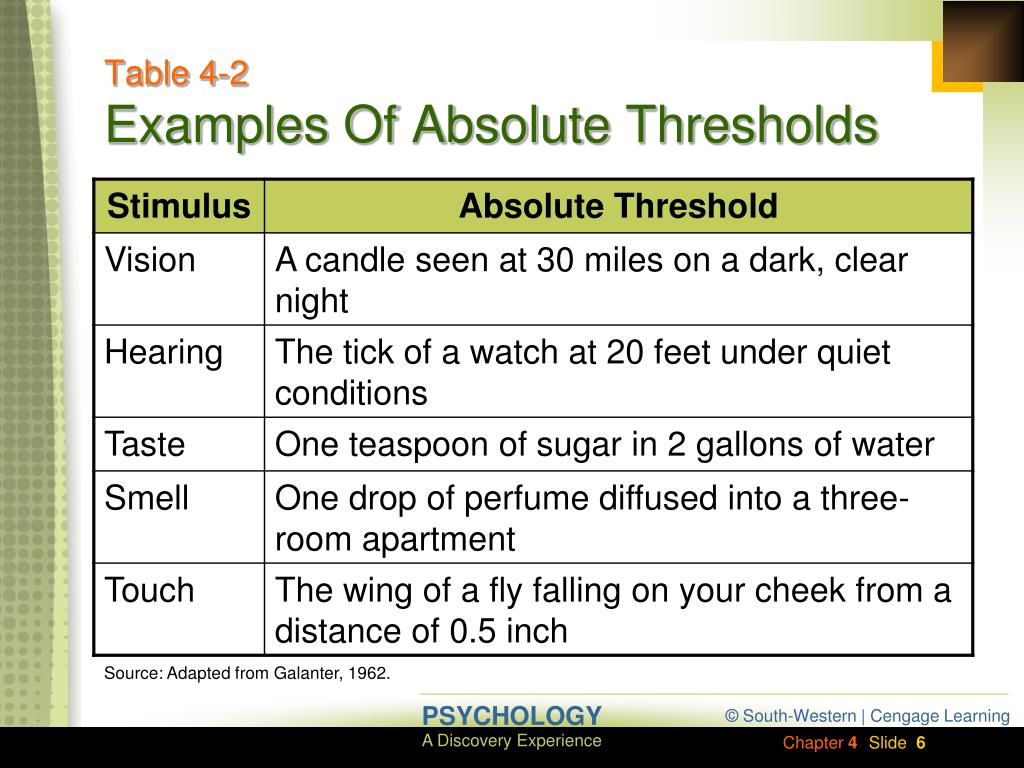
The absolute threshold is the minimum intensity of a stimulus that a person can detect 50% of the time. Think of it as the line between sensing nothing and sensing something. If a stimulus is below your absolute threshold, for all practical purposes, it doesn't exist for you.
To get a clearer picture of this concept, let's look at a text that defines it and an image that provides some classic examples.
Chapter 3: Consumer Perception
This PDF from a consumer behavior textbook provides a clear, academic definition of the different types of sensory thresholds. We'll focus on the first one for now.
Please read the section titled 'Threshold Levels.' Focus on the definition of the 'absolute threshold.' You can ignore the 'terminal threshold' for now, as it's less relevant for our purposes.
As the text explains, this is the lowest level at which you can experience a sensation. The following image makes this concept very intuitive.
Application in Marketing
The marketing application of the absolute threshold is straightforward but crucial: a marketing stimulus must be intense enough to be perceived.
- Visuals: Is the font on your packaging large enough to be read from a normal shopping distance? Is your billboard legible to a driver passing by at 60 mph?
- Audio: Is your radio ad or brand jingle loud enough to be heard above the background noise in a car or a store?
- Scent: If you're using scent marketing in a retail space, is the fragrance strong enough for shoppers to detect it when they walk in?
If your message falls below the consumer's absolute threshold, your entire marketing investment in that stimulus is wasted. It's the first and most fundamental perceptual hurdle to clear.
2. Difference Threshold: Noticing a Change
While the absolute threshold is about detecting something versus nothing, the difference threshold is about detecting a change between two stimuli. It is more formally known as the Just Noticeable Difference (JND).
The JND is the smallest change in the intensity of a stimulus that we can detect.
This concept is governed by a principle discovered in the 19th century by Ernst Weber, now known as Weber's Law. The law states that the amount of change needed for us to recognize a difference is not a fixed amount, but a constant proportion of the original stimulus.
This is a critical insight. It means that our perception of change is relative. A $1 discount on a $4 box of cereal feels significant, but a $1 discount on a $40 shirt feels trivial. The absolute change is the same ($1), but the proportional change is what matters to our brain.
To get an intuitive feel for this, let's watch a short video that uses excellent, business-relevant examples.
BizBasics: "Weber-Fechner Law of Pricing" with Ron Wilcox
In this video from the Darden School of Business, Professor Ron Wilcox explains the core idea behind what he calls the 'Weber-Fechner Law of Pricing' using simple, everyday scenarios.
Watch the entire video. Notice how he explains that we perceive prices relatively, not absolutely. This is the key insight of Weber's Law as it applies to marketing.
As Professor Wilcox explained, the formula for Weber's law is quite simple:
Where:
- is the intensity of the original stimulus (e.g., the original price, the original weight).
- (delta I) is the change in intensity needed to be noticeable (the JND).
- is a constant proportion for a particular sense (e.g., sound, weight, brightness).
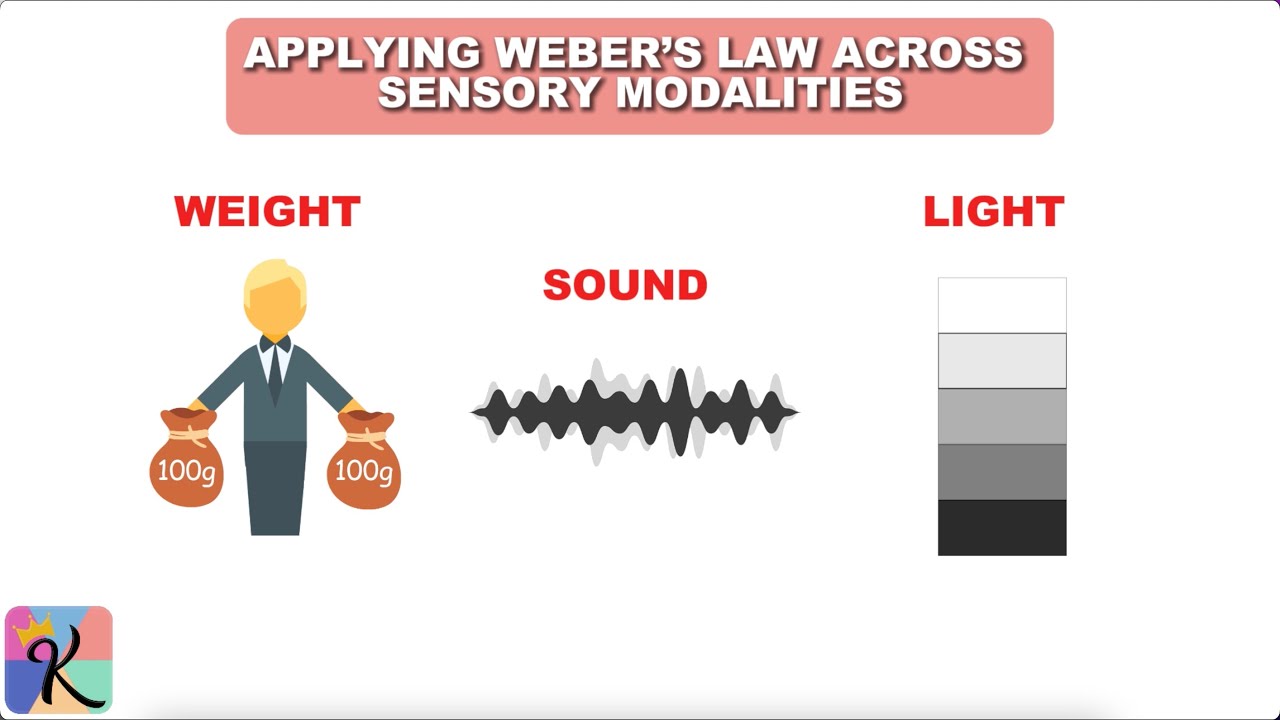
To dig a little deeper into this, the following video explains the formula and shows that the constant k differs for various senses like weight, light, and sound.
Weber´s Law (Sensory Processing): Proportion & Examples – Sensing the Environment | Lecturio
This Lecturio video offers a slightly more technical but very clear breakdown of Weber's Law and its formula.
Please watch from the beginning to 01:55. Focus on understanding the components of the formula and the idea that the proportion needed for detection (the 'k' value) varies by sense.
The key takeaway is that for a change to be perceived, it must overcome a certain percentage threshold, and this percentage is what marketers must manage.
Marketing Strategies Using the Just Noticeable Difference (JND)
Understanding the JND allows marketers to pursue two opposite strategies, depending on their goal.
- Make changes you want consumers to notice above the JND.
- Make changes you don't want consumers to notice below the JND.
Let's explore how this works in practice.
What is Just Noticeable Difference? Marketing Psychology
This article from Arfadia, 'What is Just Noticeable Difference?', is excellent for exploring the practical marketing applications of Weber's Law. It covers both strategies and includes modern examples.
Please read three sections from this article: Start at the section titled 'Real-World Applications of Weber's Law in Marketing.' This outlines the two core strategies. Then, read the section 'When Shrinkflation Backfires in the Digital Era.' This discusses a classic 'below JND' strategy and its risks today. Finally, read the 'Frequently Asked Questions' section. It provides great, practical rules of thumb (like the 8-12% rule for price changes).
As the article highlights, this principle is used everywhere:
-
Positive Changes (Above JND):
- Discounts: A price reduction needs to be significant enough to be perceived as a real bargain. A 2% discount won't motivate anyone, but a 20% discount will.
- Product Improvements: When launching a "new and improved" version, the improvement (e.g., more product, better feature) must be noticeable to justify the claim. M&M's "10% More Free" campaign is a classic example.
- Package Redesigns: A brand refresh needs to be different enough to signal change and modernity but similar enough to remain recognizable.
-
Negative Changes (Below JND):
- Price Increases: Companies often raise prices in small increments over time, hoping that each small jump falls below the JND and goes largely unnoticed by consumers.
- Shrinkflation: This is the classic example of reducing product quantity (e.g., ounces in a bag of chips, number of diapers in a package) while keeping the price and packaging the same. It's an effective price increase hidden below the JND of visual size perception. However, as the article notes, social media has made consumers very aware of this tactic, creating a risk of backlash.
Test your understanding!
You are the marketing manager for a popular brand of coffee. Due to rising bean costs, you must effectively increase the price per gram for the consumer. Using the principles of the Just Noticeable Difference, propose two different ways you could do this. For each option, explain the strategy and identify a potential risk.
Show answer
Here are two possible strategies based on the JND:
-
Strategy 1: Price Increase (Below JND)
- Action: Implement a small price increase, for example, 4-5%. The goal is to keep the price hike below the consumer's typical JND for this type of product (research suggests this is often around 8-12%).
- Reasoning: A small, incremental price hike might not be consciously noticed by most shoppers, especially if it's a routine purchase, thus minimizing a negative reaction or a switch to a competitor.
- Risk: Even if below the JND for many, price-sensitive shoppers or comparison websites will spot the change immediately. A gradual increase might also be noticed over time.
-
Strategy 2: Downsizing/Shrinkflation (Below JND)
- Action: Keep the price the same but reduce the amount of coffee in the package. For example, change the package from 12 oz to 11 oz while keeping the bag size visually similar.
- Reasoning: Consumers are often less sensitive to changes in weight than they are to changes in price. The change in the package's feel or appearance might fall below their JND, so they don't perceive they are getting less for their money.
- Risk: This strategy is now widely known as "shrinkflation" and is often met with significant consumer anger and brand damage when exposed, especially on social media. The risk of being "called out" is very high and can erode trust more than a straightforward price increase.
Conclusion
Today, we've moved from how the brain receives signals to the limits of what it can perceive. Understanding these limits is not just an academic exercise; it's a core component of effective and ethical marketing strategy.
Your key takeaways are:
- Absolute Threshold: The minimum stimulation needed for a sense to fire. In marketing, your message must always be above this threshold to have any impact.
- Difference Threshold (JND): The smallest change in a stimulus that can be detected. It is governed by Weber's Law, which states that the JND is a constant proportion of the original stimulus.
- Marketing Applications: The JND is a powerful tool. Marketers can aim to be above the JND for positive changes (discounts, improvements) they want consumers to notice, or below the JND for negative changes (price hikes, downsizing) they hope will go unnoticed.
In our next lesson, we will continue exploring how we perceive the world by differentiating between bottom-up and top-down processing. This will help us understand how raw sensory data combines with our existing knowledge, expectations, and goals to create our unique perception of reality—and of the brands we encounter.