Hello! Welcome to the fourth lesson in our module on perception and attention.
In our last session, we explored the crucial distinction between bottom-up and top-down processing. We saw how the brain both builds perception from raw sensory data (bottom-up) and uses existing knowledge and expectations to interpret that data (top-down). This explained how we make sense of a marketing message once we've perceived it.
But in today's world, saturated with advertisements, social media posts, and endless stimuli, the biggest challenge isn't just being understood—it's being noticed in the first place. How does the brain decide which of the thousands of potential messages to even let in for processing?
That brings us to our topic today: selective attention. We will explore the brain's powerful filtering mechanism that allows us to focus on what's important and ignore the rest. By the end of this lesson, you will be able to describe the mechanism of selective attention and its role in filtering marketing messages in a cluttered environment.
Understanding this is fundamental to your goal of mastering neuromarketing. It's the science behind cutting through the noise and is the first, most critical battleground for any brand's message.
The Cocktail Party Problem: Your Brain's Bouncer
Imagine you're at a loud party or a busy networking event. Music is playing, and dozens of conversations are happening at once. Yet, you can somehow tune out all that background noise and focus on the single person you're talking to. At the same time, if someone across the room were to mention your name, your attention would likely snap to that conversation instantly.
This everyday experience, known as the "cocktail party effect," is the perfect illustration of selective attention. Your brain acts like a bouncer at a club, deciding who and what gets into your conscious awareness.
To study this scientifically, psychologists use tasks like dichotic listening, where a person listens to two different messages simultaneously (one in each ear) and is asked to "shadow," or repeat, just one of them. The fascinating part is what happens to the message they are told to ignore.
This short video provides an excellent introduction to the concept of selective attention and the shadowing task used to study it.
Theories of selective attention | Processing the Environment | MCAT | Khan Academy
This video from Khan Academy Medicine introduces selective attention using the cocktail party analogy and explains the 'shadowing task' that psychologists use to measure it.
Please watch the first 1 minute and 18 seconds of the video. Focus on how it defines selective attention and the setup of the shadowing task.
As the video and experiments show, we have a limited capacity for attention. We can't process everything. This makes the brain's selection mechanism critically important. So, how does this filter actually work?
Models of the Mind's Filter
Scientists have developed several models to explain how the brain's attentional filter operates. Think of this as a progression of ideas, with each one building on and refining the last.
1. Broadbent's Filter Model (Early Selection)
The first major theory, proposed by Donald Broadbent, suggested that the filter acts very early in the process.
- The Idea: All sensory information enters a buffer, but a filter then selects one channel based on basic physical characteristics (e.g., the pitch of a voice, the location of a sound). Only the selected information passes on to be processed for meaning. Everything else is blocked.
- The Analogy: This is like a radio tuner. You can only tune into one station (the physical frequency) at a time, and all other stations are completely ignored.
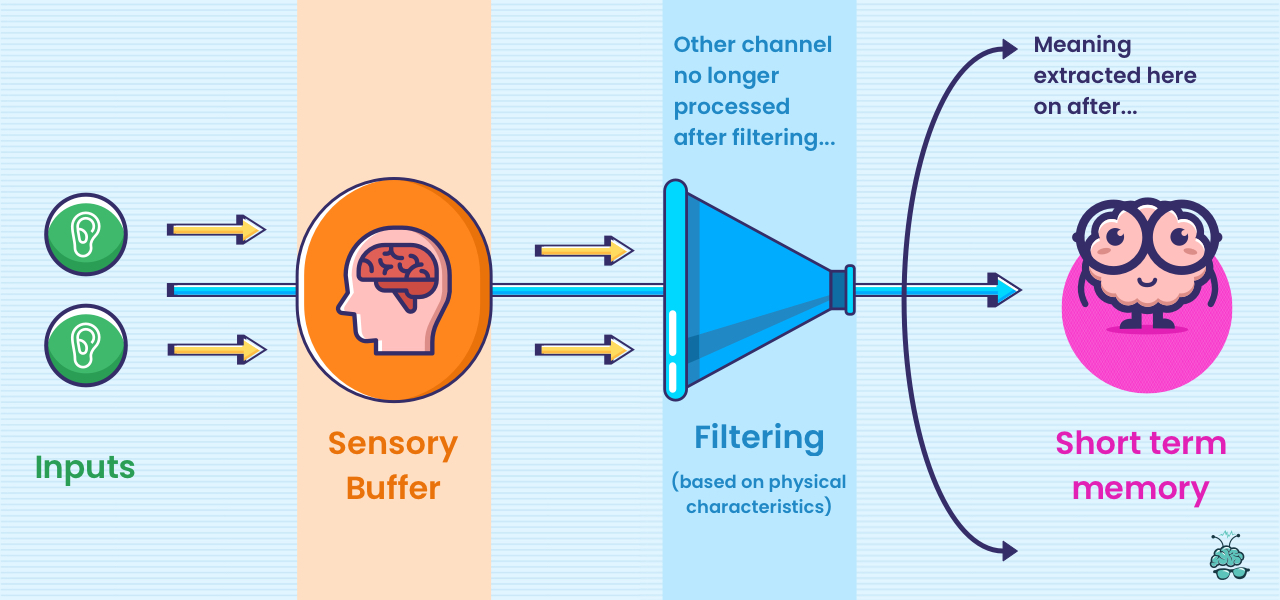
Now, watch the next segment of the Khan Academy video for a clear explanation of this model.
Theories of selective attention | Processing the Environment | MCAT | Khan Academy
This segment explains Broadbent's Early Selection theory, where the filter operates right after the sensory register, based on physical characteristics.
Please watch from 01:26 to 02:42. Notice how the filter comes before perceptual processes that assign meaning.
The problem with this model? It can't explain the cocktail party effect. If unattended information is completely blocked, how could you possibly hear your name from across the room?
2. Treisman's Attenuation Model (The Dimmer Switch)
To solve this puzzle, Anne Treisman proposed a more flexible model.
- The Idea: Instead of an all-or-nothing filter, the brain has an "attenuator" that acts like a volume knob or a dimmer switch. It "turns down" the volume on unattended information but doesn't block it completely. This allows the brain to still monitor the unattended information for anything important (like your name!). If something meaningful is detected, the brain can switch focus.
- The Analogy: This is like a bouncer at a club who isn't just checking IDs at the door. They are also listening to the chatter in the line and can pull a VIP (meaningful information) out of the crowd and let them in, even if they weren't at the front.
This video segment explains Treisman's more nuanced theory.
Theories of selective attention | Processing the Environment | MCAT | Khan Academy
This part of the video introduces Treisman's Attenuation theory, which refines Broadbent's model by proposing an attenuator that weakens, rather than eliminates, unattended signals.
Please watch from 02:42 to 04:24. This section first points out the limitation of early selection (the cocktail party effect) and then introduces both the Late Selection model and Treisman's Attenuation model as solutions.
Treisman's Attenuation Model is generally the most accepted because it flexibly accounts for our ability to both focus intently and still be alerted by important, unattended stimuli.
Selective Attention in a Marketing Context
So, what does this mean for marketing? Consumers are living in a constant "cocktail party" of brands. For a message to succeed, it must first be selected by the brain's attentional system.
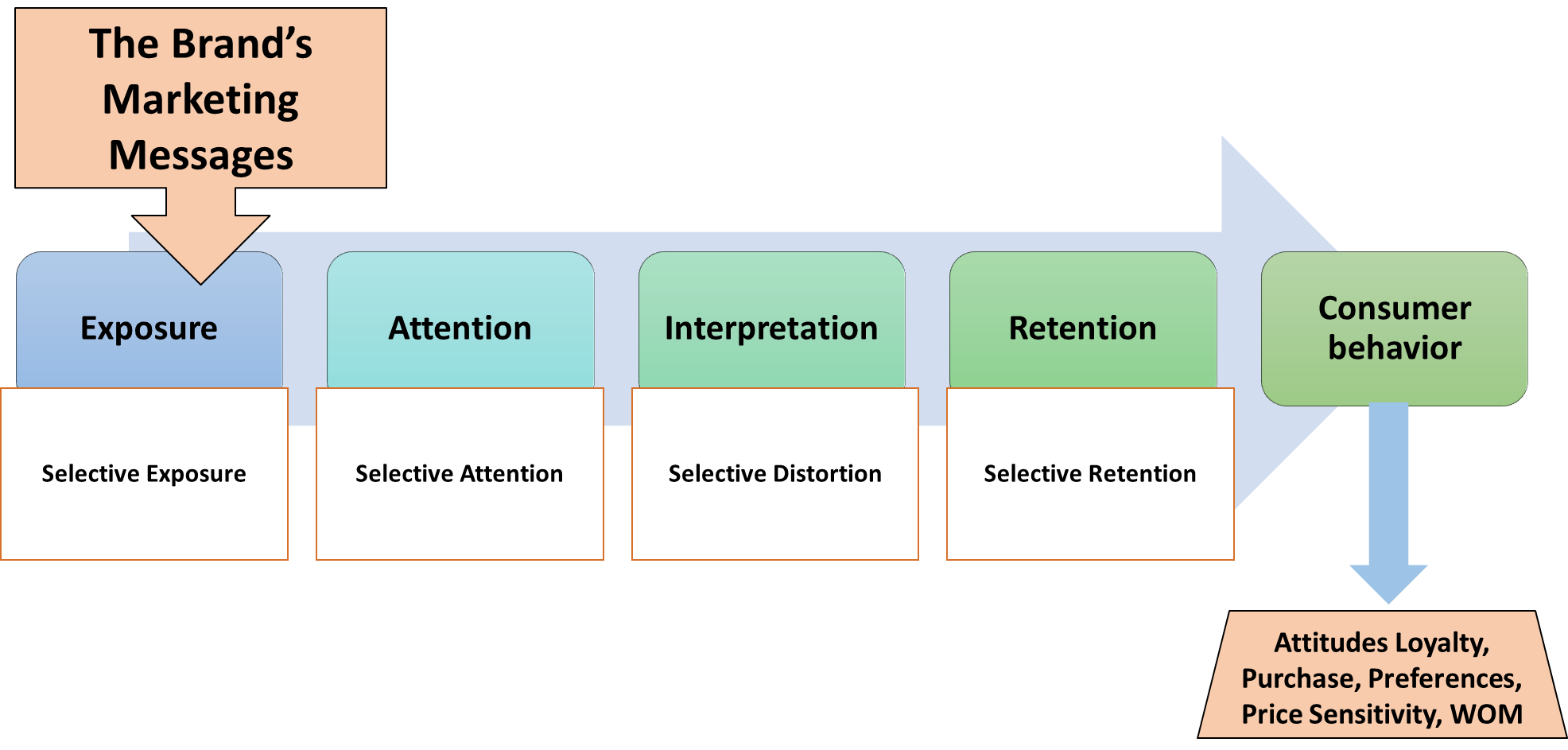
Marketers can design their communications to grab attention in two main ways, which conveniently link back to our last lesson on bottom-up and top-down processing.
For a deeper dive into this, let's turn to an article on Cognitive Marketing.
What Is Cognitive Marketing? The Science of Why People Buy
This article from Cognitigence explains how marketers can apply principles of attention to cut through the noise. It directly links these strategies to bottom-up and top-down attention.
Please read two sections. First, under the heading 'Consumer Perception & Attention Mechanisms', read the paragraph defining 'Attention'. Then, under 'Capturing Attention', read that short paragraph. Focus on how stimulus characteristics capture 'bottom-up' attention, while goal relevance captures 'top-down' attention.
As the article explains, we can capture attention through:
-
Bottom-Up Attention (Stimulus-Driven): This involves making the stimulus itself so powerful that it's impossible to ignore. It appeals to the brain's most basic filters.
- Novelty: Something new or unexpected (e.g., a car ad that features a hamster instead of a car).
- Intensity & Salience: Bright colors, loud sounds, large fonts, motion in a static environment (e.g., a flashing "SALE" sign or an animated banner ad).
- Contrast: An object or message that stands out from its background (e.g., a black-and-white photo in a magazine full of color ads).
-
Top-Down Attention (Goal-Driven): This involves making the message personally relevant to the consumer's current needs, goals, or interests. This is where the brain's "VIP list" comes into play.
- Personal Relevance: An ad for flights to Italy shown to someone who has been researching Roman history.
- Needs & Goals: Seeing an ad for a local pizza place when you are hungry and thinking about dinner.
- Self-Identity: A fitness enthusiast is more likely to notice an ad for a new protein supplement.
Modern digital marketing is a masterclass in top-down attention. When platforms use your search history or browsing behavior to serve you personalized ads, they are betting that the message's relevance to your goals will be strong enough to pass through your attentional filter.
Test your understanding!
A brand is launching a new energy drink. Their target audience is college students who are often tired from studying. The ads will be placed on crowded campus bulletin boards and on busy social media feeds.
- Suggest one bottom-up strategy they could use in their ad design to capture attention.
- Suggest one top-down strategy they could use in their ad copy or messaging.
Show answer
-
Bottom-Up Strategy: They could use a highly saturated, fluorescent color scheme that contrasts sharply with the other flyers on the bulletin board. Or, for social media, they could use a short, looping video with rapid, eye-catching motion (like liquid splashing in a dynamic way) that would stand out in a static feed. These strategies rely on purely physical, sensory characteristics to grab the eye.
-
Top-Down Strategy: The ad copy could read, "Late night study session? We've got you." This message is directly relevant to the student's current goals and state of mind (needing to study, feeling tired). It taps into their needs, making it meaningful information that their brain is more likely to select for further processing.
Conclusion
Today, we've pulled back the curtain on one of the brain's most essential functions for navigating the modern world. Without selective attention, we would be overwhelmed.
Your key takeaways are:
- Selective attention is the brain's cognitive mechanism for filtering out irrelevant information and focusing on what matters.
- The "cocktail party effect" perfectly demonstrates our ability to both focus on one stream of information while still monitoring our environment for important cues (like our name).
- The most accepted model is Treisman's Attenuation Theory, which proposes that unattended information is weakened (attenuated), not blocked entirely, allowing meaningful stimuli to break through.
- In marketing, attention is a battle won on two fronts: bottom-up (using salient, intense, or novel stimuli) and top-down (making the message personally relevant to the consumer's goals).
When you explain to a business stakeholder why a generic advertisement failed, you can now frame it scientifically. You can say, "The ad lacked a salient stimulus to capture bottom-up attention, and its message wasn't relevant enough to trigger the audience's top-down filter." This is a powerful way to communicate the value of creative, targeted marketing.
In our next lesson, we'll address a related challenge. We've learned how to capture attention, but what happens when a consumer sees or hears your message too often? They begin to tune it out automatically. We'll explore this phenomenon, called sensory adaptation, and discuss how marketers can overcome it.