Hello! Welcome to the first lesson in our new module, "Sensory Marketing: Sound, Scent, and Touch."
In the previous module, we did a deep dive into the world of vision, analyzing how elements like color, shape, and faces are processed by the brain to create effective marketing visuals. While sight is arguably the most dominant sense in marketing, today we shift our focus to what is perhaps the most primal and emotionally powerful sense: smell.
This lesson is designed to address a key learning outcome: to explain the unique neural pathway of smell and its direct link to memory and emotion centers in the brain. We will explore the fundamental science of olfaction, answering the question: why can a fleeting scent instantly transport you back to a childhood memory with such clarity and emotional force?
Understanding this "why" is the foundation for everything we will discuss later about scent marketing. Let's begin by exploring what makes the sense of smell so different from all our other senses.
1. The Olfactory Exception: A Direct Line to Emotion
All of our senses act as translators, converting external stimuli (like light waves or sound waves) into the electrical language of the brain. However, they don't all follow the same route. Most sensory information—from your eyes, ears, and skin—makes a critical pit stop before being processed.
This stop is at a brain structure called the thalamus. You can think of the thalamus as the brain's busy central switchboard or relay station. It receives incoming sensory signals, sorts them, and directs them to the appropriate regions of the cerebral cortex for conscious processing. For example, it sends visual information to the visual cortex and sound information to the auditory cortex.
Smell, however, is the rebel. It is the only sense that largely bypasses the thalamus.
To get a clear overview of this unique process, let's watch a short segment from SciShow.
The video 'How Smells Trigger Memories' provides a concise and clear explanation of how the brain's wiring for smell differs from other senses.
Please watch from 01:15 to 01:52. Focus on the explanation of how smell signals bypass the thalamus and where they go instead.
As the video explains, instead of going to the thalamus, scent signals travel directly from your nose to the olfactory bulb, the brain's primary smell-processing center. From there, they have a direct connection to two of the most important structures for marketing: the amygdala (emotion) and the hippocampus (memory).
This anatomical distinction is the single most important concept in this lesson. As neuroscientist Vanessa Clarizia Marchesin puts it in the article "Brands turn to scent marketing," "Unlike other senses like sight or hearing, which are routed through the thalamus, smell bypasses that filter and goes straight to the emotional core."
Let's look at a diagram to visualize this.
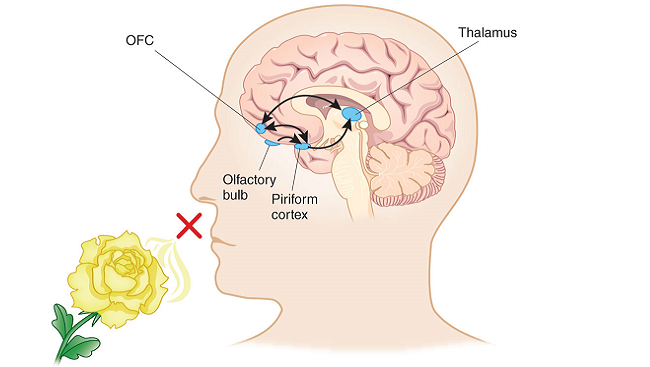
2. Tracing the Scent Pathway: From Nose to Brain
Now that we know about the "olfactory shortcut," let's trace the journey of a smell in more detail, from a molecule floating in the air to a signal inside your brain.
The following video from CrashCourse offers an excellent step-by-step explanation.
Taste & Smell: Crash Course Anatomy & Physiology #16
The video 'Taste & Smell: Crash Course Anatomy & Physiology #16' breaks down the biological process of olfaction. The case study at the beginning also powerfully illustrates the importance of smell in our daily lives.
Watch from 02:26 to 05:31. As you watch, follow the journey of an odor molecule: How it enters the nose and dissolves in the olfactory epithelium. How it binds to olfactory sensory neurons. How the signal travels to the olfactory bulb. Crucially, pay attention to the two final pathways it takes: one to the frontal lobe for conscious identification and the other directly to the limbic system for an emotional and memory-based reaction.
Let's break down the key players in that journey:
- Olfactory Epithelium: A patch of tissue deep inside your nasal cavity where millions of specialized olfactory sensory neurons are located.
- Olfactory Bulb: A structure at the very front of the brain that receives the signals from the sensory neurons. Think of it as the first processing station for smell.
- Limbic System: This is the destination that makes smell so powerful. It's often called the "emotional brain" and includes two key structures:
- Amygdala: The brain's emotion processor, responsible for generating feelings like fear, pleasure, and arousal. It acts as an instant "threat or reward" detector.
- Hippocampus: The brain's memory hub, essential for consolidating experiences into long-term memories.

Because of this direct wiring, a scent can trigger an emotional reaction and a memory recall before your conscious mind has even had time to identify the smell itself.
3. The Result: Emotional, Vivid Memories
This unique neural architecture is why smell is so deeply intertwined with memory and emotion. An article from the Harvard Gazette, "How scent, emotion, and memory are intertwined," explains that because of this direct link, "smell and emotion are stored as one memory."
This phenomenon, where a smell triggers a vivid and often old memory, is sometimes called a "Proustian moment," named after the author Marcel Proust who famously wrote about a tea-soaked cake unlocking a flood of childhood memories. The scientific term is odor-evoked autobiographical memory.
These memories are not just factual recollections; they are intensely emotional and perceptual. You don't just remember that you visited your grandmother's house; you feel the comfort of her kitchen and can almost taste the cookies she was baking.
This happens because the neural signal for the smell was coded in your brain right alongside the emotional and contextual information from that moment, thanks to the close proximity of the olfactory bulb, amygdala, and hippocampus.
Test your understanding!
Imagine you are advising a bakery client. They ask you, "Why should I invest in venting the smell of fresh bread onto the street? Won't a big, beautiful photo of bread in my window do the same thing?"
Based on what you've learned, how would you explain the difference in how a customer's brain processes the smell of bread versus the sight of it?
Show answer
You could explain it like this:
"A photo of bread is powerful, but it's processed differently by the brain than the actual smell. When a customer sees the photo, that visual information travels to the brain's 'relay station,' the thalamus, before being sent to the visual cortex to be consciously identified. It's a rational process: 'That is a picture of bread. It looks nice.'
The smell of bread, however, takes a shortcut. It bypasses that rational relay station and goes directly to the brain's emotion and memory centers—the amygdala and hippocampus. This triggers an immediate, unconscious, and emotional reaction. It doesn't just make them think of bread; it makes them feel hunger, comfort, and nostalgia. This deep, emotional connection is far more persuasive at motivating a purchase than a purely visual cue."
Conclusion
In this lesson, we've uncovered the unique neural wiring that makes smell a marketer's most potent, if subtle, tool.
Key Takeaways:
- Smell is unique: It is the only sense that largely bypasses the brain's main sensory "switchboard," the thalamus.
- A Direct Pathway: Olfactory signals travel directly from the olfactory bulb to the limbic system, the brain's ancient hub for emotion (amygdala) and memory (hippocampus).
- Emotion Before Reason: This direct link means that scents often trigger an emotional and memory-based response before we even consciously identify the smell.
- Unified Memories: Because of this wiring, smells and emotions are often stored together as a single, powerful memory, leading to vivid, odor-evoked recollections.
Preview of the Next Lesson:
Now that we've established the powerful "why" behind scent's influence, our next lesson will focus on the "how." We will explore the learning outcome: Identify strategic applications of scent marketing in retail and branding to influence mood and behavior. We'll look at real-world examples of how brands use custom scents to make you stay longer, feel more luxurious, and form a lasting bond with their products.