Hello! Welcome to our next lesson in electrostatics.
In the previous lesson, we established a powerful framework for solving electrostatic problems using Poisson's and Laplace's equations. We saw that to get a specific solution, we need to provide boundary conditions, typically the value of the potential on the surfaces of a region. We also proved the crucial Uniqueness Theorem, which guarantees that if we find a solution that fits the boundaries, it is the solution.
Today, we will explore the perfect physical objects for setting up these boundary conditions: conductors. The learning outcome for this lesson is to analyze the behavior of conductors in electrostatic equilibrium and apply boundary conditions. We will discover the fundamental properties that make conductors so special and see how these properties lead to important physical and engineering applications.
1. The Fundamental Properties of Conductors
A conductor is defined by the presence of charges (usually electrons) that are free to move throughout the material. Electrostatic equilibrium is the state reached when there is no net motion of these charges. This simple definition has profound consequences.
For there to be no net motion, the net force on any free charge inside the conductor must be zero. Since , this directly implies that the electric field must be zero everywhere inside the conducting material.
This single fact, , is the key to everything that follows. Let's explore its consequences with the help of the brilliant experimentalist and lecturer Walter Lewin.
8.02x - Lect 5 - E= - grad V, Conductors, Electrostatic Shielding (Faraday Cage)
This video segment provides an exceptionally clear proof and demonstration of the first few properties of conductors.
Watch the segment from 20:34 to 25:15. Professor Lewin uses Gauss's Law to rigorously prove that if \mathbf{E}=0 inside a conductor, then any net charge must reside on its surface. Pay close attention to his argument using a Gaussian surface placed just inside the conductor's surface.
From the reasoning in the video and our fundamental principles, we can establish several key properties for a conductor in electrostatic equilibrium:
- The electric field is zero inside the conductor. .
- The charge density is zero inside the conductor. . As Gauss's Law () shows, if , then must also be zero.
- Any net charge resides on the surface. This is a direct consequence of property #2.
- A conductor is an equipotential volume. For any two points A and B inside the conductor, the potential difference is . Since everywhere along the path, the integral is zero, and . The entire conductor, including its surface, is at a single, constant potential.
- The electric field just outside a conductor is perpendicular to its surface. If there were a tangential component to the electric field (), it would exert a force on the surface charges and cause them to move, which would violate our assumption of static equilibrium. Therefore, .
This set of lecture notes provides a concise summary of these crucial points.
To solidify your understanding, please read the first page of the following notes. It presents a clear, itemized list of the properties we just discussed.
Read page 1, focusing on the section "Electrostatic properties of conductors". This summarizes points #1 through #4 and introduces the formula for the electric field at the surface, which we will derive next.
2. Boundary Conditions at a Conductor's Surface
We can now formalize the boundary conditions at the interface between a conductor and a vacuum (or a dielectric). Let's label the region just outside the conductor as Region 1 and the conductor itself as Region 2.
We know inside the conductor. This simplifies the general electromagnetic boundary conditions significantly.
Lecture -- Electrostatic Boundary Conditions
This video provides a rigorous derivation of the boundary conditions at an interface, and then applies them specifically to the conductor case.
Watch the segment from 13:07 to 16:10. The video explains that for a perfect conductor, the free charges will arrange themselves to make the internal field zero. It then uses the general boundary conditions (which are derived earlier in the video) to show how this zero internal field determines the field at the surface.
As derived in the video, the boundary conditions are:
- Tangential Field: . This confirms property #5: the electric field at the surface is purely normal.
- Normal Field: Using a small Gaussian "pillbox" that straddles the surface, Gauss's law tells us .

The only non-zero flux is through the top face of the pillbox, outside the conductor. This gives us , which simplifies to the single most important boundary condition for a conductor:
where is the local surface charge density and is the outward-pointing unit vector normal to the surface.
Test your understanding!
A solid, neutral conducting sphere is placed in a uniform external electric field . After equilibrium is reached:
- What is the electric field inside the sphere?
- Describe the electric field lines both outside and inside the sphere.
- Describe the distribution of induced surface charge on the sphere. Where is it positive, negative, and zero? Where is its magnitude greatest?
Show answer
-
Inside Field: The electric field inside the conductor must be zero. The free charges within the sphere redistribute themselves to create an internal field that exactly cancels the external field: .
-
Field Lines:
- Far from the sphere, the field lines are uniform and point in the direction.
- Near the sphere, the field lines bend to strike the surface perpendicularly. Lines approaching from the top () terminate on the upper hemisphere. Lines leave the lower hemisphere perpendicularly and continue downwards.
- There are no field lines inside the sphere.
-
Charge Distribution:
- To create the opposing internal field, negative charges (electrons) are drawn to the surface where the external field enters the sphere (the "top" hemisphere, where ). This results in a negative surface charge .
- This leaves a net positive charge on the surface where the field exits (the "bottom" hemisphere, where ). This results in a positive surface charge .
- The charge density is zero along the "equator" of the sphere (the circle in the -plane, ).
- The magnitude of the charge density, , is greatest at the "poles" () and smoothly decreases to zero at the equator. This is because the charges accumulate most densely where they are "pulled" or "pushed" the hardest by the external field.
3. Consequences and Applications
A. Electrostatic Shielding and the Faraday Cage
What happens if a conductor is hollow?
The property inside the material of the conductor leads to a remarkable phenomenon called electrostatic shielding.
Case 1: An empty cavity
Imagine a conductor of any shape, with an empty cavity inside it. Since the conductor's surface is an equipotential, the wall of the cavity forms an equipotential boundary. We are looking for a solution to Laplace's equation () inside the cavity, with the boundary condition (a constant) on the entire boundary.
One obvious solution is everywhere inside the cavity. According to the Uniqueness Theorem from our last lesson, this must be the only solution. If is constant, then .
The electric field inside an empty cavity within a conductor is always zero, regardless of any fields that may exist outside the conductor.
Electromagnetism I: Electrostatics
The handout from the Physics Olympiad notes makes this point with beautiful clarity using the uniqueness theorem.
Read "Example 12" on page 24. This is a perfect example of applying advanced mathematical principles for a powerful physical insight.
The interior of the conductor is "shielded" from external fields. This is the principle of the Faraday cage.
8.02x - Lect 5 - E= - grad V, Conductors, Electrostatic Shielding (Faraday Cage)
Professor Lewin provides an unforgettable demonstration of shielding, both from charges placed on the conductor and from external fields.
This is a longer but very worthwhile watch. 25:15 - 28:22: He extends the argument to a hollow conductor, showing the inside remains charge-free and field-free. 31:33 - 36:30: He explains how a conducting box shields its interior from an external field. 43:09 - 50:01: He gets inside a cage and has it charged to hundreds of thousands of volts by a Van de Graaff generator, demonstrating the Faraday cage effect in a dramatic fashion.
B. Charge Distribution at Sharp Points
We know charge resides on the surface, but is the density uniform? Generally, no. The charges will rearrange themselves to maintain the constant potential. This often leads to charge accumulation.
Electromagnetism I: Electrostatics
Where does charge tend to accumulate? This example provides a clear, semi-quantitative answer.
Read "Example 11" on page 23. It analyzes the case of two spheres of different radii connected by a wire (forcing them to be at the same potential). Pay attention to the conclusion that charge density \sigma is inversely proportional to the radius, \sigma \propto 1/R.
The conclusion is that charge density is greatest on regions of highest curvature (sharpest points). The electric field will also be strongest at these sharp points. This is the principle behind lightning rods, which are designed to be sharp so they can "bleed" charge into the air and prevent a massive strike.
C. Electrostatic Pressure
The mutual repulsion of charges on the surface creates an outward force. This can be thought of as a "pressure" pushing the surface outwards. To calculate it, we must be careful: the field acting on a small patch of charge is the field due to all other charges on the conductor, not the total field.
Electromagnetism I: Electrostatics
The following handout provides a clever and physically intuitive derivation of this pressure.
Read "Example 10" on page 22. The key insight is that the total field just outside (E_{out} = \sigma/\epsilon_0) is the sum of the field from the local patch (E_{patch} = \sigma/2\epsilon_0) and the field from the rest of the conductor (E_{rest}). The force on the patch is due only to E_{rest}.
The result is a purely outward electrostatic pressure given by:
where is the magnitude of the field just outside the surface. Note that the pressure is always outward, regardless of the sign of .
4. Engineering Application: Electrostatic Precipitator
The principles of conductors, sharp points, and forces on charges come together in an important engineering device for pollution control: the electrostatic precipitator (ESP).
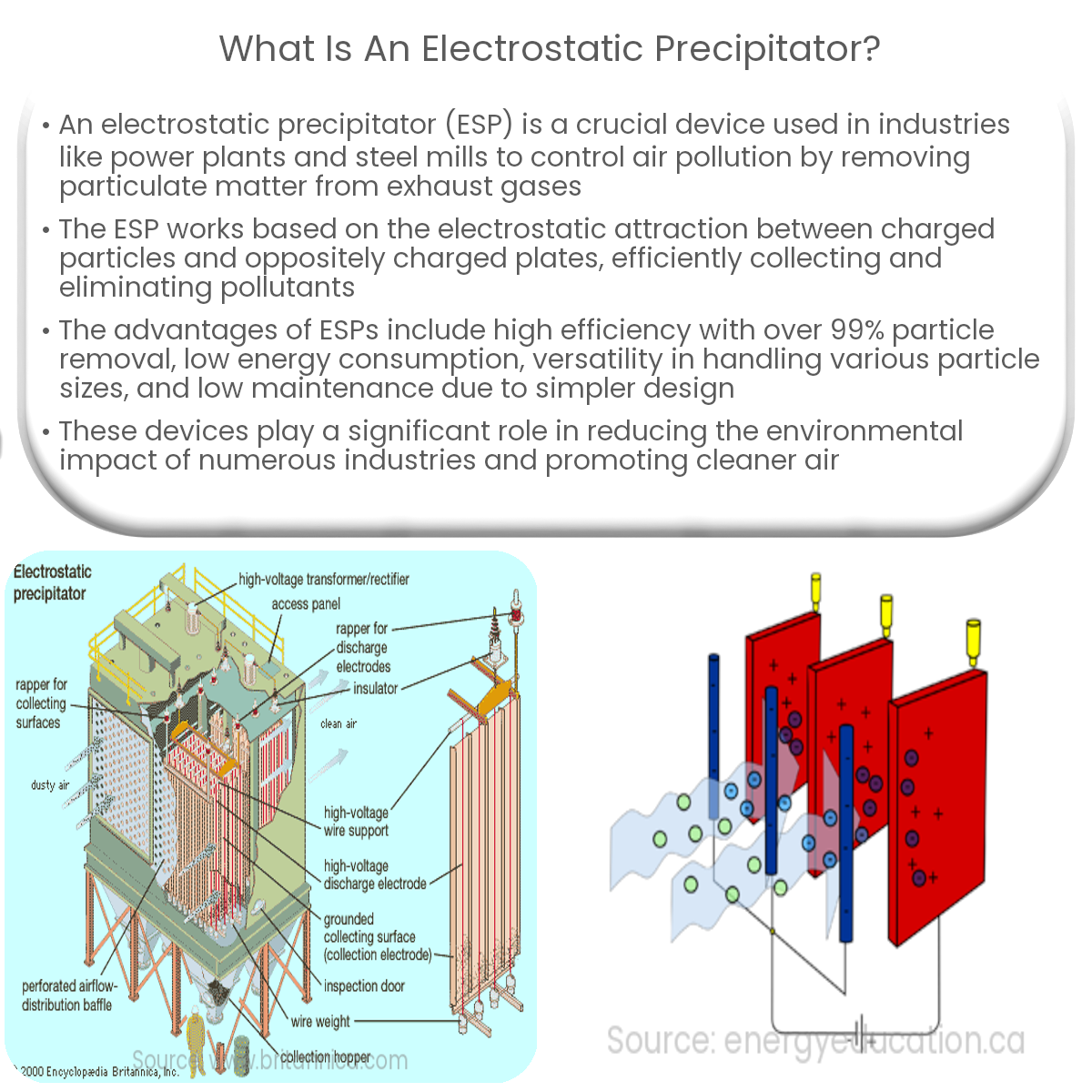
ESPs are used in power plants and factories to remove fine particulate matter (like smoke and ash) from exhaust gases. Here is how it works:
- Corona Discharge: A very high voltage is applied to thin wires running through the center of the device. Because the wires are "sharp," the electric field near them is extremely strong (as we learned in section 3B).
- Ionization: This field is strong enough to rip electrons from air molecules, creating a cloud of ions called a "corona."
- Particle Charging: As smokestack particles drift past the wire, they are bombarded by these ions and acquire a net electric charge.
- Collection: The charged particles are then attracted by the electric field to large, grounded collecting plates (conductors), where they stick. Periodically, the plates are mechanically "rapped" to knock the collected dust into a hopper for disposal.
This is a powerful application of electrostatics to solve a major environmental and health problem.
Conclusion
In this lesson, we established the fundamental rules governing conductors in electrostatic equilibrium. These are not just abstract concepts; they are the foundation for shielding technology and have direct applications in engineering.
Key Takeaways:
- A conductor in equilibrium has inside and is an equipotential volume.
- All excess charge on a conductor resides on its surface.
- The electric field just outside a conductor is always perpendicular to the surface, with magnitude .
- These properties lead to electrostatic shielding (the Faraday cage effect), where a conducting shell isolates its interior from external fields.
- Surface charge tends to accumulate on sharp points, where the electric field is strongest.
- This outward field results in an electrostatic pressure on the conductor's surface.
Preview of the Next Lesson:
The fact that a conductor is an equipotential surface is incredibly useful. In our next lesson, "Calculate the capacitance of various conductor geometries and analyze energy stored in electric fields," we will use this property to define capacitance, a purely geometric quantity that describes a conductor's ability to store charge at a given potential. We will spend our time solving Laplace's equation for various arrangements of conductors.