Hello! Welcome to our lesson on capacitance and electric energy.
In our last lesson, we explored the behavior of conductors in electrostatic equilibrium. We established that the entire body of a conductor is an equipotential and that any net charge resides on its surface. This property of being an equipotential surface is the key to today's topic.
We will now define a quantity, capacitance, which is a measure of a system of conductors' ability to store electric charge and energy. Your learning outcome for this lesson is to calculate the capacitance of various conductor geometries and analyze energy stored in electric fields.
We will cover:
- The definition of capacitance and a general procedure for calculating it.
- Applying this procedure to three standard geometries: parallel plates, coaxial cylinders, and concentric spheres.
- Deriving the formulas for the energy stored in a capacitor and the energy density of the electric field itself.
- An engineering application involving capacitive sensors.
1. What is Capacitance?
A capacitor is fundamentally a system of two conductors, typically holding equal and opposite charges, and . Because conductors are equipotentials, there will be a well-defined potential difference, , between them.
Experiments show that the charge stored on the conductors is directly proportional to the potential difference between them. The constant of proportionality is called the capacitance, .
The unit of capacitance is the Farad (F), where 1 Farad = 1 Coulomb/Volt.
Crucially, capacitance does not depend on or . It is a purely geometric quantity that depends only on the size, shape, and separation of the conductors, as well as the insulating material (dielectric) between them. For now, we'll assume the space between conductors is a vacuum (or air, which is very similar).
2. Calculating Capacitance
There is a standard, three-step "recipe" for calculating the capacitance of any two-conductor system. This procedure leverages the tools we've already mastered, particularly Gauss's Law.
The video below outlines this general method and then applies it rigorously to the three most important symmetric geometries.
Calculating the Capacitance of Parallel Plates, Coax Cable and Concentric Spheres
The video 'Calculating the Capacitance...' from Physics Ninja provides a clear and methodical derivation for the capacitance of parallel plates, coaxial cables (cylinders), and concentric spheres. It perfectly demonstrates the standard calculation procedure.
Please watch from the beginning to 18:49. The first three minutes lay out the general three-step strategy. Then, the video applies this strategy to each of the three geometries. Focus on how each step is executed: Find E-field: Using a suitable Gaussian surface for the given symmetry. Find Potential Difference V: By integrating the electric field along a path from one conductor to the other (V = -\int \mathbf{E} \cdot d\mathbf{l}). Calculate Capacitance C: Using the definition C = Q/V.
To complement the video, here are the same derivations in a rigorous textbook format, along with helpful diagrams.
Chapter 5 Capacitance and Dielectrics
The MIT 8.02T course notes on 'Capacitance and Dielectrics' provide excellent, detailed derivations that you can refer to alongside the video or study on their own.
Please read pages 5-4 to 5-8 (Section 5.2, "Calculation of Capacitance"). This covers the parallel-plate, cylindrical, and spherical capacitor examples. Pay close attention to the mathematical setup for each case.
Here are the key geometries and their capacitance formulas, which you should now understand how to derive:

Summary of Capacitance Formulas:
| Geometry | Capacitance Formula |
|---|---|
| Parallel Plates (Area , separation ) | |
| Cylindrical (Radii , length ) | |
| Spherical (Radii ) | |
| Isolated Sphere (Radius ) | (This is the limit of the spherical case as ) |
Test your understanding!
Consider the formula for the cylindrical capacitor, . What happens to the capacitance as the inner radius approaches the outer radius ? Does this limit make physical sense? (Hint: Think about the behavior of as ).
Show answer
Let , where is a small separation. Then . For small , we know from the Taylor expansion that . So, .
Substituting this into the capacitance formula:
The term is approximately the surface area of the cylinders, and is the separation. The formula becomes , which is the formula for a parallel-plate capacitor.
This makes perfect physical sense. When the radii are very close, a small section of the curved cylindrical surfaces looks just like two parallel plates.
3. Energy Stored in an Electric Field
Charging a capacitor requires work. As you move charge from one plate to the other, you are working against the electric field created by the charge already there. This work is stored as potential energy in the electric field between the conductors.
Let's derive the total energy stored. Imagine charging a capacitor, which is initially uncharged, by transferring small amounts of charge . The work done to move across a potential difference is .
The total work done to charge the capacitor to a final charge is the integral:
Using the relation , we can write this stored energy in three equivalent forms:
Energy Density of the Electric Field
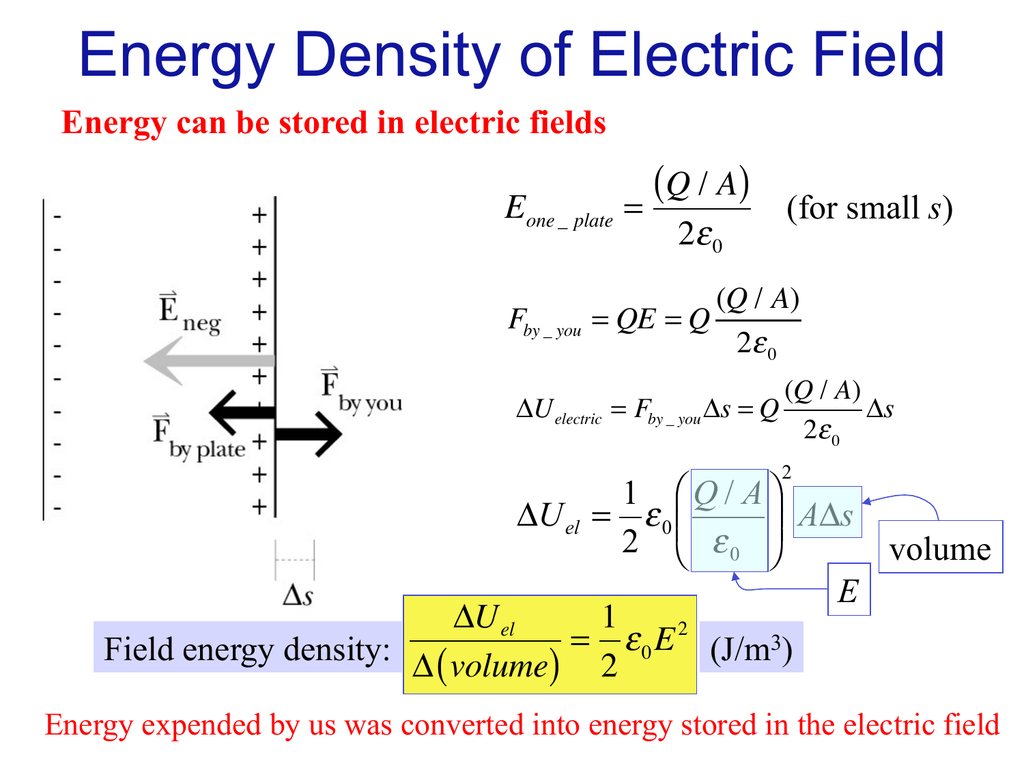
Where is this energy stored? The modern view is that the energy resides in the electric field itself. We can define an electric energy density, (energy per unit volume).
Let's find it for a parallel-plate capacitor. The volume between the plates is .
We have and . Substituting these into :
The energy density is the total energy divided by the volume:
Although derived for a parallel-plate capacitor, this result is completely general. The energy stored in any electrostatic field is given by integrating the energy density over all space where the field exists:
This is a profound result. It tells us that an electric field is a seat of energy.
The following resources provide a formal derivation of these energy concepts.
Chapter 5 Capacitance and Dielectrics
The MIT notes provide a clear derivation of the stored energy by calculating the work done to charge the capacitor.
Please read pages 5-13 to 5-14 (Section 5.4, "Storing Energy in a Capacitor" and 5.4.1, "Energy Density of the Electric Field"). This text formally derives the formulas we just discussed.
For a complementary perspective, this video walks through the algebraic steps to arrive at the energy density formula starting from the capacitor energy.
Watch the video from 0:06 to 9:58. Professor Anderson provides a step-by-step derivation of the energy density formula u_E = \frac{1}{2}\epsilon_0 E^2.
4. Advanced Application: Energy Methods and Capacitive Sensing
We can use the energy formulation to solve more complex problems. For instance, we can calculate the capacitance of a system by first finding the total stored energy in terms of voltage and geometry, and then using the relation .
This approach is powerful for systems with mixed materials.
Chapter 11: Energy, Power Flow, and Forces
The following advanced example from another set of MIT notes calculates the energy stored in a capacitor partially filled with a dielectric. It then uses the energy to find the capacitance.
Read 'Example 11.4.1. An Electrically Linear System' on pages 21-22. Follow the two methods: first calculating the total energy w_e by integrating the energy density over the two different regions, and then finding the capacitance C from the final expression for energy.
This idea that capacitance depends on geometry () is the basis for many engineering applications, particularly in sensors.
Engineering Application: Capacitive Sensors
A capacitive sensor is a device that transduces a physical quantity (like displacement, pressure, or acceleration) into a change in capacitance, which can be easily measured electronically.
-
Displacement Sensor: For a parallel-plate capacitor, . If one plate is fixed and the other can move, any change in the separation will cause a measurable change in capacitance. This is the principle behind many high-precision micrometers.
-
Pressure Sensor: A common design uses a flexible diaphragm as one plate of a capacitor. When pressure is applied, the diaphragm deflects, changing the distance to a fixed second plate. This is widely used in MEMS (Micro-Electro-Mechanical Systems) pressure sensors found in everything from car tire pressure monitors to medical devices.
-
Accelerometer: In a MEMS accelerometer, a small "proof mass" is suspended by springs. When the device accelerates, the mass moves due to inertia, changing its position relative to fixed electrodes. This change in position alters the capacitance between the mass and the electrodes, allowing the acceleration to be measured.
The relationship between force and capacitance change is given by . For a capacitor held at constant voltage, , so the force is:
This shows that a change in geometry that changes the capacitance will produce a force, the principle behind capacitive actuators.
Conclusion
Today we have formalized the concept of capacitance and seen how to calculate it for several key geometries. More profoundly, we have connected the macroscopic property of stored energy in a capacitor to the microscopic picture of energy residing in the electric field itself.
Key Takeaways:
- Capacitance () is a geometric property of a conductor system that quantifies its ability to store charge.
- The standard procedure for calculating capacitance is to find (via Gauss's Law), integrate to find , and apply the definition.
- The energy stored in a capacitor is given by .
- This energy is understood to be stored in the electric field with a volume density of .
- The dependence of capacitance on geometry is exploited in a wide range of engineering sensors.
Preview of the Next Lesson:
Our calculations today relied on high degrees of symmetry where Gauss's Law was applicable. But what about less symmetric problems, like a charged cube or a rectangular box held at various potentials? For these, we cannot easily find the field first. In the next lesson, we will focus on solving Poisson's and Laplace's equations directly for the potential in these more complex "boundary-value problems," using powerful mathematical techniques like the method of separation of variables.