Hello! Welcome to your lesson on the conservation of angular momentum.
In our last lesson, we analyzed the dynamics of rolling motion using Newton's second law for both translation and rotation. We saw that solving these problems required us to handle forces, torques, and constraint equations simultaneously. At the end, I hinted that there's often a more powerful way to tackle complex rotational problems, especially when forces are unknown or mechanical energy isn't conserved. That tool is the principle of conservation of angular momentum.
Today, we will master this principle. Our learning outcome is to solve problems involving conservation of angular momentum in complex systems. This includes systems where the moment of inertia changes, and systems undergoing rotational collisions. This is one of the most fundamental and powerful conservation laws in physics, with applications ranging from the motion of planets and galaxies to the design of satellites and gyroscopes.
1. The Principle of Conservation of Angular Momentum
We begin with the rotational analogue of Newton's second law, which you've seen before:
where is the total angular momentum of the system and is the net external torque acting on it.
From this equation, the Law of Conservation of Angular Momentum follows directly:
If the net external torque on a system about a chosen point is zero, then the total angular momentum of the system about that point remains constant.
Mathematically:
If , then , which implies , or:
The Crucial Choice of Pivot Point
The power and subtlety of this law lie in the phrase "about a chosen point." The net torque depends on the point you choose to calculate it around. A clever choice of pivot can make the torques from complicated external forces disappear.
Consider a bullet striking a door hinged at one end.
- Linear Momentum: When the bullet hits, the hinge exerts a large, unknown external force on the door. Because , the linear momentum of the bullet-door system is not conserved.
- Angular Momentum: If we choose the hinge as our pivot point, the lever arm for the hinge force is zero. Therefore, the torque from this messy external force is zero (). If we can neglect other external torques (like gravity or air resistance during the brief collision), the angular momentum of the system about the hinge is conserved.
This is the key insight for solving many complex collision problems.
To formalize this concept and see the classic example of an ice skater, please read the first part of the following resource.
This section from the OpenStax University Physics textbook clearly states the law of conservation of angular momentum and provides the classic example of an ice skater.
Read the first part of section 11.3, 'Conservation of Angular Momentum', up to (but not including) Example 11.7. Focus on the statement of the law (Equation 11.10) and the physical reasoning behind the ice skater example, including the analysis of the change in rotational kinetic energy.
2. Systems with Changing Moment of Inertia
As the ice skater example shows, one major class of problems involves a single rotating object that changes its mass distribution. Since is conserved, we can write:
If the moment of inertia decreases (like the skater pulling her arms in), the angular velocity must increase to keep the product constant.
What about kinetic energy? The initial and final rotational kinetic energies are and . Substituting , we get:
Since the skater pulls her arms in, , which means . The rotational kinetic energy is not conserved; it increases. This extra energy comes from the work the skater does to pull her arms inward against the rotational motion.
Test your understanding!
A diver has a moment of inertia of in a fully extended layout position and in a compact tuck position. If she begins a rotation in the layout position with an angular velocity of , what is her angular velocity when she moves into the tuck position? What is the ratio of her final kinetic energy to her initial kinetic energy?
Show answer
Using conservation of angular momentum, :
Her angular velocity quadruples to .
The ratio of kinetic energies is:
Her rotational kinetic energy also quadruples, with the increase coming from the work she did to tuck her body.
3. Rotational Collisions
The second major class of problems involves collisions where objects stick together or interact and move off separately. These are the rotational analogues of the inelastic and elastic collisions you've studied for linear motion. In many cases, mechanical energy is lost to heat and deformation, making angular momentum conservation the only viable tool.
The bullet-and-door problem is the canonical example. The following video provides an excellent, rigorous analysis of this problem, perfectly aligning with your preference for detailed derivations.
Conservation of Angular Momentum: Bullet and Door Collision Problem
Let's dive into a classic example of a rotational collision. The following video from the channel Physics Ninja masterfully analyzes the collision of a bullet with a hinged door. It clearly explains why angular momentum is the correct conserved quantity to use and walks through the calculation for two different scenarios.
Please watch from the beginning up to 17:24. This covers: Why angular momentum is conserved but linear momentum is not (0:00 - 5:02). The full calculation for when the bullet gets stuck in the door (5:02 - 11:25). Analysis of the energy loss in this inelastic collision (11:25 - 13:34). The calculation for the case where the bullet passes through the door (13:34 - 17:24). Pay close attention to how the initial and final angular momenta are formulated for the system.
The key steps in solving such problems are:
- Define the System: e.g., bullet + disk.
- Choose the Pivot: Select a point where torques from unknown external forces are zero (e.g., the hinge).
- Calculate : Sum the angular momenta of all parts of the system before the collision. For a point particle with momentum at position from the pivot, . Its magnitude is often just , where is the lever arm.
- Calculate : Sum the angular momenta after the collision. If objects stick together, this is often , where is the combined moment of inertia of the final object.
- Apply Conservation: Set and solve for the unknown (e.g., ).
4. Generalizing Angular Momentum: Orbital and Spin
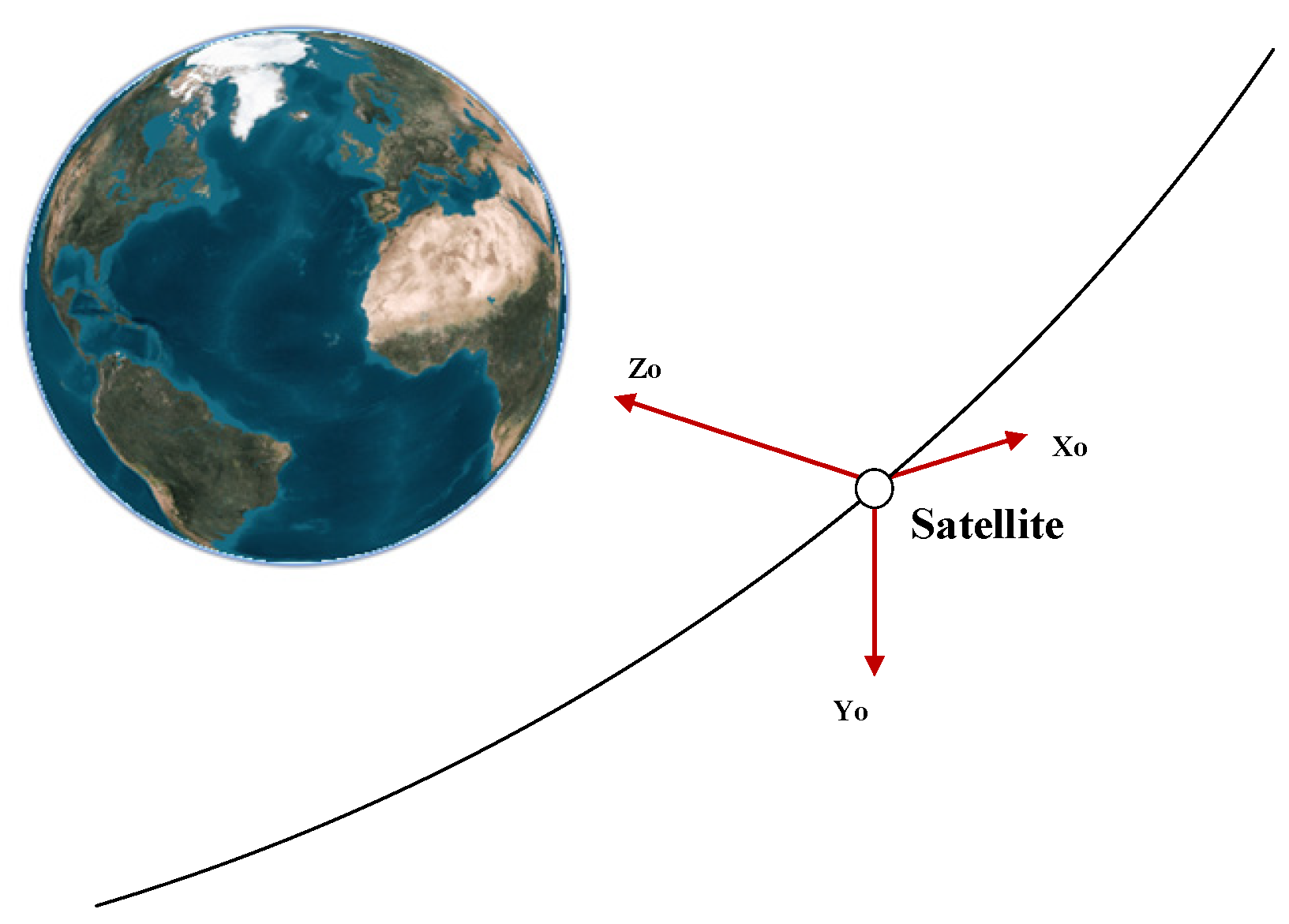
So far, we have considered either a non-rotating particle moving past a pivot, or a rigid body rotating about a fixed axis. What about a more complex case, like Earth orbiting the Sun while also spinning on its own axis?
The total angular momentum of a rigid body about an arbitrary origin 'O' can be decomposed into two parts:
- Orbital Angular Momentum (): The angular momentum of the center of mass (CM) as it moves about the origin O. It is calculated as if the entire mass of the body were a point particle at the CM.
- Spin Angular Momentum (): The angular momentum of the body's rotation about its own center of mass.
The total angular momentum is the vector sum:
This decomposition is extremely powerful and is fundamental in astrophysics and aerospace engineering. A more advanced treatment, which you'll encounter in analytical mechanics, involves the moment of inertia tensor for handling 3D rotations where and may not be parallel.
The following resource introduces this decomposition from the perspective of high-level problem-solving.
For more complex systems, like a planet orbiting the sun while also spinning, we need to generalize our calculation of angular momentum. This is addressed in a powerful way in high-level physics texts. This Olympiad-level handout by Kevin Zhou explains the decomposition.
Please read 'Idea 3' on page 3. Focus on the final equation for total angular momentum. Understand this as the sum of 'orbital' angular momentum (of the center of mass) and 'spin' angular momentum (about the center of mass). For most 2D problems, you can think of the spin part as simply I_cm * w.
Conclusion
Today we explored the law of conservation of angular momentum, a cornerstone of physics. It provides an elegant and powerful method for solving problems that would be difficult or impossible using force and torque equations alone.
Key Takeaways:
- Conservation Law: The total angular momentum of a system is conserved if the net external torque about a chosen pivot point is zero.
- Problem-Solving Power: This principle is your primary tool for systems with unknown internal or external forces (where you can choose a pivot to cancel their torques) and for inelastic rotational collisions where mechanical energy is not conserved.
- Types of Problems: We solved problems involving a change in the moment of inertia () and rotational collisions where point masses interact with rigid bodies.
- General Decomposition: The total angular momentum of any system can be expressed as the vector sum of its orbital angular momentum () and its spin angular momentum ().
This principle is essential in engineering for designing stable rotating systems, from flywheels in engines to the reaction wheels that control the attitude of satellites.
Preview of the Next Lesson:
We have now concluded our core study of rotational dynamics. In the next lesson, we will pivot to another fundamental topic in mechanics: oscillations. We will begin by deriving and solving the equation of motion for Simple Harmonic Motion (SHM), a ubiquitous type of motion that describes systems from a simple pendulum to the vibrations of atoms in a crystal lattice.