Hello! Welcome to your lesson on rotational dynamics.
In our previous lesson, we developed the rotational analogues of Newton's second law, and its more general form . You learned how to apply these laws to solve problems involving fixed-axis rotation and general planar motion.
Today, we will focus on a crucial and very common type of motion that combines translation and rotation: rolling motion. Our learning outcome is to analyze the dynamics of rolling motion without slipping. We will combine the translational and rotational equations of motion with a new constraint equation that defines "pure rolling." This will allow us to determine the acceleration of rolling objects and understand the forces at play.
By the end of this lesson, you will be able to:
- Define the kinematic condition for rolling without slipping.
- Analyze the role of static friction in rolling motion.
- Calculate the total kinetic energy of a rolling object.
- Solve for the acceleration of an object rolling down an incline using both dynamics and energy methods.
- Analyze the transition from slipping to pure rolling motion.
Let's begin by defining what "rolling without slipping" means from a physics perspective.
1. The Kinematics of Pure Rolling
Rolling motion is a combination of pure translation of the center of mass (CM) and pure rotation about the center of mass. The key to analyzing this motion lies in the "without slipping" constraint.
Physical Meaning: When an object rolls without slipping, the point on the object that is in contact with the surface is instantaneously at rest relative to that surface.
Let's break this down mathematically. In the reference frame of the ground, the velocity of the contact point, , is the vector sum of the velocity of the center of mass, , and the velocity of the contact point relative to the center of mass. This latter velocity is simply the tangential velocity from rotation, which has magnitude and points opposite to .

So, for motion along a straight line:
The "no-slip" condition requires , which leads to our fundamental constraint equation:
By differentiating this with respect to time (assuming R is constant), we get the corresponding relationship for accelerations:
These two equations are the mathematical heart of rolling without slipping. They provide the crucial link that connects the translational equations of motion () with the rotational ones ().
Rotational & Translational Motion Rolling without Slipping
To solidify these ideas, please review the first few slides of this presentation from MIT's 8.01T course.
Please read the slides from the beginning up to and including the 'Concept Question: Rolling Without Slipping'. Focus on the derivation of the 'Constraint Relations' and the definition of rolling, skidding, and slipping.
2. Energy and the Role of Friction
A common point of confusion is the role of friction. If an object is rolling down an incline, what force provides the torque to make it rotate? The answer is static friction, .
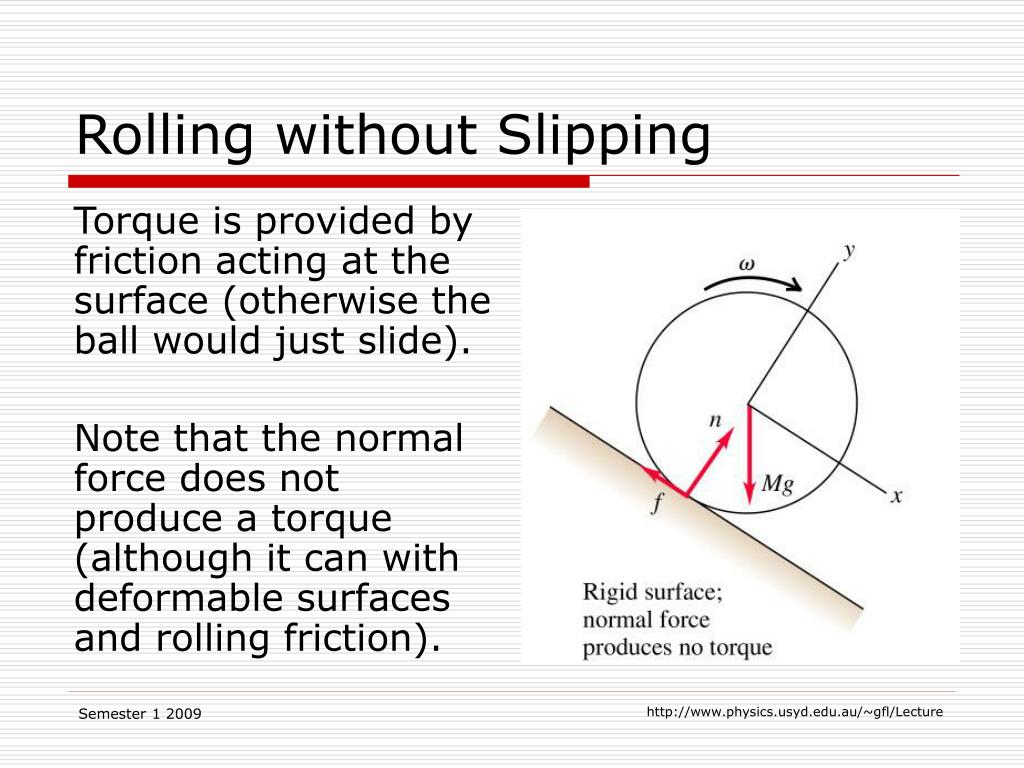
Since the contact point is instantaneously at rest, the friction involved is static, not kinetic. A key consequence is that static friction does no work (, because the displacement of the point of application is zero). Therefore, if static friction is the only non-conservative force present, mechanical energy is conserved for an object that is rolling without slipping.
The total kinetic energy of a rolling object is the sum of its translational and rotational kinetic energies:
Using the no-slip condition , we can express this entirely in terms of :
This expression is extremely useful for solving problems using conservation of energy.
Test your understanding!
Two cylinders of the same radius start from rest at the top of an incline. Cylinder A is a hollow shell (), and Cylinder B is a solid disk (). Which one reaches the bottom first? Why? (This is the "Cylinder Race" question from the MIT slides, resource LINK, section 4).
Show answer
Cylinder B (the solid disk) reaches the bottom first.
Here's why: For a given total kinetic energy (converted from potential energy ), the object with the smaller moment of inertia will have less of its energy tied up in rotation and more in translation.
From , a smaller means a larger for the same total energy. A larger final velocity means it covers the distance in less time.
Since , the solid cylinder will be faster.
3. Dynamics: Rolling Down an Inclined Plane
Let's now solve the classic problem of an object rolling down an incline using dynamics. This approach will allow us to find the acceleration and the required static friction force.
We will follow the methodology laid out in the video below. It systematically applies the translational and rotational forms of Newton's second law, along with the no-slip constraint.
36.2 Worked Example - Wheel Rolling Without Slipping Down Inclined Plane - Torque Method
This MIT OpenCourseWare video provides an excellent worked example of a wheel rolling down an inclined plane using the torque method. It's a perfect illustration of the principles we've just discussed.
Watch the video from the beginning (00:00) to 04:10. The lecturer sets up the free-body diagram, writes the force and torque equations, and combines them with the no-slip condition to solve for the linear acceleration.
As demonstrated in the video, the derivation proceeds as follows:
- Forces (Translation): Apply along the incline.
- Torques (Rotation): Apply about the center of mass.
- Constraint: Use the no-slip condition.
- Solve: We have a system of three equations with three unknowns (, , and ). Substituting (3) into (2) gives . Substituting this into (1) gives:
Solving for yields the general result for the acceleration of any object rolling without slipping down an incline:
This result confirms our conceptual finding from the "Cylinder Race": the acceleration depends on how mass is distributed (). Objects with smaller moments of inertia accelerate faster.
4. Advanced Scenario: Transitioning from Slipping to Rolling
What happens if the "without slipping" condition is not met initially? Consider a bowling ball that is thrown down a lane with an initial velocity but no initial angular velocity (). It starts by sliding (or slipping).
In this case, kinetic friction () acts on the ball. This friction does two things simultaneously:
- It opposes the translational motion, causing a linear deceleration.
- It applies a torque about the center of mass, causing an angular acceleration.
The ball will continue to slip until the translational and rotational speeds satisfy the no-slip condition, , at which point kinetic friction ceases and static friction takes over (or becomes zero if on a horizontal plane). During this slipping phase, mechanical energy is not conserved because the kinetic friction does negative work.
This is a more complex and realistic problem, perfect for testing your understanding of dynamics. The following video gives a masterful, in-depth analysis of this exact scenario.
This video from Mooc Bogazici provides a rigorous, step-by-step solution to the problem of an object transitioning from pure slip to pure roll. This is a common type of problem in advanced mechanics and competitive exams.
This video is quite long, so we'll focus on the core dynamics part. Please watch the following segments: Problem Setup and Equations of Motion (00:00 - 11:26): Pay attention to how the problem is defined and how the equations for v(t) (translational) and \omega(t) (rotational) are derived using kinetic friction. Solving for Final State (11:26 - 15:32): See how the no-slip condition v_f = R\omega_f is used to find the time it takes to stop slipping, and the final velocity of the ball.
This analysis demonstrates a powerful application of our dynamics toolkit to a situation where energy conservation cannot be used directly to find the final state due to the dissipative work done by kinetic friction.
Conclusion
In this lesson, we have thoroughly analyzed the dynamics of rolling motion. We've seen how a simple kinematic constraint, , elegantly connects the translational and rotational worlds.
Key Takeaways:
- Rolling without slipping implies the contact point is instantaneously at rest, leading to the constraint .
- The total kinetic energy of a rolling body is the sum of its translational and rotational parts: .
- Static friction is the agent that provides torque for angular acceleration in pure rolling. It does no work, so mechanical energy can be conserved.
- Kinetic friction acts when an object is slipping. It does work, dissipates mechanical energy, and drives the system toward a state of pure rolling.
- Problems can be solved using a dynamics approach (, ) or an energy conservation approach (if applicable).
The principles of rolling motion have vast applications, from the design of ball bearings and vehicle tires to more exotic problems in physics. For example, the handout Mechanics VIII: 3D Rotation (resource LINK) explores complex scenarios like a rolling coin (Problem 9) or a millstone grinding grain (Problem 4), showing how these fundamental ideas extend to advanced engineering and physics problems.
Preview of the Next Lesson:
In the "slipping to rolling" problem, we noted that mechanical energy is not conserved. However, as hinted in the MIT slides (resource LINK, section 8), if we cleverly choose our pivot point to be a fixed point on the ground, the torque from friction becomes zero. This means that angular momentum about that specific point is conserved! In our next lesson, we will delve into solving problems involving conservation of angular momentum in complex systems, a powerful technique for tackling problems where forces are unknown or energy is not conserved.