Hello! Welcome to your next lesson in our "Rotational Dynamics and Oscillations" module.
In our last lesson, we established the concept of moment of inertia, , as a measure of an object's resistance to rotational acceleration. You learned how to use integration to calculate for various continuous rigid bodies, a crucial first step in analyzing rotational motion.
Today, we will build upon that foundation by introducing the rotational analogues of force and momentum: torque and angular momentum. Our goal is to apply the rotational versions of Newton's laws to solve dynamics problems involving these concepts. This lesson directly addresses the learning outcome: Apply the rotational analogues of Newton's laws to solve problems involving torque and angular momentum.
By the end of this lesson, you will be able to:
- Define torque and angular momentum as vector quantities.
- Formulate the two rotational analogues of Newton's second law.
- Develop a systematic approach to solving problems that involve both rotation and translation.
- Apply these principles to analyze complex systems, including those with fixed and moving pivots.
Let's begin by defining the cause of rotational motion: torque.
1. Torque and Angular Acceleration ()
Just as a net force causes linear acceleration (), a net torque causes angular acceleration.
Torque, represented by the Greek letter tau (), is the rotational equivalent of force. It is defined as the cross product of the position vector (from the pivot point to the point of force application) and the force vector :
The magnitude of the torque is , where is the angle between and . The direction of the torque vector is perpendicular to the plane formed by and , given by the right-hand rule.
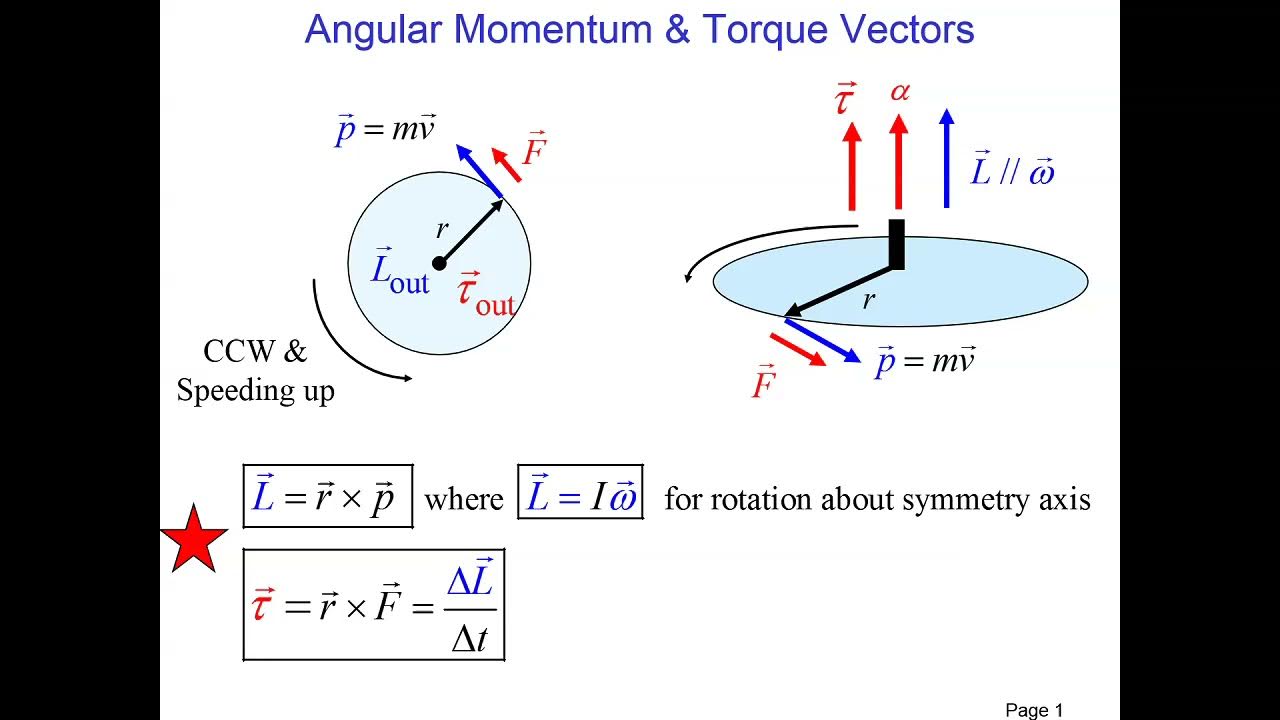
For a rigid body rotating about a fixed axis, the net torque is directly proportional to the angular acceleration , with the moment of inertia as the constant of proportionality.
This is the rotational analogue of Newton's second law, . You'll find this form extremely useful for problems involving fixed-axis rotation. The resource "olympiad problems on mechanics" refers to this as IDEA 43, a fundamental tool for rotational dynamics.
To see this law in action, let's analyze a classic problem. The following video demonstrates how to use the torque equation to solve for the motion of an Atwood machine where the pulley has mass. This method has a significant advantage: by choosing the pivot at the center of the pulley, the unknown tension forces in the string do not appear in the torque equation, simplifying the problem considerably.
10. Equations of Motion, Torque, Angular Momentum of Rigid Bodies
Please watch this segment from an MIT OpenCourseWare lecture. It masterfully solves the Atwood machine problem by focusing on the system as a whole and applying the torque equation to the pulley.
Watch from 17:39 to 29:30. Pay close attention to how a free-body diagram of the entire system is used to calculate the net external torque, and how this is set equal to the time derivative of the system's total angular momentum to find the acceleration.
This example highlights a key problem-solving strategy you requested: choosing a reference frame or pivot point to simplify the equations. As noted in IDEA 2 from the Olympiad resource, choosing a pivot that zeroes the torques of uninteresting forces (like internal tensions or contact forces) is highly effective.
2. Angular Momentum and the General Rotational Second Law
While is powerful, a more fundamental and general form of the rotational second law involves angular momentum, .
For a single particle, angular momentum is the rotational analogue of linear momentum () and is defined as:
By taking the time derivative of this definition, we arrive at the most general form of Newton's second law for rotation:
The first term is , since is parallel to itself. The second term is , which is the definition of net torque . This yields the fundamental relationship:
This equation states that the net external torque on a system equals the rate of change of its total angular momentum. This is the rotational equivalent of .
Conservation of Angular Momentum
A profound consequence of this law is the principle of conservation of angular momentum. If the net external torque on a system is zero, then , which means the total angular momentum of the system remains constant.
Angular Momentum of a Rigid Body
For a rigid body rotating with angular velocity about a fixed axis of symmetry, the angular momentum simplifies to:
Substituting this into the general law gives , recovering our earlier formula.
It's important to recognize that is a special case. In general, for an arbitrarily shaped body, the angular momentum vector is not necessarily parallel to the angular velocity vector . This occurs in dynamically unbalanced systems and leads to wobbling and vibrating axles—a key concern in mechanical engineering. The relationship is described by the inertia tensor, , a topic we will explore in continuum mechanics. The following video gives a glimpse of this complexity.
10. Equations of Motion, Torque, Angular Momentum of Rigid Bodies
For a deeper look, watch this segment from another MIT lecture. It explains why L and ω are not always aligned and how this relates to dynamic imbalance.
Watch from 50:17 to 58:33. Focus on the idea that off-diagonal terms in the moment of inertia matrix cause components of angular momentum to appear in directions other than the spin axis.
3. A Systematic Approach to Problem Solving
We now have a complete toolkit for rotational dynamics. A robust problem-solving methodology involves combining the laws for translation and rotation.
- System & Coordinates: Identify the system, draw free-body diagrams for each component, and establish an inertial coordinate system.
- Equations of Motion:
- Translation: Apply for the center of mass motion.
- Rotation: Apply about a chosen point. This often simplifies to about the center of mass or a fixed pivot.
- Constraint Equations: Relate translational and rotational motion. For an object rolling without slipping, for example, and .
- Solve: Solve the resulting system of algebraic or differential equations.
The next video provides a superb classification of rigid body problems and demonstrates how to apply this methodology to increasingly complex scenarios.
12. Problem Solving Methods for Rotating Rigid Bodies
This MIT OCW lecture provides a brilliant framework for solving problems in rotational dynamics. It classifies problems into four types, giving you a structured way to think about them. We'll walk through the examples shown.
This video forms the core of our problem-solving section. We'll break it down. Introduction (00:54 - 03:04): Listen to the introduction of the fundamental laws and the four problem classes. Pendulum Example (11:22 - 32:34): This is a Class 2 problem (pure rotation about a fixed axis not through the center of mass). Follow the derivation for the physical pendulum. This is a great application of the parallel axis theorem and leads to the equation of motion for an oscillator. Hockey Puck Example (32:34 - 50:02): This is a Class 3 problem (no external constraints on motion). It perfectly illustrates separating motion into translation of the CM and rotation about the CM. Truck & Pipe Example (50:02 - 1:06:43): This is a Class 4 problem (moving point of constraint). It requires the full, general torque-angular momentum equation and is a fantastic example of the rigorous application you're looking for.
Summary of Problem-Solving Insights from the Video:
- Fixed Axis (): For any problem with a fixed pivot point , summing torques about that point is the most direct approach. The pendulum is a prime example.
- General Planar Motion ( & ): For unconstrained motion like the hockey puck, it's almost always best to analyze the translation of the center of mass and the rotation about the center of mass as two separate but coupled problems.
- Moving Pivot (Full Equation): For complex cases like the pipe rolling in an accelerating truck, the pivot point is also moving (and accelerating). Here, you must use the full equation . The video shows that even in this complex case, a clever choice of reference point (the contact point on the truck bed) can simplify the problem by making the second term zero.
Test your understanding!
Consider Problem 18 from the JEE Advanced Physics questions file (ID LINK): "A thin and uniform rod of mass M and length L is held vertical on a floor with large friction. The rod is released from rest so that it falls by rotating about its contact-point with the floor without slipping."
When the rod makes an angle with the vertical, what is the net torque about the contact point on the floor? Use this to find the angular acceleration .
Show answer
- Free-Body Diagram: The forces acting on the rod are gravity () acting downwards from the center of mass, the normal force () acting upwards from the floor, and the friction force () acting horizontally.
- Choose Pivot: The contact point with the floor is an excellent choice for the pivot. The normal and friction forces pass through this point, so their torques are zero.
- Calculate Torque: The only force producing a torque about the contact point is gravity. The center of mass is at a distance from the pivot. The lever arm is the perpendicular distance from the pivot to the line of action of the gravitational force, which is .
- Apply Rotational Second Law: We use . The moment of inertia of a rod about its end is .
- Solve for : This expression gives the angular acceleration of the rod as a function of its angle, which could then be used to find the angular velocity via integration ().
Conclusion
In this lesson, we have moved from rotational kinematics to rotational dynamics. You've been equipped with the essential laws and a powerful, systematic framework for solving problems.
Key Takeaways:
- Torque () is the rotational analogue of force.
- Angular Momentum () is the rotational analogue of linear momentum.
- Newton's Second Law for rotation has two key forms:
- (for fixed-axis rotation).
- (the general case).
- If the net external torque is zero, the total angular momentum of a system is conserved.
- A powerful problem-solving strategy is to decouple motion into the translation of the center of mass and rotation about the center of mass.
Preview of the Next Lesson:
We will now focus on a particularly important and ubiquitous application of these principles: rolling motion. In the next lesson, "Analyze the dynamics of rolling motion without slipping," we will combine the translational and rotational equations of motion with the no-slip constraint to analyze how objects like wheels, cylinders, and spheres roll down inclines and across surfaces. This topic is rich with applications in both engineering and physics.