Hello! Welcome to the second module of our course, "Rotational Dynamics and Oscillations."
In the previous module, we built a comprehensive framework for describing translational motion using Newtonian mechanics and calculus. In our last lesson, we saw how to tackle complex, multi-concept problems by breaking them down and applying fundamental principles, often using integration on differential elements of a system.
This lesson marks our transition from the motion of point-like particles to the motion of extended, rigid bodies. We'll begin with the rotational equivalent of mass: the moment of inertia. Just as mass measures an object's resistance to changes in its linear motion, the moment of inertia measures its resistance to changes in its rotational motion.
Today, we will focus on the learning outcome: Calculate the moment of inertia for continuous rigid bodies using integration. This is a foundational skill for everything that follows in rotational dynamics. We will see that the calculus techniques you've been practicing, particularly integration, are the essential tools for this task.
Our goals for this lesson are to:
- Understand the integral definition of the moment of inertia.
- Develop a systematic strategy for calculating it for various shapes.
- Apply this strategy to derive the moment of inertia for common objects like rods, rings, discs, and spheres.
- Appreciate how different methods can be used to solve the same problem, highlighting both direct calculation and elegant symmetry arguments.
From Discrete Masses to Continuous Bodies
For a collection of discrete point masses , each at a perpendicular distance from an axis of rotation, the total moment of inertia is a simple sum:
However, real objects like flywheels, planets, or spinning tops are continuous distributions of mass. We can't simply sum up the particles. This is where integration comes in. We imagine the body is composed of an infinite number of infinitesimal mass elements, dm, and we sum their contributions by integrating.
The fundamental formula for the moment of inertia of a continuous body is:
Here, is the perpendicular distance of the mass element from the axis of rotation. Our entire task boils down to expressing and in terms of a single integration variable (like , , or ) and evaluating the integral over the body's geometry.
The video below provides an excellent introduction to this concept and the general strategy.
How to Find Mass Moment of Inertia
To start, please watch the first two minutes of this video from Brain Station Advanced. It clearly explains why we need integration for extended bodies and sets up the fundamental formula we will be using throughout this lesson.
Watch from 01:27 to 02:11. Focus on the transition from a sum over discrete masses to an integral over a continuous mass distribution.
The General Strategy
Calculating the moment of inertia is a systematic process:
- Choose Coordinates: Define a coordinate system and specify the axis of rotation.
- Select a Mass Element (
dm): This is the most crucial step. Choose a small piece of the object whose moment of inertia is either known or easy to express. The choice should exploit the body's symmetry. - Express
dmusing Density: Relate the mass elementdmto a geometric element (likedx,dA, ordV) using the appropriate mass density:- Linear mass density (): For 1D objects like a thin rod. , so .
- Surface mass density (): For 2D objects like a disc. , so .
- Volume mass density (): For 3D objects like a sphere. , so .
- Set up the Integral: Substitute the expressions for and into . Determine the correct integration limits to cover the entire object.
- Evaluate: Solve the integral.
Derivations for Common Shapes
Let's apply this strategy to derive the moment of inertia for several standard shapes. We'll use the same video as a guide.
1. Thin Ring (or Hollow Cylinder) about its Central Axis
This is the simplest case. For a ring of mass and radius , every mass element is at the same perpendicular distance from the central axis.
Since is just the total mass , the result is immediate:
This is also the formula for a thin-walled hollow cylinder, as it is just a stack of identical rings.
How to Find Mass Moment of Inertia
Watch how this simple case is handled in the video.
Watch from 02:11 to 03:03 for the ring derivation, and then from 09:21 to 10:30 for the application to a hollow cylinder. Notice that no complex integration is needed because r is constant.
2. Thin Rod about its Center
Consider a uniform thin rod of mass and length , rotating about a perpendicular axis through its center.
- Coordinates & Axis: Let the rod lie on the x-axis from to . The axis of rotation is the y-axis.
- Mass Element: A small segment of length at position .
dm: The linear mass density is . So, .- Distance: The perpendicular distance from
dmat positionxto the y-axis is simply . - Integral:
- Evaluation:
The video below walks through this exact derivation.
How to Find Mass Moment of Inertia
Now let's see the derivation for a thin rod. Pay close attention to how the linear mass density λ is used to relate dm to dx.
Watch from 03:03 to 06:02. Follow the setup of the integral and the evaluation using the limits -L/2 to +L/2.
Test your understanding!
Using the same method, calculate the moment of inertia of the same rod, but this time about a perpendicular axis passing through one of its ends. (Hint: Your integration limits will change).
Show answer
Let the rod lie on the x-axis from to , with the axis of rotation at .
The setup is the same: and . The integral becomes:
Notice that the moment of inertia is larger about the end than about the center. This makes intuitive sense: more of the mass is, on average, farther from the axis of rotation.
3. Solid Disc (or Solid Cylinder) about its Central Axis
For a uniform solid disc of mass and radius , rotating about the axis perpendicular to its plane and passing through its center.

- Coordinates & Axis: Use polar coordinates in the plane of the disc. The axis is the z-axis.
- Mass Element: This is a key example of a clever choice. We choose
dmto be a thin ring of radius and infinitesimal thickness . We already know the MOI of a ring is its mass times its radius squared. dm: The surface mass density is . The area of our elemental ring is its circumference times its thickness: . Thus, .- Integral: The moment of inertia of this elemental ring is . To find the total moment of inertia, we integrate these rings from the center () to the edge ():
- Evaluation:
This result also holds for a solid cylinder rotating about its long central axis, as a solid cylinder is just a stack of discs.
How to Find Mass Moment of Inertia
The derivation for a solid disc is a classic example of choosing the right dm. Watch how the disc is broken down into concentric rings.
Watch from 06:19 to 09:21 for the disc, and then from 10:30 to 11:42 for the solid cylinder. Focus on the setup: dm = σ (2πr dr) and dI = r² dm.
The Solid Sphere: A 3D Challenge
Calculating the moment of inertia for a solid sphere is a more advanced application of integration, but it's an excellent test of your skills. We'll explore two distinct methods.
Method 1: Slicing into Discs
This is the most direct integration approach. We slice the sphere into a series of thin discs perpendicular to the axis of rotation.
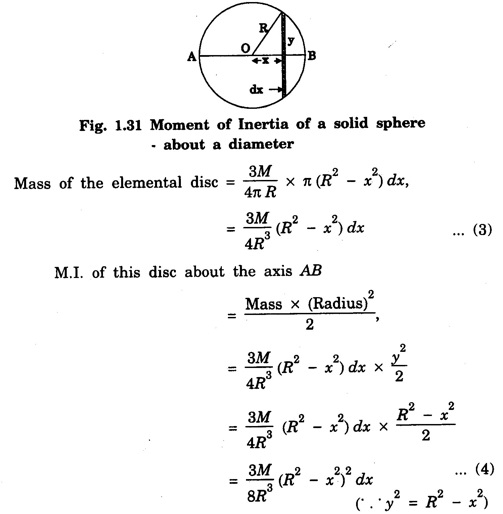
- Setup: Let the sphere be centered at the origin, rotating about the z-axis. Consider a thin disc at height with thickness .
- Disc Properties: From the sphere's geometry, , so the disc's radius is .
- Mass of Disc
dm: The volume density is . The disc's volume is . So, . - MOI of Disc
dI: From our previous result, the MOI of this elemental disc about the z-axis is . - Integrate: We sum the contributions from all discs, from to . This is a standard polynomial integral. Evaluating it and substituting back gives the final result.
How to Find Mass Moment of Inertia
The following video segment demonstrates this 'stack of discs' method. It's a bit lengthy, but it's a very clear, step-by-step application of single-variable calculus.
Watch from 15:46 to 18:34. Follow the logic of defining the properties of an elemental disc (its mass and radius) and then integrating.
Method 2: The Elegance of Symmetry
There is a more clever and physically insightful method that uses the sphere's symmetry, which is a technique you will encounter often in theoretical physics.
29.5 Deep Dive - Moment of Inertia of a Sphere
Now, let's watch a more advanced derivation from an MIT OpenCourseWare lecture. This method exploits the perfect symmetry of the sphere to simplify the calculation dramatically.
Watch the entire video (from 00:00 to 05:28). The key steps are: Recognizing that by symmetry, the moments of inertia about the x, y, and z axes must be equal: I_x = I_y = I_z = I. Summing them: I_x + I_y + I_z = 3I. Showing that this sum simplifies the integral to ∫2r²dm, where r is the spherical radius. Evaluating this much simpler integral using spherical shells for dm.
Both methods lead to the same famous result:
Comparing the two methods is instructive. The first is a direct, brute-force calculation. The second requires a deeper physical insight about symmetry but results in a far simpler integral. Developing the ability to recognize such symmetries is a hallmark of an expert physicist.
Conclusion and Next Steps
In this lesson, you've learned the fundamental skill of calculating the moment of inertia for continuous rigid bodies using integration. This is the rotational equivalent of finding the mass of an object and is the first crucial parameter needed to describe its rotation.
Key Takeaways:
- The moment of inertia is the rotational analogue of mass.
- The value of depends critically on the mass distribution relative to the axis of rotation.
- The general strategy involves choosing a suitable differential mass element () and integrating its contribution over the entire body.
- Clever choices of (like using rings for a disc) and exploiting symmetry can significantly simplify calculations.
- We have derived the standard results for several key shapes:
- Ring/Hollow Cylinder:
- Rod (center):
- Disc/Solid Cylinder:
- Solid Sphere:
Preview of the Next Lesson:
Now that we know how to calculate rotational inertia (), we are ready to build a theory of rotational dynamics. In the next lesson, we will introduce the rotational analogue of force—torque ()—and the rotational analogue of Newton's second law, . We will then use these new tools to solve problems involving the angular acceleration of rigid bodies.