Introduction
Welcome back! In our last lesson, we mastered the use of the Euler-Lagrange equations to derive the equations of motion for complex systems. We saw how this method provides a powerful, systematic algorithm for describing dynamics, and even how to find constraint forces using Lagrange multipliers.
In that process, you might have noticed something interesting: for systems with rotational symmetry, like the spherical pendulum, the Lagrangian often depended on the angular velocity (e.g., ) but not the angle itself (). Today, we will explore the profound implications of this observation.
This lesson delves into the connection between symmetries and conservation laws, one of the most beautiful and fundamental concepts in physics. We will start by defining cyclic (or ignorable) coordinates—those that don't appear in the Lagrangian—and show how they immediately lead to a conserved quantity. We will then generalize this idea to Noether's Theorem, a cornerstone of theoretical physics which states that for every continuous symmetry of a system, there exists a corresponding conserved quantity.
1. Cyclic Coordinates and Conserved Momenta
Let's begin with the simple observation from our previous work. What happens when a generalized coordinate, let's call it , does not explicitly appear in the Lagrangian? This means the partial derivative of the Lagrangian with respect to that coordinate is zero:
Such a coordinate is called cyclic or ignorable.
Now, let's look at the Euler-Lagrange equation for this specific coordinate :
Since the second term is zero, the equation simplifies dramatically to:
This equation tells us that the quantity inside the parenthesis, , is a constant of the motion. We call this quantity the generalized momentum (or conjugate momentum) corresponding to the coordinate , denoted as .
So, we have our first major result:
If a generalized coordinate is cyclic, then its corresponding generalized momentum is conserved.
This provides a powerful shortcut for finding conserved quantities directly from the Lagrangian.
Conservation laws and Noether's theorem
To see this principle in action, let's watch the first part of the video 'Conservation laws and Noether's theorem' from Dr Mitchell's physics channel. It clearly defines cyclic coordinates and works through two classic examples.
Watch the segment from 01:59 to 14:47. The first part (up to 04:42) provides the formal definition of cyclic coordinates and the derivation of the conserved momentum. The second part demonstrates this with two crucial examples: a free particle in Cartesian coordinates (leading to conservation of linear momentum) and in spherical polar coordinates (leading to conservation of angular momentum). Notice how the choice of coordinates determines which conservation law becomes obvious.
As the video highlighted, in Cartesian coordinates for a free particle, are cyclic, and the conserved momenta are , , and . In spherical coordinates for the same free particle, is cyclic, and the conserved momentum is , which you should recognize as the z-component of angular momentum, .
This dependency on the coordinate system suggests that a deeper, more fundamental principle is at work.
Test your understanding!
A particle of mass moves in three dimensions under a potential that only depends on and . The Lagrangian is .
Which coordinate is cyclic, and what is the corresponding conserved quantity?
Show answer
The Lagrangian does not contain the coordinate , only its time derivative . Therefore, is a cyclic coordinate.
The corresponding generalized momentum is , which is conserved.
So, the component of linear momentum in the z-direction is conserved. This makes physical sense: since the potential (and thus the force) does not depend on , there is no force in the z-direction to change the momentum in that direction.
2. From Cyclic Coordinates to Continuous Symmetries
The fact that a coordinate is cyclic means that the Lagrangian is invariant under a change to that coordinate (e.g., a translation ). This invariance is called a symmetry.
For instance, when the Lagrangian for a free particle is written in Cartesian coordinates, it is invariant under the translation . This is why is a cyclic coordinate. This property reflects the homogeneity of space: the laws of physics are the same everywhere.
Similarly, when the Lagrangian for a particle in a central potential is written in spherical coordinates, it is invariant under a rotation . This is why is cyclic. This property reflects the isotropy of space: the laws of physics are the same in all directions.
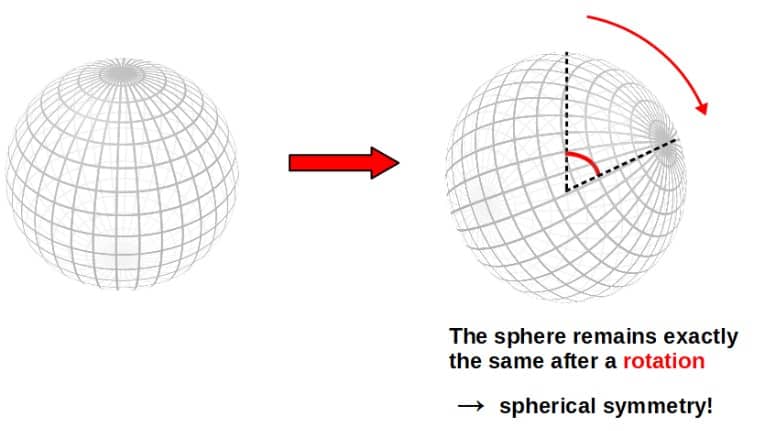
The key insight is to generalize from "a coordinate doesn't appear" to "the Lagrangian is invariant under a continuous transformation". A continuous transformation is one that can be built up from infinitesimal changes, like a translation by any distance or a rotation by any angle. This leads us to one of the most elegant results in physics.
3. Noether's Theorem
The connection between symmetry and conservation laws was formalized by Emmy Noether in 1915. Noether's Theorem states:
For every continuous symmetry of the Lagrangian, there is a corresponding conserved quantity.
This is a much more powerful and general statement than our initial observation about cyclic coordinates. It doesn't depend on a clever choice of coordinates. If a symmetry exists, a conservation law must also exist.
The Derivation
The proof of Noether's theorem is a beautiful application of the concepts you've learned. Let's outline the main steps.
Consider a continuous transformation of the coordinates parameterized by : , where corresponds to no transformation (). If this transformation is a symmetry, the Lagrangian's value remains unchanged. Mathematically, this means its derivative with respect to the symmetry parameter is zero:
Using the chain rule, we expand this derivative:
Now, we use the Euler-Lagrange equation, , to substitute for the first term:
Recognizing this as the result of the product rule for differentiation, we can combine the terms:
This proves that the quantity inside the time derivative, the Noether charge, is conserved. Evaluating it at gives us the conserved quantity in our original coordinates:
To see this derivation presented in detail and applied to a concrete example, we'll return to Dr. Mitchell's video and supplement it with the formal written proof from David Tong's notes.
Conservation laws and Noether's theorem
This video segment provides a rigorous, step-by-step derivation of Noether's theorem. It then immediately applies the theorem to the case of rotational symmetry to explicitly derive the conservation of angular momentum.
Watch the segment from 14:47 to 58:34. The first part (14:47 - 39:54) builds the conceptual link between cyclic coordinates and the invariance of the Lagrangian under a symmetry transformation. The second, crucial part (39:54 - 58:34) presents the formal derivation of Noether's theorem and demonstrates its power by re-deriving the conservation of angular momentum from rotational symmetry, without needing to find a cyclic coordinate first.
For a concise, formal treatment that you can study at your own pace, read the relevant section from David Tong's lecture notes. This text presents the proof of Noether's theorem and then succinctly lists the three most fundamental symmetry-conservation pairs.
Read the section '2.4 Noether’s Theorem and Symmetries' (pages 22-25). Start from the heading and read through to the end of the 'Example: Homogeneity of Time'. Pay close attention to the proof and the three key examples that connect foundational symmetries of spacetime to the conservation of momentum, angular momentum, and energy.
The three fundamental pairs you should now be familiar with are:
- Symmetry under Spatial Translation (Homogeneity of space) Conservation of Linear Momentum.
- Symmetry under Spatial Rotation (Isotropy of space) Conservation of Angular Momentum.
- Symmetry under Time Translation (Homogeneity of time) Conservation of Energy.
4. Application: Simplifying Problems with Conservation Laws
Beyond their fundamental importance, conservation laws are immensely practical. Identifying a conserved quantity provides a first integral of motion—an algebraic equation involving velocities rather than accelerations. This often allows us to reduce the complexity of a problem, sometimes even solving it completely.
A classic example is the spherical pendulum, where we can use the conservation of angular momentum to reduce a two-degree-of-freedom problem into a simpler one-degree-of-freedom problem governed by an "effective potential".
Let's see how identifying a cyclic coordinate and its conserved momentum radically simplifies a problem. The 'Spherical Pendulum' example in Tong's notes is a perfect illustration of this technique.
Read the subsection '2.5.3 Spherical Pendulum' (pages 28-30). Notice how the Lagrangian immediately shows that φ is ignorable. The conserved angular momentum J is calculated, and this allows φ̇ to be eliminated from the equation of motion for θ. This reduces the problem to a single, albeit complex, equation for θ which can be analyzed using the concept of an effective potential, Ve↵.
Conclusion
Today, we have uncovered one of the deepest principles in mechanics. What began as a simple observation about a missing variable in the Lagrangian has blossomed into a profound connection between the symmetries of a system and the quantities it must conserve.
Key Takeaways:
- A cyclic or ignorable coordinate is one that does not appear in the Lagrangian. Its corresponding generalized momentum is conserved.
- This is a special case of Noether's Theorem, which states that every continuous symmetry of the Lagrangian gives rise to a conserved quantity.
- The fundamental conservation laws of momentum, angular momentum, and energy arise from the fundamental symmetries of spacetime: homogeneity and isotropy of space, and homogeneity of time.
- Practically, identifying conserved quantities simplifies solving the equations of motion, often by reducing the number of degrees of freedom or providing a first integral of motion.
Preview of the Next Lesson:
Throughout our study of Lagrangian mechanics, we have seen the importance of both generalized coordinates and their conjugate generalized momenta . The Lagrangian formalism is expressed in the space of . In our next lesson, we will introduce a new, equally powerful framework called Hamiltonian mechanics. This formalism is expressed in the space of , known as phase space. We will learn how to move from the Lagrangian to the Hamiltonian using a mathematical procedure called a Legendre transformation, and we will see that this new perspective offers unique insights into the dynamics of physical systems.