Hello! Welcome to the next lesson in our journey to master Docker for professional use.
In our last session, we clarified the relationship between Docker and the Kubernetes ecosystem. We established that while Kubernetes no longer uses the Docker daemon as its direct runtime, docker build remains the essential tool for creating the OCI-compliant images that Kubernetes runs. This sets the stage perfectly for today's topic.
As a DevOps engineer, a critical part of your role is choosing the right tool for the job. Two of the most common tools in the container world are Docker Compose and Kubernetes. Today, we will compare the use cases for Docker Compose (local development) and Kubernetes (production orchestration). We'll explore why they aren't competitors, but rather complementary tools that serve different stages of the application lifecycle.
The Lifecycle Divide: Development vs. Production
At a high level, the distinction between Docker Compose and Kubernetes is about the environment they are designed to manage. Docker Compose excels at defining and running multi-container applications on a single host, while Kubernetes is designed to orchestrate containers across a cluster of multiple hosts.
This fundamental difference is visualized well in the following diagram.
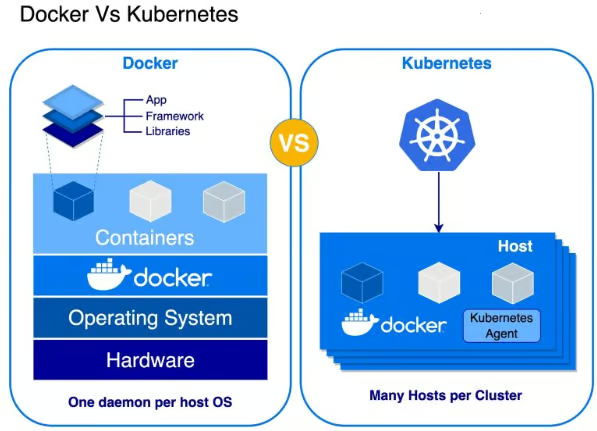
Given your familiarity with both Docker Compose and Kubernetes, this distinction is likely intuitive. Let's formalize it.
Docker Compose: The Developer's Toolkit
Docker Compose is designed to simplify the developer experience. Its primary goal is to create a reproducible, multi-service environment on a local machine with a single command (docker compose up).
The video below gives a great summary of where each tool fits into the overall development and deployment process.
Docker vs Kubernetes vs Docker Swarm | Comparison in 5 mins
This video from TechWorld with Nana, titled "Docker vs Kubernetes vs Docker Swarm", clearly delineates the roles of Docker/Compose and Kubernetes in a typical workflow.
Please watch from the beginning to 03:04. Pay close attention to the diagram that shows Docker being used for local development and in the CI process, while Kubernetes comes into play for managing the application in the actual cluster environment.
As the video highlights, Docker Compose is the ideal tool for:
- Local Development: Simulating a full application stack (e.g., web server, API, database, cache) on your laptop.
- Automated Testing: Creating isolated environments within a CI/CD pipeline to run integration or end-to-end tests.
- Prototyping: Quickly spinning up and tearing down a proof-of-concept application.
The key value proposition is simplicity and speed for a single-host environment.
A Deeper Dive: Feature and Capability Comparison
The different use cases are driven by a significant divergence in features and capabilities. Docker Compose prioritizes ease of use, while Kubernetes prioritizes robustness, scalability, and automation for production workloads.
To explore this, let's examine an excellent article that breaks down the key differences.
Docker Compose vs Kubernetes - Differences Explained
The article "Docker Compose vs Kubernetes - Differences Explained" from Spacelift provides a detailed, feature-by-feature comparison that is perfect for understanding the trade-offs.
Please read the following sections: "What is Kubernetes?" and "What is Docker Compose?": These sections will formalize the definitions and primary use cases for each tool. "Kubernetes vs. Docker Compose: Key differences": This is the most important section. Focus on understanding the differences in scope, auto-scaling, self-healing, and overall complexity. This will give you a solid framework for deciding when to use each technology.
Key Distinctions Summarized
The article you just read covers the critical points of comparison. Let's summarize them in a table.

To bring these points home, this short video provides a very direct and practical summary of when to choose one over the other based on business needs like scale and downtime tolerance.
To Docker-Compose or To Kubernetes: A Brief Overview
This video, "To Docker-Compose or To Kubernetes," offers a concise breakdown of the decision-making process.
Watch the section from 04:22 to 05:12. It directly addresses the core of our learning outcome: matching the tool to the project's requirements.
As you can see, the choice is not about which tool is "better," but which is appropriate for the task. For a small project running on a single server where occasional downtime is acceptable, Docker Compose (perhaps with Docker Swarm for basic clustering) can be sufficient. For a large-scale, business-critical application that demands high availability and automatic scaling, Kubernetes is the undisputed standard.
Test your understanding!
A startup is launching a new application. They are using Docker Compose to run their web server and database in production on a single virtual machine. They tell you they are "doing container orchestration." As they plan for user growth, what key risks do they face with this setup, and what would be your primary recommendation?
Show answer
Their current setup exposes them to several significant risks associated with using Docker Compose for production at scale:
- Single Point of Failure: If the single VM goes down (due to hardware failure, OS issues, etc.), the entire application becomes unavailable. Docker Compose has no built-in mechanism to failover to another host.
- No Auto-Scaling: As user traffic increases, the application will slow down. They would have to manually scale up their VM or container, which is inefficient and not responsive to real-time demand.
- Limited Self-Healing: While Compose can restart a failed container (
restart: always), it cannot handle a node failure or more complex application health issues. - Basic Networking: It lacks the sophisticated service discovery, load balancing, and network policy features needed for a secure and robust production environment.
Recommendation:
My primary recommendation would be to plan a migration to a managed Kubernetes service (like GKE, EKS, or AKS). This would address all the risks above by providing automated scaling, self-healing, high availability across multiple nodes, and advanced networking. They can continue to use Docker Compose for their local development environments to maintain developer velocity, reinforcing the idea that the tools are complementary.
Bridging the Gap: From Compose to Kubernetes
Since many development workflows start with Docker Compose, a common task for a DevOps team is to transition that application to run on Kubernetes.
While you cannot run Docker Compose directly on a Kubernetes cluster, the two are not totally isolated. The configuration in a docker-compose.yml file captures the essential services, environment variables, and ports needed for the application. This serves as an excellent blueprint for creating the corresponding Kubernetes manifests (Deployments, Services, ConfigMaps, etc.).
Tools like Kompose exist specifically to help with this translation. Kompose can read a docker-compose.yml file and automatically generate initial Kubernetes YAML manifests. While the output often requires manual refinement to incorporate Kubernetes-specific features like liveness probes or persistent volume claims, it provides a fantastic starting point and accelerates the migration process. This is mentioned in the Spacelift article you read earlier.
Conclusion
You now have a clear, practical framework for differentiating between Docker Compose and Kubernetes. This is a fundamental concept that separates junior and senior engineers in the cloud-native space.
Key Takeaways:
- Different Scopes: Docker Compose is for single-host environments, while Kubernetes is for multi-host clusters.
- Different Goals: Compose prioritizes developer speed and simplicity. Kubernetes prioritizes production robustness, scalability, and automation.
- Key Kubernetes Advantages: The defining features that make Kubernetes the production standard are auto-scaling, self-healing, and built-in service discovery and load balancing.
- Complementary, Not Competing: The most effective teams use both. Docker Compose streamlines the "inner loop" of local development and testing, while Kubernetes powers the "outer loop" of production deployment and operations.
In this lesson, we've focused on the "why" and "when" of using Kubernetes. In our next lesson, we will focus on the "how." We'll begin adapting a Dockerized application to be a "good citizen" in a Kubernetes cluster by implementing health checks, which are crucial for Kubernetes's self-healing capabilities.