Hello! In our first lesson, we mapped out the entire video creation process, breaking it down into five key stages: Idea, Assets, Assembly, Polish, and Publishing. Having this map is essential, but even the best map is useless without a destination. Staring at the whole journey at once can feel overwhelming, especially when you're committed to creating reflective, meaningful content.
This is where today's lesson becomes your most important strategic tool. Our goal is to define the scope of your first project: a "Minimum Viable Video" (MVV). This isn't about lowering your standards; it's about setting a clear, achievable goal designed to guide you through all five production stages for the first time. By focusing on a 1-2 minute essay on a single, simple idea, we give ourselves the greatest possible chance of completion. This act of finishing your first piece is the most powerful antidote to perfectionism and will build the momentum you need to start your channel.
From Product to Video: The "Minimum Viable" Concept
The term "Minimum Viable Product" (MVP) comes from the world of software and product development, but the philosophy behind it is incredibly useful for any creative project. It's a strategy for starting smart.
Take a look at the famous illustration below. It perfectly captures the core idea.
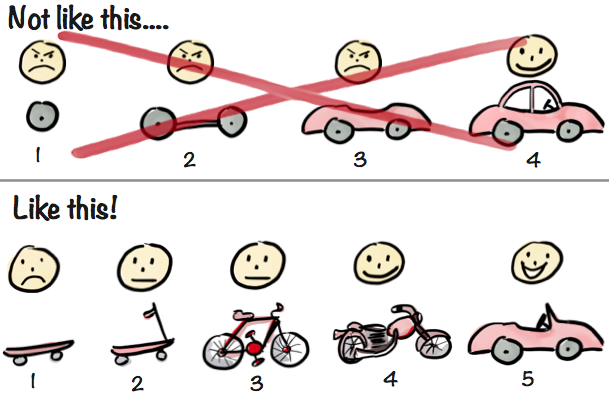
The top row shows a common mistake: building a product in isolated, unusable pieces. A single tire doesn't help someone who wants to get from point A to B. The customer is unhappy until the very end.
The bottom row shows the MVP approach. The core need is "I need to get from A to B." The first thing delivered is a skateboard. Is it a car? No. But is it a viable solution to the core problem? Yes. It's the minimum thing you can build that is also a complete, usable product. From there, you can gather feedback and iterate, improving to a scooter, then a bicycle, and so on.
To see this concept explained in more detail, watch the following video.
Making sense of MVP (Minimum Viable Product)
The video "Making sense of MVP (Minimum Viable Product)" provides a clear, narrated walkthrough of the skateboard-to-car analogy.
Watch the video from the beginning until the end. Pay close attention to how the narrator distinguishes between an unusable part (a tire) and a simple but functional solution (a skateboard) from the two examples. Then listen to his concluding question from the final summary: "What's your skateboard?"
This is the question we will now answer for your first video project. What is the "skateboard" version of one of your personal video essays?
Defining Your Minimum Viable Video (MVV)
Based on the MVP principle, a Minimum Viable Video is the simplest possible video that still feels like a complete, satisfying experience for a viewer. It's not a broken piece; it's a finished, albeit small, story. We can define it by its three core components: Scope, Idea, and Structure.
1. The Scope: 1-2 Minutes
Your MVV will be short. A length of 1-2 minutes is the perfect container for a first project. It's long enough to express a complete thought but short enough to be manageable across all five production stages.
This is not a limitation on your creativity; it's a focusing lens. Powerful stories can be told in very little time.

As a practical guideline, a standard speaking pace is about 150 words per minute. This gives us a tangible target for the "Idea" stage.
This academic guide for creating video essays provides a useful benchmark for connecting script length to video length.
Read the introductory paragraphs. Pay special attention to the bulleted list that gives equivalent video lengths for different essay word counts. While your project is much smaller, this demonstrates the direct link between the words you write and the final video's duration.
So, for your 1-2 minute MVV, you'll be aiming to write a script of approximately 150-300 words. This transforms the daunting task of "making a video" into the much more manageable task of "writing a single page of text."
2. The Idea: A Single, Simple Focus
The most common mistake when scripting is trying to say too much at once. Your MVV must be built around a single, simple idea. This is the "1 subject = 1 video" rule.
Script writing for social media videos
This guide on script writing offers a golden rule that is perfectly suited for defining the scope of our MVV.
In this PDF, find the section titled "3. Do one thing at a time". Read this short section carefully, from the main rule to its explanation. This principle is your primary defense against an overly complicated first video.
For your video essays, this means resisting the temptation to tell your entire life story. Instead, focus on a single moment, a single lesson learned, or a single change in perspective.
- Instead of: "My journey with meditation."
- Try: "The first time I successfully meditated for 10 minutes and what it felt like."
- Instead of: "The importance of protecting the environment."
- Try: "A single moment on the island where I live that made me feel connected to nature."
Confining yourself to one simple idea makes the entire process more manageable and results in a clearer, more impactful video.
3. The Structure: A Complete, Simple Story
This is the most crucial part. For a video to be viable, it needs to feel complete. It needs a beginning, a middle, and an end. It needs to tell a story.
You've mentioned that storytelling feels intimidating, which is a very common feeling. The good news is that a compelling story structure doesn't need to be complex. A creator named Tim Runia developed a "stupidly simple" method using just five lines. This will be our blueprint for a "viable" story.
The ONLY 5 Lines You Need To Tell Any Story
This video, "The ONLY 5 Lines You Need To Tell Any Story," breaks down narrative structure into a simple, non-intimidating framework.
Watch the video from the beginning, focusing on these key segments: First, watch the introduction where he describes the problem of overthinking—it may sound familiar! Next, pay close attention to his explanation of the five lines: Situation, Desire, Conflict, Change, and Result. Finally, see how this applies to a full story by watching his five-line summary of his own YouTube video.
This five-line framework is your "skateboard." A video that contains these five elements, no matter how short, will feel like a complete and satisfying narrative. It has an arc. It moves from one state to another. This is the essence of a viable story.
Conclusion
You now have a clear, actionable definition of your first project. Your Minimum Viable Video is not a compromise—it is a strategic first step designed for completion and learning.
Key Takeaways:
- A Minimum Viable Video (MVV) is the simplest video you can make that tells a complete story. It's your "skateboard."
- Its scope is defined by three constraints:
- Length: 1-2 minutes (around 150-300 words of script).
- Idea: A single, focused subject. Don't try to boil the ocean.
- Structure: A complete narrative arc, which can be outlined with the simple 5-line model (Situation, Desire, Conflict, Change, Result).
By embracing this MVV model for your first project, you are setting yourself up for success. You are creating a project that is small enough to finish, but complete enough to teach you the entire end-to-end process of making a video.
In our next lesson, we'll formalize this approach by exploring the "Done is Better than Perfect" mindset and how to apply it practically to the five stages of production we've already learned. This will be the final piece of our mental toolkit before we begin brainstorming the specific idea for your first video essay.