Welcome to the first lesson of our new module on parametric surfaces. In the previous module, we explored how to describe one-dimensional curves in space using a single parameter, . We saw how a vector function can trace everything from simple lines to the structurally perfect catenary arch. Now, we will expand this powerful idea into the next dimension.
In this lesson, we will transition from curves to surfaces by introducing a second parameter. You will learn how to express a three-dimensional surface using a vector-valued function of two parameters, and . This concept, , is the mathematical foundation for creating the complex, free-form geometries that are hallmarks of contemporary parametric architecture.
From One Parameter to Two: Defining a Surface
Just as a parametric curve is the set of all points generated by as varies over an interval, a parametric surface is the set of all points generated by as the pair varies over a two-dimensional region, often called the parameter space or domain.
Imagine you have a flat, rectangular sheet of stretchable material. The coordinates identify a point on this flat sheet. A parametric function acts as a rule that takes each point from the flat sheet and maps it to a unique point in 3D space. As you map every point from the sheet, you "form" the 3D surface.
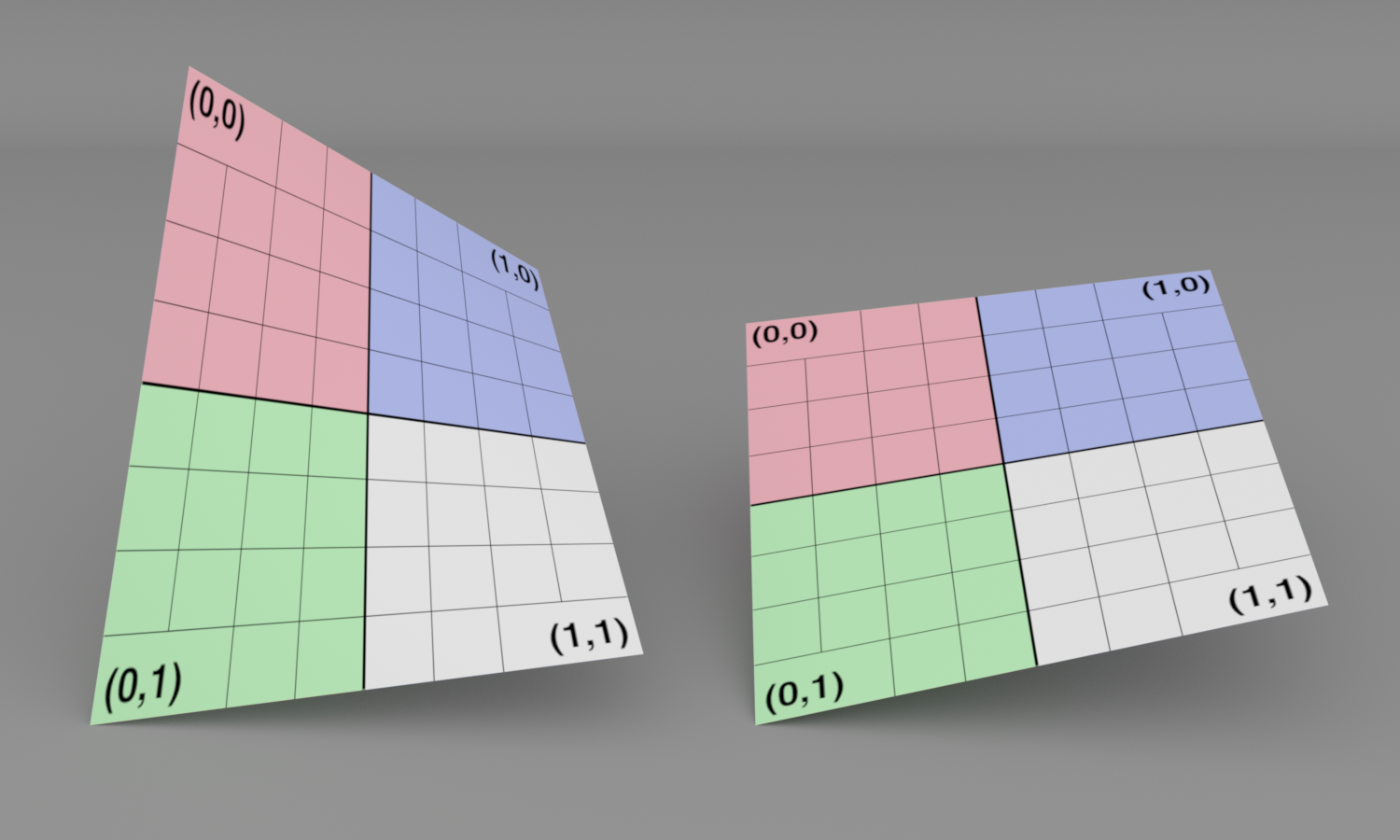
This concept of a -coordinate system on a surface is fundamental in 3D modeling, including software like Blender. These are the "UV coordinates" used for applying textures to a 3D model. Here, we are using them to define the geometry itself.
The following video provides an excellent introduction to the three ways surfaces can be described mathematically—explicitly, implicitly, and parametrically—and makes a strong case for why the parametric form is so powerful.
Describing Surfaces Explicitly, Implicitly & Parametrically // Vector Calculus
This video from Dr. Trefor Bazett elegantly introduces the different ways to describe surfaces, setting the stage for why parametric representations are so crucial in vector calculus and design.
Introduction: Watch the first minute, "what we mean by that", to understand the concept of a surface as a two-dimensional object embedded in 3D space. Review of Curves: The review of how curves are described from "between a and b" provides a perfect bridge from our last module. Surfaces in 3D: Pay close attention to the segment from "between a c and a d", which formally introduces the parametric form \vec{r}(u,v) and the idea of a parameter domain.
To solidify this foundational idea, the following article provides a clear, written explanation.
Parametric functions, two parameters (article) | Khan Academy
This Khan Academy article clearly explains the transition from one-parameter functions for curves to two-parameter functions for surfaces.
Read the first two sections, starting from the beginning down to the end of the table. This will formalize the definition of \vec{r}(u,v) and its component functions x(u,v), y(u,v), z(u,v).
Strategies for Parameterizing Surfaces
The main challenge is not understanding the definition, but learning how to find the parametric equations for a given surface. This process is called parameterization. The strategy you choose often depends on the geometry of the surface. We'll explore the most common approaches.
For a comprehensive guide with several worked examples, the following resource is invaluable. We will refer to it throughout this section.
Calculus III - Parametric Surfaces
This text from Paul's Online Math Notes is a concise yet thorough tutorial on how to parameterize common surfaces. It will be our primary guide for the examples below.
First, read the introductory section to see the formal definition of a parametric surface and its representation, from the beginning down to the first example. Then, as we discuss each case below, you can refer to the corresponding examples in this document.
Case 1: Explicit Surfaces
If a surface is given as an explicit function, like , the parameterization is straightforward. We can simply let our parameters be and .
Let and .
Then the parametric representation is:
Example: A Paraboloid
Consider the paraboloid .
Using the strategy above, a valid parameterization is .
While correct, this parameterization isn't always the most useful, especially for surfaces with rotational symmetry. A more natural choice often involves using a coordinate system that reflects that symmetry. For the paraboloid, its circular cross-sections suggest that cylindrical coordinates would be a better fit.
If we let and , then .
This gives a more elegant parameterization:
Here, represents the radius from the z-axis, and represents the angle of rotation.
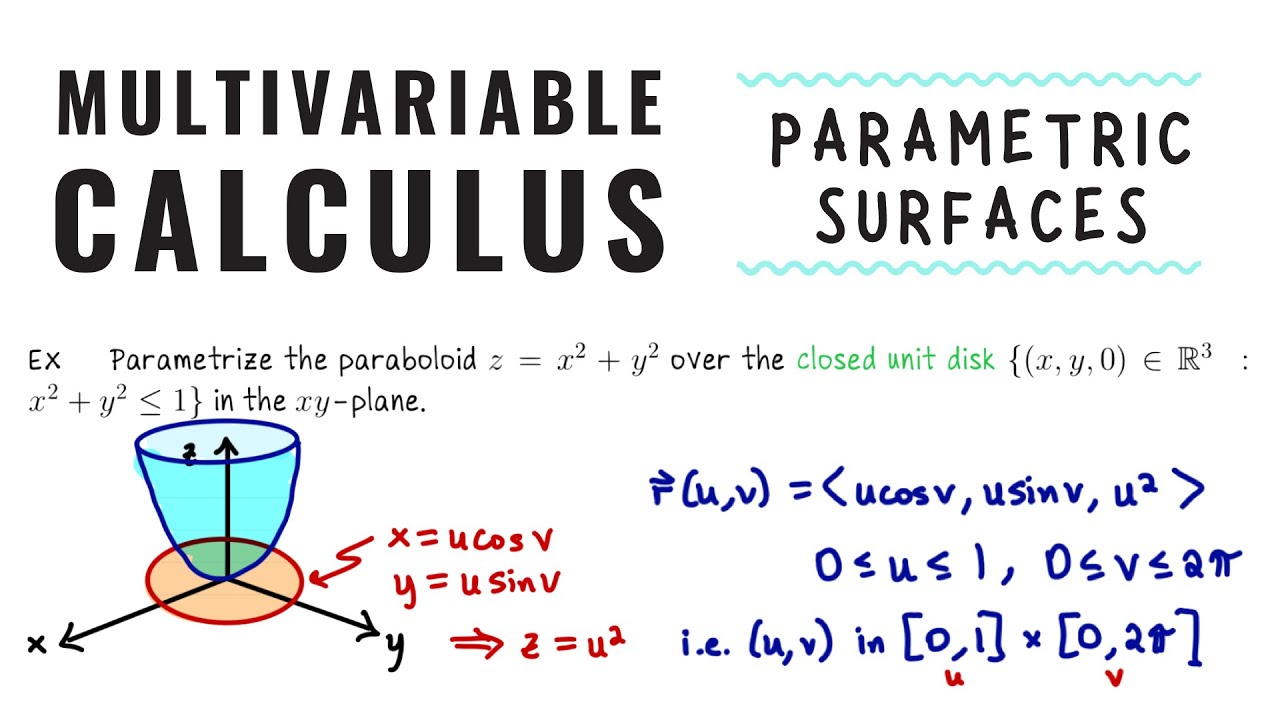
Refer to Example 2a in the "Parametric Surfaces" reading and watch the following video segment for a walkthrough of this technique.
Calculus 3: Parametric Surfaces and Their Areas (Video #32) | Math with Professor V
This video by "Math with Professor V" explains how to handle surfaces that are already defined as functions.
Watch the explanation on parameterizing explicit functions. Then, see how this is applied to a paraboloid example from the paraboloid example.
Case 2: Surfaces with Natural Coordinate Systems
For common geometric primitives used in architecture—spheres, cylinders, cones—it's almost always best to use the coordinate system that matches their intrinsic geometry.
-
Cylinder: For a cylinder of radius aligned with the z-axis, its equation is . We use cylindrical coordinates.
- Parameters: height and angle .
- Equations: , , .
- Vector Form: .
- The domain is typically and some interval for that defines the cylinder's height.
-
Sphere: For a sphere of radius centered at the origin, we use spherical coordinates.
- Parameters: angles (or ) and (or ).
- Equations: , , .
- Vector Form: .
- The standard domain is and .
You can find detailed derivations for the sphere and cylinder in Examples 2c and 2d of the "Parametric Surfaces" reading from Paul's Online Math Notes. The following video also provides excellent walkthroughs.
Calculus 3: Parametric Surfaces and Their Areas (Video #32) | Math with Professor V
Professor V demonstrates how to parameterize a cylinder and a sphere.
For the cylinder, watch the segment from the cylinder example. For the sphere, watch from the sphere example.
The key insight is to choose parameters that "naturally" describe the surface. For a sphere, we naturally think of its latitude and longitude—two angles. For a cylinder, we think of its height and a rotation angle. This choice not only simplifies the equations but also provides a more intuitive way to control the shape, a core tenet of parametric design.
Grid Lines
A great way to visualize a parametric surface is to consider its grid lines (or traces). These are the curves on the surface that you get by holding one parameter constant and letting the other vary.
- The curves where is a constant are called -curves.
- The curves where is a constant are called -curves.
For the cylinder :
- Holding constant gives horizontal circles (the -curves).
- Holding constant gives vertical lines along the cylinder's side (the -curves).
This concept is explained visually in the following clip.
Calculus 3: Parametric Surfaces and Their Areas (Video #32) | Math with Professor V
This short segment explains the concept of grid lines using the cylinder example.
Watch the explanation from "Grid lines".
Conclusion
In this lesson, we have made the crucial leap from one-dimensional curves to two-dimensional surfaces. By employing a vector function of two parameters, , we can precisely define the location of every point on a surface, effectively mapping a flat 2D domain into a 3D form.
Here are the key takeaways:
- A parametric surface is defined by a vector function . The parameters come from a 2D domain.
- The process of finding this function for a given shape is called parameterization.
- A simple strategy for explicit surfaces like is to use and as the parameters: .
- A more powerful strategy, especially for shapes with rotational symmetry like spheres and cylinders, is to use parameters from a more suitable coordinate system (spherical or cylindrical).
- Holding one parameter constant generates curves, or grid lines, on the surface, which correspond to the UV grid in 3D modeling.
We now have the tool to describe a surface. In our next lesson, we will begin to analyze it. We will learn how to calculate the surface normal vector by taking partial derivatives of our parametric function . The normal vector is essential for understanding a surface's orientation, which has profound implications for architectural design, from creating offset surfaces for shells to simulating how light reflects off a facade.