Welcome to the final lesson in our module on parametric curves. We have journeyed through the foundational tools of digital design—from the building blocks of Bézier curves and the versatile B-splines to the all-encompassing power of NURBS. These are mathematical constructs, tools invented by engineers and computer scientists to control shape. Now, we will turn our attention to a curve not born from a formula, but from the laws of physics itself: the catenary.
In this lesson, you will discover the mathematical definition of this unique curve, which is elegantly formed by something as simple as a hanging chain. More importantly, we will explore why this natural shape represents a pinnacle of structural efficiency, forming the basis for some of the most enduring and beautiful arches and shells in architecture.
The Shape of a Hanging Chain
What shape does a flexible chain or rope make when it hangs between two points under its own weight? For centuries, many great minds, including Galileo, assumed the answer was a parabola. While visually similar, the true shape is a distinct curve called a catenary, from the Latin word catena, meaning "chain."
The key distinction lies in the distribution of the load. As the image below illustrates, a cable loaded uniformly along the horizontal (like the main cable of a suspension bridge, where the vertical hangers are closely spaced and the heavy deck is the dominant load) forms a parabola. A cable loaded uniformly along its own length (like a simple chain hanging under its own weight) forms a catenary.
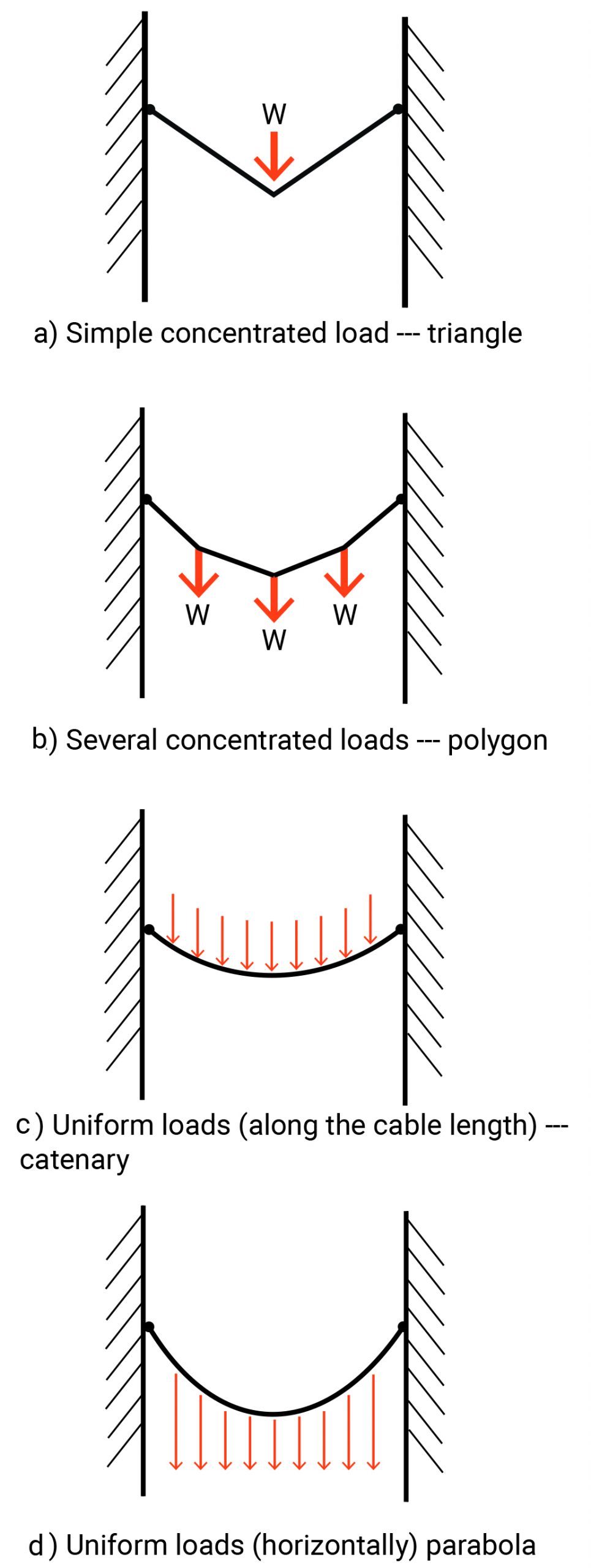
This seemingly subtle physical difference results in a fundamentally different mathematical description.
Catenary Curve (Mathematics) – Study Guide | StudyGuides.com
This study guide provides a concise definition of the catenary and clarifies the common confusion with the parabola.
Please read the first entry, "What is the catenary curve?", for a formal definition. Then, scroll down and read the three entries starting from "What is the shape..." to understand the key mathematical distinction between a catenary and a parabola.
The Physics and Mathematics of the Catenary
Since the catenary is a shape dictated by static equilibrium, we can derive its equation by analyzing the forces acting on it. Given your background in physics and mathematics, the derivation from first principles will be both accessible and illuminating. It involves balancing the tension forces and the gravitational force on an infinitesimal segment of the chain.
The following video provides an excellent, step-by-step derivation of the catenary's differential equation and its solution.
How Do You Find The Shape of Hanging Rope? Classic Physics Problem
This video from the "Physics with Elliot" channel walks through the classic physics problem of finding the shape of a hanging rope.
Watch the following segments to understand the derivation: The Setup: Watch from the beginning to the horizontal tension constant. This part breaks down a rope into small segments and identifies the forces involved: tension and gravity. Forming the Equation: Continue from the vertical force balance. This section relates the components of tension to the slope of the curve, ultimately deriving a second-order differential equation for the rope's shape, y(x). Solving the Equation: Watch from the mathematical solution. This is the core of the derivation, where the differential equation is solved using separation of variables, leading to the introduction of hyperbolic sine (sinh) and hyperbolic cosine (cosh) functions.
As the video demonstrates, the solution to the differential equation describing the hanging chain is a hyperbolic cosine function. The standard equation for a catenary, with its lowest point (vertex) at , is:
Here, the parameter is a constant that defines the "flatness" of the curve. Physically, it represents the ratio of the horizontal component of tension at the vertex to the weight per unit length of the chain (). A larger value of corresponds to higher tension and a flatter curve, while a smaller value of corresponds to lower tension and a more pronounced 'U' shape.
For a more detailed written derivation that you can follow at your own pace, the "Introductory Statics" resource provides an excellent alternative.
1. Introductory Statics: the Catenary and the Arch
This document by Michael Fowler offers a rigorous mathematical derivation of the catenary equation from static equilibrium principles.
Read the section from the beginning down to the final derived equation, "The Catenary". This will reinforce the concepts from the video using a slightly different, but equally valid, approach.
Structural Efficiency: The Ideal Arch
The true genius of the catenary for architecture lies not in its hanging form, but in its inverted one.
A hanging chain is in a state of pure tension. The force at any point along the chain is directed perfectly tangent to the curve. There are no shear or bending forces; each link simply pulls on its neighbors along the line of the curve.
In the 17th century, the scientist Robert Hooke had a profound insight: if you invert the shape of a hanging chain, you create a structure that is in a state of pure compression. As he famously stated, "As hangs the flexible line, so but inverted will stand the rigid arch."

This is the principle of the "ideal arch." Materials like stone, brick, and unreinforced concrete are exceptionally strong under compression but very weak under tension. A catenary arch directs the entire load of its own weight (and any uniformly distributed load above it) downwards along the curve's path, squeezing the blocks together. There are no internal forces trying to push the arch sideways (shear) or bend the blocks, which would create tension. This makes the catenary the most materially efficient shape possible for a masonry arch.
The following video beautifully illustrates Hooke's discovery and its revolutionary impact on architecture.
How Upside-Down Models Revolutionized Architecture
This video by architect Stewart Hicks explains the history and application of using upside-down models, focusing on the catenary.
Watch the segment explaining Robert Hooke's discovery. This part visualizes how a chain in tension becomes a perfect compression system when inverted. Then, watch the segment on Antoni Gaudí's models. This shows the most famous architectural application of this principle, where Gaudí used complex hanging chain models to design the intricate, branching columns of his churches.
Antoni Gaudí's work, particularly his models for the Colònia Güell church and the Sagrada Família, remains the most celebrated use of this principle. He constructed elaborate models from strings and weights to find these pure compression forms, then translated the inverted shapes into his building designs, creating structures that are both structurally honest and organically beautiful.
Other famous examples include the Gateway Arch in St. Louis, designed by Eero Saarinen. It is technically a weighted catenary, flattened at the top, because the arch is thicker at the base than at the apex. Its shape is described by the equation , a variation of the basic catenary formula adjusted for its specific dimensions and non-uniform mass.
From Arches to Shells
The same principle extends from the one-dimensional line of an arch to a two-dimensional surface. A hanging piece of fabric, like burlap, will form a surface of pure tension. If this shape is inverted, it creates an efficient, thin-shell structure that acts in pure compression. The Swiss engineer Heinz Isler pioneered this method in the mid-20th century, creating remarkable shell structures by freezing water-soaked, hanging textiles and using the resulting shapes as models.
Conclusion
In this lesson, we have seen how a fundamental law of physics gives rise to a curve of extraordinary architectural importance. The catenary is more than just an elegant shape; it is a direct expression of structural honesty.
Here are the main takeaways:
- A catenary is the curve formed by a flexible chain hanging under its own weight, described mathematically by the hyperbolic cosine function: .
- It is distinct from a parabola, which is formed by a load distributed uniformly along a horizontal axis.
- A hanging catenary is in pure tension. When inverted, it becomes an ideal arch shape that is in pure compression.
- This property makes the catenary arch exceptionally efficient for materials strong in compression, like stone and concrete, as it eliminates internal shear and bending stresses. Architects like Antoni Gaudí used this principle to design complex and stable structures.
This concludes our exploration of parametric curves. We have built a strong foundation, moving from the mathematical tools we use to define curves to the physical principles that generate them. In the next module, we will expand our view from one dimension to two, beginning our study of Parametric Surfaces. We will start by learning how to express a surface using two parameters, and , which will open the door to modeling the complex, free-form geometries that define contemporary architecture.