In our last lesson, we established the mathematical language for describing surfaces using a vector function of two parameters, . We now have the ability to define a surface, but to truly work with it, we need to be able to analyze its geometric properties. This lesson moves from description to analysis.
Today, we will focus on one of the most important properties of a surface: its orientation in space. You will learn how to compute the surface normal vector at any point on a parametric surface. This vector, which is perpendicular to the surface, is a cornerstone of 3D graphics and parametric design. It's the key to understanding how light will reflect, how to construct an offset surface for a shell or roof, and how to align components to a curved form. Your background in calculus will be instrumental here as we extend the concept of a derivative into the realm of surfaces.
From Grid Lines to Tangent Vectors
In the previous lesson, we saw that by holding one parameter constant (e.g., ), a parametric surface reduces to a parametric curve that lies on the surface. These are the grid lines.
From single-variable calculus, you know that the derivative of a vector function for a curve, , gives a vector that is tangent to the curve. We can apply the same logic here. The partial derivative of with respect to , which we denote as or , is the tangent vector to the -grid line. Similarly, is the tangent vector to the -grid line.
At any given point on the surface, these two vectors, and , are both tangent to the surface. As long as they are not parallel, they define a plane called the tangent plane.

The following video from Khan Academy provides an excellent conceptual foundation for this idea, explaining how these tangent vectors arise from the parametric definition.
Constructing a unit normal vector to a surface | Multivariable Calculus | Khan Academy
This video, "Constructing a unit normal vector to a surface," explains the geometric intuition behind using partial derivatives to find tangent vectors.
Watch the first part of the video, from the beginning until "slope in that...". Focus on how changing one parameter at a time (like u or v) generates movement along the surface, and how the partial derivative captures the direction of that movement as a tangent vector.
To see this connection between partial derivatives and tangent vectors explored in more detail, the next video offers a helpful visualization.
Partial derivative of a parametric surface, part 2
This video, "Partial derivative of a parametric surface, part 2," animates how a "nudge" in the parameter space results in a tangent vector on the 3D surface.
Watch the first few minutes, from "cause movement in the output space". This will reinforce the idea of a partial derivative as a tangent vector. Then, you can skip to the end of the video from "two different vectors" to see how these two distinct tangent vectors define the tangent plane.
The Normal Vector: A Job for the Cross Product
Now that we have two vectors, and , that lie in the tangent plane, how do we find a vector that is perpendicular to that plane? As you'll recall from our second module, this is precisely what the cross product does.
The cross product yields a new vector that is, by definition, orthogonal to both and . Therefore, this vector is normal to the tangent plane and to the surface itself.
We define the normal vector as:
This vector gives us the orientation of the surface, but its magnitude can vary. For many applications, we need a unit normal vector, , which has a length of 1. To get this, we simply normalize by dividing it by its magnitude:
Let's return to the Khan Academy video to see this final step explained.
Constructing a unit normal vector to a surface | Multivariable Calculus | Khan Academy
The second half of the video completes the construction of the unit normal vector.
Watch from "A normal vector" to see how the cross product is used to find a normal vector. The brief explanation of the right-hand rule from "it would be A..." is important. It determines the direction of the normal (e.g., "outward" or "inward"). Note that \vec{r}_u \times \vec{r}_v points in the opposite direction of \vec{r}_v \times \vec{r}_u. Finally, see how this is all put together to define the unit normal vector from "We have constructed a unit normal vector.".
Calculation Walkthrough
Let's consolidate this into a clear, step-by-step process. The following article from Khan Academy provides an excellent, complete example of calculating the unit normal vector for a specific parametric surface.
Unit normal vector of a surface (article) | Khan Academy
This article provides a step-by-step guide to computing the unit normal vector, mirroring the concepts from the videos.
Read through the article to see a complete calculation. The parameters here are named t and s instead of u and v, but the process is identical. Start with the introduction to formalize the definition. Follow Step 1, which involves finding the partial derivatives and computing their cross product to get a normal vector. Review Step 2, which shows how to normalize this vector to get a unit normal vector. The Summary at the end provides a concise recap of the entire procedure.
Example: Normal of a Cylinder
To further solidify your understanding, let's apply this method to a familiar shape from our last lesson: a cylinder of radius centered on the z-axis. The parametric equation is:
Here, corresponds to the height and corresponds to the angle of rotation.
-
Find the partial derivatives (tangent vectors):
(This vector points straight up, tangent to the vertical grid lines).
(This vector is horizontal, tangent to the circular grid lines).
-
Compute the cross product (normal vector):
We will compute to get an outward-pointing normal.This result makes perfect geometric sense. The normal vector at any point on the cylinder is horizontal () and points radially away from the z-axis.
-
Normalize to get the unit normal vector:
- Find the magnitude of :
- Divide by its magnitude:
- Find the magnitude of :
This final vector has a length of 1 and always points directly away from the center of the cylinder, giving us the precise orientation of the surface at any point.
For a more rigorous treatment and further examples, you can consult the following text on differential geometry.
[PDF] Classical Differential Geometry of Surfaces - Dr. Wolfgang Lindner
This document provides a formal mathematical approach to surface normals, complete with several worked examples. Your math background will make this text accessible and informative.
In Chapter 2, find the subsection "Normal on a Parametric Surface" (page 23). Read the introduction to this subsection starting with the main formula. Then, look at Example 7 (Cylinder) on page 24 to see a calculation that confirms our own derivation above.
Application in Parametric Design
This mathematical procedure is exactly what happens behind the scenes in parametric design software like Grasshopper. When you need to place objects on a curved surface so that they are properly aligned, you are using surface normals.
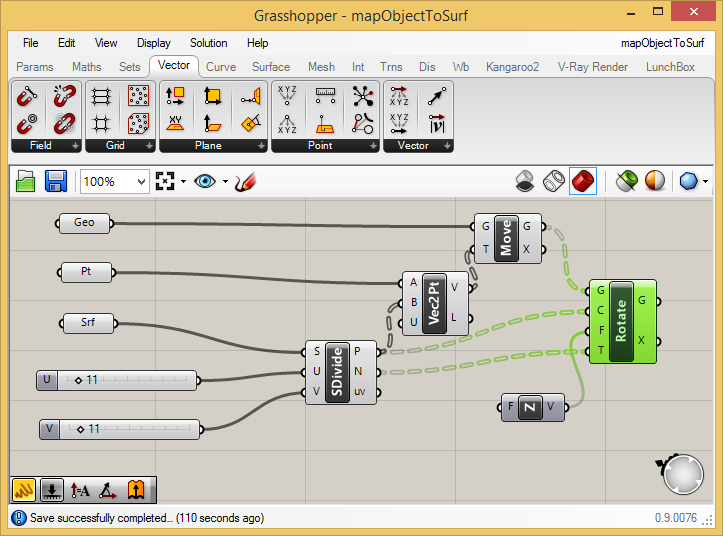
In the script above, the SDivide component takes a surface and calculates a grid of points on it. Crucially, it also outputs the normal vector (N) at each of these points. This list of vectors is then fed into a Rotate component to orient geometry (panels, fins, etc.) so that it sits flush with the surface at that location. Without the normal vector, aligning objects to complex, doubly-curved surfaces would be nearly impossible.
Conclusion
In this lesson, we have developed a robust mathematical method to determine the orientation of a parametric surface at any point. This bridges the gap between simply defining a surface and being able to perform meaningful geometric operations on it.
Key takeaways from today's lesson are:
- The partial derivatives of a parametric surface, and , represent vectors tangent to the surface's grid lines.
- The cross product of these two tangent vectors, , produces a vector that is normal (perpendicular) to the surface.
- To obtain a unit normal vector , which has a length of 1, you must divide the normal vector by its magnitude: .
- The direction of the normal vector (e.g., "inward" vs. "outward") depends on the order of the cross product and is determined by the right-hand rule. This concept is called surface orientation.
- This calculation is fundamental to many operations in 3D modeling and parametric design, especially for aligning objects to curved surfaces.
In our next lesson, we will explore two classic methods for generating parametric surfaces: ruled surfaces and surfaces of revolution. These techniques, which have been used by architects and engineers for centuries, provide powerful and intuitive ways to create complex forms from simple profiles, and we can now analyze them using the tools you've just learned.