Hello! Welcome to our next lesson on the powerful forces that shape our planet.
In the previous lesson, we investigated earthquakes, exploring how the immense stress at plate boundaries is released as seismic energy. We established that the type of plate boundary strongly influences the nature of the earthquakes that occur there. Today, we turn our attention to the other major geological hazard directly linked to plate tectonics: volcanism.
Our learning outcome for this lesson is to explain the mechanisms of volcanism, types of volcanoes, and their relationship to plate boundaries. We will explore why volcanoes form in specific locations, what determines whether an eruption is a gentle flow of lava or a catastrophic explosion, and how these processes create the different types of volcanic mountains we see on Earth.
This lesson will connect directly with your interest in mapping by showing how these dramatic surface features are expressions of deep, planetary processes, creating distinct patterns across the globe.
1. Where and Why Do Volcanoes Form?
Like earthquakes, most volcanoes are not randomly distributed. Their locations are intimately tied to the processes occurring at plate boundaries and a few special areas within the plates. Magma, the molten rock beneath the Earth's surface, is generated in three main tectonic settings.
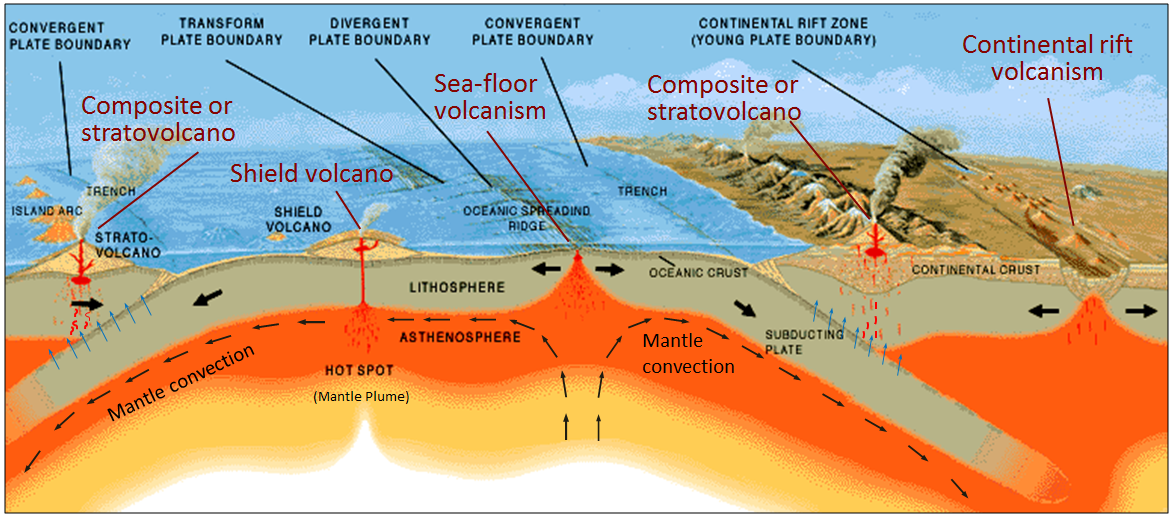
The key to forming a volcano is melting rock to create magma. This happens in several ways:
A. Divergent Boundaries:
Here, tectonic plates are pulling apart. As they separate, the pressure on the underlying hot mantle rock (the asthenosphere) is reduced. This reduction in pressure lowers the melting point of the rock, causing it to melt in a process called decompression melting. This magma, being less dense than the surrounding rock, rises to fill the gap, erupting on the surface.
- Mid-Ocean Ridges: Most divergent boundaries are on the seafloor, where this process creates long chains of undersea volcanoes.
- Continental Rifts: Where continents are pulling apart, such as the East African Rift Valley, decompression melting creates volcanoes on land.
B. Convergent Boundaries (Subduction Zones):
At these boundaries, a dense oceanic plate sinks beneath another plate. As the subducting plate descends, the increasing heat and pressure force water out of the minerals in the oceanic crust. This water rises into the hot mantle rock above, lowering its melting point (much like adding salt to ice lowers its melting point). This process is called flux melting. The resulting magma rises, melting its way through the overlying continental or oceanic crust to feed a line of volcanoes on the surface. This is why the "Ring of Fire" around the Pacific Ocean, a zone of intense subduction, is home to the majority of Earth's active volcanoes.
C. Hotspots (Intraplate Volcanism):
Some volcanoes, like those that form the Hawaiian Islands, are found in the middle of a tectonic plate, far from any boundary. These are caused by mantle plumes—columns of exceptionally hot rock rising from deep within the mantle. As the plume reaches the base of the lithosphere, decompression melting generates a massive amount of magma, creating a "hotspot." As the tectonic plate moves over this stationary hotspot, a chain of volcanoes is formed.
To solidify your understanding of where volcanoes form—and just as importantly, where they don't—please watch the following video and read the accompanying text.
The 4 Tectonic Plate Boundaries and the Hazards they Create
This short video from Simple Geography effectively illustrates why volcanoes form at divergent and convergent boundaries, and crucially, why they are absent at transform and continental-continental collision boundaries.
Watch the following clips: Divergent Boundaries: 1:10 - 1:38 Convergent (Subduction) Boundaries: 1:55 - 2:41 Continental-Continental: 3:58 - 4:11 Transform Boundaries: 4:51 - 5:04 Focus on the simple explanation for the presence or absence of magma at each boundary type.
Now, let's go into more detail on the specific melting processes in these locations.
The text 'Where Volcanoes Are Located' from Opengeography.org provides a great written summary of the three main settings for volcanism we've just discussed.
Please read the sections titled 'VOLCANOES ALONG CONVERGENT PLATE BOUNDARIES,' 'VOLCANOES ALONG DIVERGENT PLATE BOUNDARIES,' and 'VOLCANIC HOTSPOTS.' Pay close attention to the descriptions of how melting occurs in each setting.
2. The Mechanism: Magma Composition and Eruption Style
Why are some volcanic eruptions gentle, with lava flowing calmly for kilometers, while others are devastatingly explosive? The answer lies in the composition of the magma itself.
First, let's clarify two terms:
- Magma: Molten rock beneath the Earth's surface.
- Lava: Molten rock that has erupted onto the Earth's surface.
The two most important properties of magma that determine eruption style are its viscosity and its volatile (gas) content.
Viscosity is a fluid's resistance to flow. For magma, viscosity is primarily controlled by its silica () content:
- Mafic Magma: Low in silica, low viscosity (runny, like honey). Gases can escape easily.
- Felsic Magma: High in silica, high viscosity (thick and sticky, like toothpaste). It traps gases.
This leads to two primary eruption styles:
- Effusive Eruptions: Fed by low-viscosity mafic magma. The runny magma allows volcanic gases to escape easily. This leads to relatively gentle eruptions where lava pours or fountains out and flows across the landscape.
- Explosive Eruptions: Fed by high-viscosity felsic magma. The sticky magma traps gases (mostly water vapor and carbon dioxide). As the magma rises, the pressure decreases, and these trapped gases expand dramatically. When the pressure becomes too great, it results in a violent explosion that shatters the magma into ash and rock fragments, creating dangerous phenomena like pyroclastic flows—fast-moving avalanches of hot ash, rock, and gas.
You can think of it like opening a bottle of soda. If you open it slowly, the gas escapes gently (effusive). If you shake it up first (building pressure) and then open it, the gas expands rapidly and forces the liquid out explosively.
Let's read a more detailed explanation of this crucial relationship.
This reading from Opengeography.org clearly explains how magma composition, viscosity, and gas content control whether an eruption is explosive or effusive.
Read the entire section, starting from 'It should first be noted that magma is molten material...' down to the end of 'EFFUSIVE ERUPTIONS.' Focus on the relationship between silica, viscosity, and eruption type.
3. The Result: Types of Volcanoes
The location of a volcano (tectonic setting) determines the type of magma it receives, and the magma type determines the eruption style. Over thousands of years, these eruption styles build up distinctively shaped volcanoes.
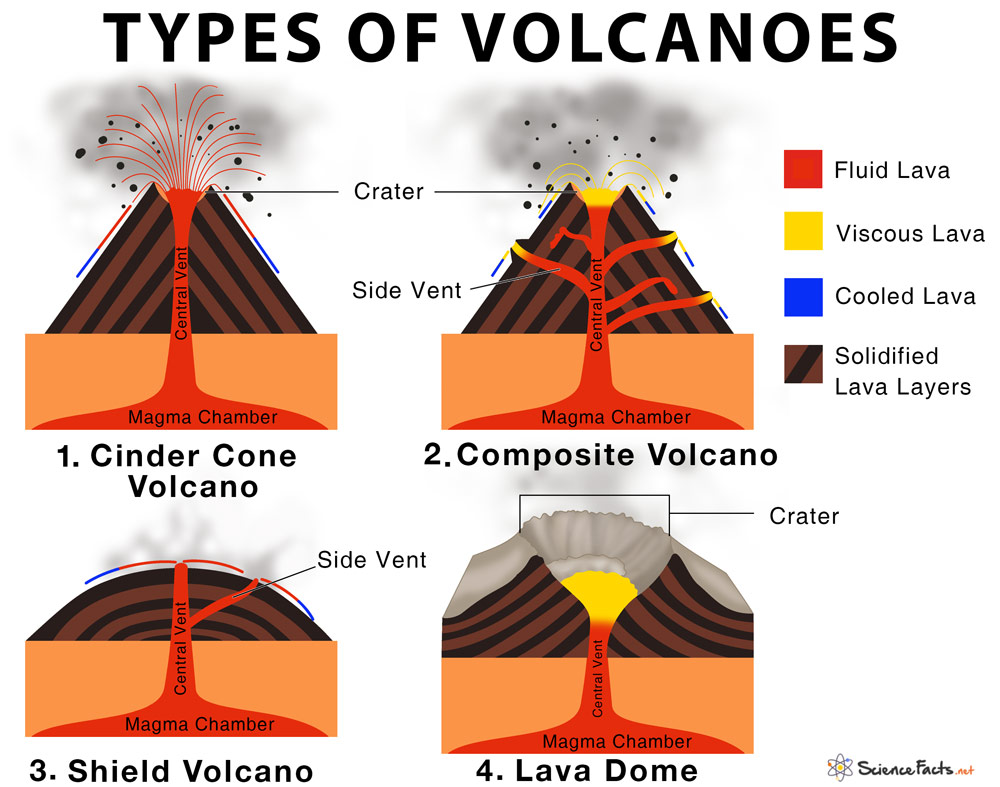
Let's begin with a video overview of the three main types of volcanoes.
Volcanoes: Formation, Types, and Activity
Professor Dave Explains provides a dynamic and clear introduction to the main types of volcanoes and their characteristics.
Please watch the following segments on the three main volcano types: Cinder Cones: 4:10 - 6:16 Composite (Stratovolcanoes): 6:16 - 8:42 Shield Volcanoes: 8:42 - 9:24 As you watch, note the connection between the volcano's shape, its eruptive style, and the examples given.
Now that you've seen the overview, let's solidify the details. Here is a summary of the characteristics of the three main types of volcanoes.
| Volcano Type | Shape & Size | Magma Type & Viscosity | Eruption Style | Tectonic Setting | Example |
|---|---|---|---|---|---|
| Shield Volcano | Very large, broad, with gentle slopes (<10°) | Mafic (low silica, low viscosity) | Effusive; fluid lava flows travel long distances | Hotspots, Divergent Boundaries | Mauna Loa, Hawaii |
| Composite Volcano (Stratovolcano) | Large, steep-sided cone (~30°) | Felsic/Intermediate (high viscosity) | Explosive; ejects ash, gas, pyroclastic flows. Can also have viscous lava flows. | Convergent Boundaries (Subduction Zones) | Mt. Fuji, Mt. St. Helens |
| Cinder Cone | Smallest type, steep sides, often with a summit crater | Gas-rich mafic magma | Explosive bursts of cinders and volcanic bombs | Flanks of larger volcanoes, continental rift zones | Parícutin, Mexico |
For a more detailed written description of each type, please refer back to the Opengeography resource.
This section of the Opengeography text provides detailed descriptions that complement the video you just watched.
Read the subsections titled 'COMPOSITE VOLCANOES,' 'SHIELD VOLCANOES,' and 'CINDER CONES.' As you read, mentally connect the descriptions back to the table above.
Test your understanding!
You are a volcanologist studying a newly discovered, active volcano on another planet. You observe the following:
- It is an enormous mountain with very gentle slopes.
- Eruptions consist of fast-moving, fluid lava flows that travel for many kilometers.
- The volcano is located in the middle of a tectonic plate, far from any boundary.
- What type of volcano is this?
- What kind of magma (mafic or felsic) is likely feeding it?
- What is the most probable geological cause of this volcano?
Show answer
- Based on its enormous size and gentle slopes created by fluid lava flows, this is a shield volcano.
- The fluid, fast-moving lava indicates it is fed by low-viscosity mafic magma.
- Its location in the middle of a plate strongly suggests it is formed by a mantle plume or hotspot, similar to the Hawaiian volcanoes on Earth.
Conclusion
In this lesson, we have connected the deep engine of plate tectonics to the dramatic volcanic features on Earth's surface. You now have a framework for understanding not just what a volcano is, but why it exists in a certain place and behaves in a certain way.
Key Takeaways:
- Volcanism is primarily found at divergent boundaries (decompression melting), convergent subduction zones (flux melting), and hotspots (mantle plumes).
- The style of an eruption is controlled by magma's viscosity and gas content, which are determined by its silica percentage. Low-viscosity mafic magma leads to effusive eruptions, while high-viscosity felsic magma causes explosive eruptions.
- The three main types of volcanoes—shield, composite (strato), and cinder cone—are built from different magma types and eruption styles, giving them their characteristic shapes and associating them with specific tectonic settings.
Preview of the Next Lesson:
We have now examined earthquakes and volcanoes as separate phenomena. In our next lesson, we will synthesize this knowledge to analyze the global distribution of tectonic hazards. We will use maps to visualize the overlapping patterns of earthquakes and volcanoes, reinforcing the overarching theory of plate tectonics and highlighting the regions of our world most at risk from these powerful geological forces.