Hello! Welcome back to our journey into physical geography.
In our last lesson, we established the Earth's basic properties: its shape as an oblate spheroid and its two primary motions, rotation and revolution. We noted that the Earth's axis is tilted at about 23.5 degrees, a seemingly small detail with enormous consequences.
Today, we will connect that axial tilt with the Earth's revolution around the Sun. Our goal is to explain exactly how this tilt causes the seasons. You'll learn why we experience warm summers and cold winters, why days get longer and shorter throughout the year, and why the seasons are reversed in the Northern and Southern Hemispheres. This is a foundational concept in climatology, an area you expressed a keen interest in, and it governs the distribution of life and weather patterns across the globe.
1. Debunking a Common Misconception: Distance Doesn't Cause Seasons
It's a common and logical-sounding idea that we have summer when the Earth is closer to the Sun and winter when it's farther away. As we learned, the Earth's orbit is an ellipse, not a perfect circle, so our distance from the Sun does vary. The point when Earth is closest to the Sun is called perihelion, and the point when it is farthest is called aphelion.
However, the timing of these events tells a different story. In the Northern Hemisphere, we experience winter in January, which is precisely when the Earth is at perihelion (closest to the Sun!). We experience summer in July when the Earth is at aphelion (farthest from the Sun). This directly contradicts the idea that distance is the cause of the seasons.
The following video explains this counter-intuitive fact and sets the stage for the real cause.
Reasons for Earths Seasons | Physical Geography with Professor Patrich
Professor Jeremy Patrich clearly explains the concepts of perihelion and aphelion and why the Earth's distance from the Sun is not the primary reason for our seasons.
Watch the segment from 18:15 to 20:30. Focus on the dates of perihelion and aphelion and how they relate to the seasons in the Northern Hemisphere.
So, if it's not distance, what is it? The answer lies in two key consequences of the Earth's axial tilt: the intensity of solar radiation and the duration of daylight.
2. The Real Causes: Sunlight Intensity and Duration
The seasons are a direct result of the varying amount of solar energy that different parts of the Earth receive throughout the year. This variation is controlled by two main factors:
- Intensity (Angle of Sunlight): When sunlight strikes the Earth's surface at a high angle (closer to 90°, or perpendicular), the energy is concentrated in a small area, making it very intense and effective at heating the ground. When it strikes at a low angle, the same amount of energy is spread out over a much larger area, so its heating effect is weaker.
- Duration (Length of Day): The longer the period of daylight, the more time there is for the Sun's energy to be absorbed and heat the surface.
The following video provides an excellent analogy using a flashlight to explain the concept of intensity, which is critical to understanding why the seasons change.
Reasons for Earths Seasons | Physical Geography with Professor Patrich
This segment of the same video uses a simple but effective flashlight analogy to demonstrate how the angle of light affects its intensity.
Please watch from 02:59 to 06:05. Pay close attention to the diagram with the flashlight and the globe. Notice how the same beam of light covers a small, concentrated area when perpendicular, but a large, diffuse area when at an angle.
So, the fundamental driver of the seasons is the change in sunlight intensity and duration. But what mechanism causes these two factors to change throughout the year? This is where the axial tilt comes into play.
3. The Mechanism: Axial Tilt and Parallelism
As we learned, the Earth's axis is tilted about 23.5° away from being perpendicular to its orbital path (the plane of the ecliptic). Crucially, this tilt remains fixed in the same direction as the Earth revolves around the Sun. This phenomenon is called axial parallelism—the axis always points toward the same spot in space (near the star Polaris, the North Star).
Because of this constant, parallel tilt, the hemisphere angled towards the Sun receives more direct sunlight (higher intensity) and experiences longer days (greater duration). Six months later, as the Earth has moved to the other side of its orbit, that same hemisphere is now angled away from the Sun, leading to less direct light and shorter days.
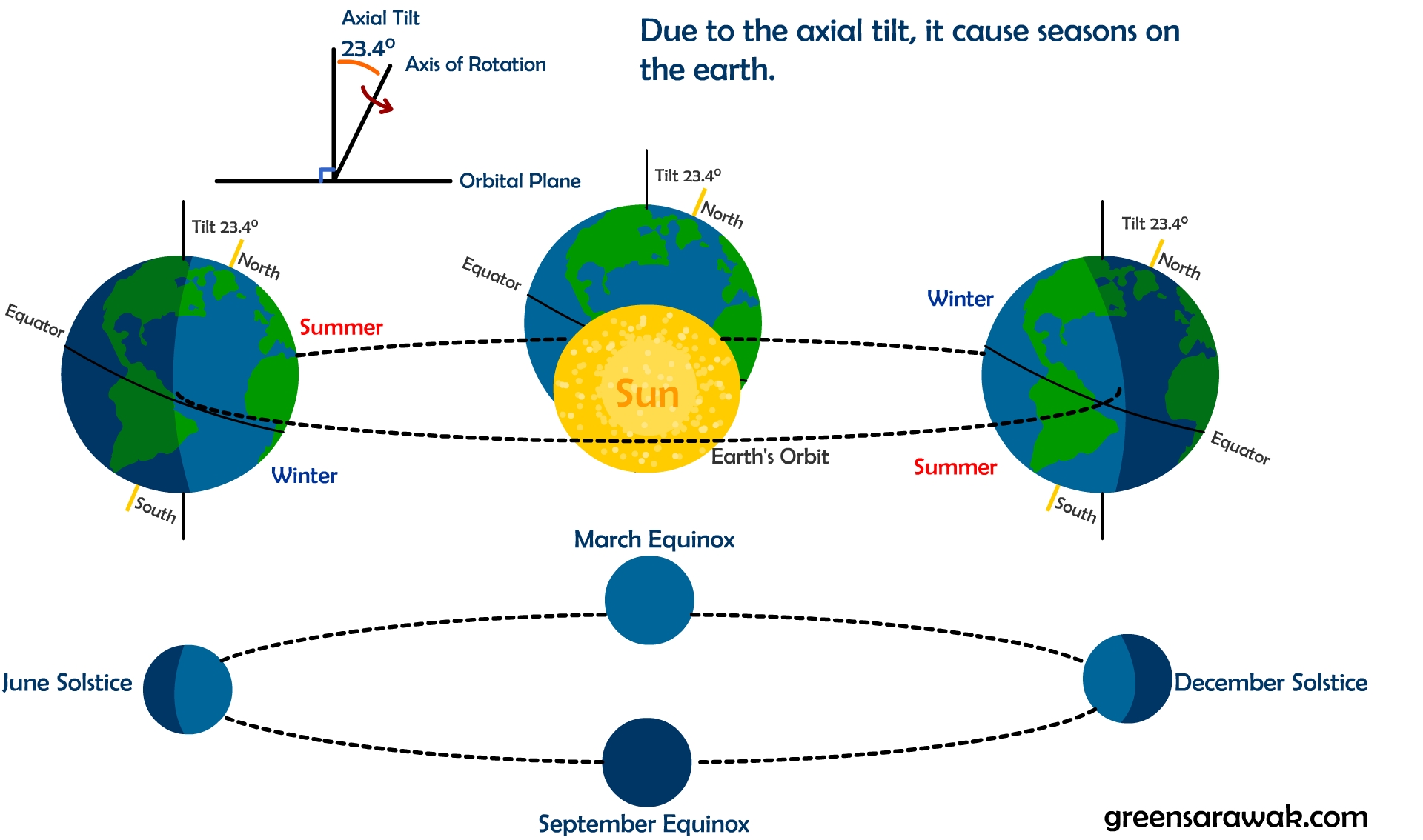
This combination of revolution, tilt, and parallelism creates a predictable, yearly cycle. Let's now explore the four key points in this cycle.
4. A Year in the Life: Solstices and Equinoxes
The Earth's orbit is marked by four key events that define our seasons: two solstices and two equinoxes. A useful concept for understanding these events is the subsolar point: the single point on Earth's surface where the Sun's rays are striking at a perfect 90° angle (i.e., the Sun is directly overhead). The seasonal migration of this point is what drives the change in seasons.
The following video provides a clear, systematic walkthrough of the entire seasonal cycle, explaining what happens at each key date.
Equinoxes and Solstices : for UPSC
This comprehensive video from Clarity of Concept UPSC will guide you through the annual journey of the Earth, explaining the solstices and equinoxes in detail. It clearly illustrates the movement of the subsolar point and the resulting changes in day length.
Watch the video from 01:36 to 11:15. This is the core of our lesson. Follow along as the video explains: The significance of the 23.5° tilt and axial parallelism. The concept of the subsolar point. The Summer Solstice (June 21), when the subsolar point is at the Tropic of Cancer. The Autumnal Equinox (Sept 23), when it is at the Equator. The Winter Solstice (Dec 22), when it is at the Tropic of Capricorn. The Spring (Vernal) Equinox (March 21), as it returns to the Equator.
To summarize and reinforce what you just watched, here are the key events for the Northern Hemisphere:
-
Summer Solstice (around June 21):
- The North Pole is at its maximum tilt toward the Sun.
- The subsolar point is at the Tropic of Cancer (23.5°N).
- This is the longest day of the year in the Northern Hemisphere.
- Areas north of the Arctic Circle (66.5°N) experience 24 hours of daylight.
-
Autumnal Equinox (around September 23):
- The Earth's axis is tilted "sideways" relative to the Sun; neither pole is tilted toward it.
- The subsolar point is directly over the Equator (0°).
- Day and night are of equal length (approximately 12 hours) everywhere on Earth.
-
Winter Solstice (around December 22):
- The North Pole is at its maximum tilt away from the Sun.
- The subsolar point is at the Tropic of Capricorn (23.5°S).
- This is the shortest day of the year in the Northern Hemisphere.
- Areas north of the Arctic Circle experience 24 hours of darkness.
-
Vernal (Spring) Equinox (around March 21):
- Identical to the Autumnal Equinox, with the subsolar point at the Equator.
- Signals the beginning of spring as days begin to lengthen towards summer.
To review these concepts in a textual format, the following reading provides a concise summary.
This page from Geo LibreTexts provides a clear summary of the Earth-Sun relationships that cause the seasons, reinforcing the concepts from the video with helpful diagrams.
Please read the entire page, starting from the introduction and covering the sections on Northern Hemisphere Summer, Winter, and Equinox. This will solidify your understanding of the solstices, equinoxes, and the role of the Tropics and Circles.
Test your understanding!
It is December 22nd. You are an explorer standing at a location in the Southern Hemisphere, specifically on the coast of Antarctica at a latitude of 70°S.
- What season is it for you?
- Based on the Earth's tilt on this day, what would you observe about the Sun's movement over a 24-hour period?
- On this same day, what is happening at the Arctic Circle (66.5°N)?
Show answer
- It is the Summer Solstice for the Southern Hemisphere. The South Pole is tilted maximally toward the Sun.
- Since your location (70°S) is south of the Antarctic Circle (66.5°S), you would experience 24 hours of continuous daylight. The Sun would circle the sky, never dipping below the horizon. This is often called the "Midnight Sun."
- On this day, the Arctic Circle is experiencing its Winter Solstice. The entire region north of 66.5°N is tilted maximally away from the Sun and experiences 24 hours of darkness.
Conclusion
In this lesson, we have untangled one of the most fundamental processes shaping our planet's environment. You now have a systematic understanding of how the seasons are a direct consequence of planetary mechanics.
Key Takeaways:
- Seasons are caused by the Earth's 23.5° axial tilt combined with its revolution around the Sun, not by its distance from the Sun.
- The key effects of the tilt are variations in the intensity (angle of sunlight) and duration (length of day) of solar energy reaching the surface.
- Axial parallelism ensures a predictable annual cycle as different hemispheres are tilted toward or away from the Sun.
- The solstices represent the extremes of this cycle (longest/shortest days), while the equinoxes represent the points of balance (equal day and night).
In our next lesson, we will move on to the third learning outcome for this module: defining and locating points on Earth's surface using latitude and longitude. Now that we understand the Earth's shape, motion, and the key lines defined by its relationship with the Sun (Equator, Tropics), we can build the coordinate system—the geographic graticule—that allows us to map our world with precision.