Hello! Welcome to the first lesson of your course on geography. I'm excited to embark on this journey with you.
This course is designed to be a systematic exploration of physical geography, mapping, and GIS, moving from foundational principles to more complex applications. Our goal is to build a deep, conceptual understanding, moving away from rote memorization.
We begin with Module 1: Earth's Foundations, which covers the fundamental characteristics of our planet. Understanding these basics is crucial, as they are the "rules" that govern everything else we will study, from weather patterns to the way we create maps.
In this first lesson, we will focus on the most basic questions: What is the shape and size of the Earth, and how does it move through space? We will explore historical discoveries, scientific evidence, and the two major motions—rotation and revolution—that define our days and years.
1. The Shape and Size of the Earth
For centuries, the apparent flatness of the ground beneath our feet led to the belief that the Earth was a flat disc. However, keen observers noted phenomena that contradicted this idea.
To understand the evidence that pointed towards a spherical Earth, please watch the first two minutes of the following video. It provides a simple, clear introduction to these early observations.
Shape Of The Earth | Earth Is An Oblate Spheroid | Geography NCERT | UPSC Prelims and Mains 2023
This video from BYJU'S IAS will first cover the simple, observable proofs that our ancestors used to deduce Earth's curved shape.
Watch the segment from 00:28 to 02:03. Focus on the examples of the approaching ship and the mountain view as evidence for a curved surface.
Measuring the World: Eratosthenes' Ingenious Experiment
Simply knowing the Earth is round wasn't enough for early scientists. The next question was, "How big is it?" Around 240 BCE, a Greek mathematician and astronomer named Eratosthenes devised a brilliant method to estimate the Earth's circumference. His experiment is a foundational moment in geography and a beautiful example of the scientific method.
The core of his method relied on comparing the shadows cast by the sun at two different locations on the same day.
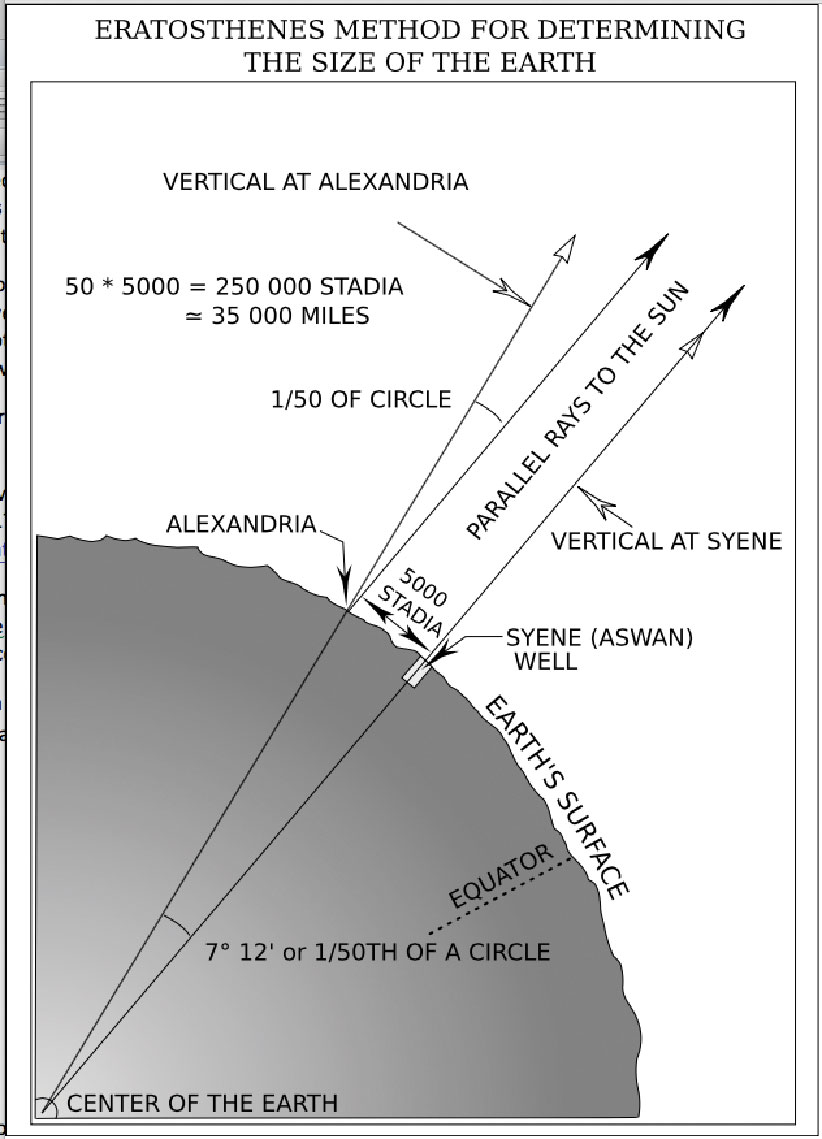
To see how he performed this calculation, please continue with the same video.
Shape Of The Earth | Earth Is An Oblate Spheroid | Geography NCERT | UPSC Prelims and Mains 2023
This next segment explains Eratosthenes' method in detail, showing how he used simple geometry and observation to achieve a remarkably accurate measurement of our planet.
Watch from 02:03 to 05:06. Pay close attention to how the difference in shadow length translates to an angle at the Earth's center, and how this angle is used with the distance between the cities to find the circumference.
Refining the Shape: From Sphere to Geoid
While "sphere" is a good approximation, modern measurements show the Earth is not perfectly round. It is slightly squashed at the poles and bulges at the equator. This specific shape is called an oblate spheroid, or more commonly in geography, a geoid (which literally means "Earth-shaped").
Why does this bulge exist? It's a direct consequence of the Earth's rotation. As the Earth spins, centrifugal force causes mass to move outward, away from the center of rotation. This force is strongest at the equator, where the rotational speed is highest (about 1,670 km/h), and non-existent at the poles. Over billions of years, this constant force has caused the planet's equatorial region to bulge slightly.
The final part of the video you just watched provides the precise measurements that confirm this shape.
Shape Of The Earth | Earth Is An Oblate Spheroid | Geography NCERT | UPSC Prelims and Mains 2023
This last short clip will introduce you to the term 'oblate spheroid' and provide the actual measurements of Earth's equatorial and polar diameters.
Watch from 05:34 to 06:33. Note the difference of approximately 44 km between the equatorial and polar diameters.
To solidify your understanding, please read the following sections from the provided text, which summarizes the evidence for Earth's shape and provides key statistics.
EXPLORING EARTH'S SHAPE, MOTIONS AND ...
This document from the curriculum resources of the Ministry of Education, Ghana, provides a clear, textual summary of the proofs of Earth's shape and its key dimensions.
Please read the section titled 'EVIDENCE OF THE SHAPE OF THE EARTH' (from page 4 to page 10). Focus on the 'CHARACTERISTICS OF THE SHAPE AND SIZE OF THE EARTH' for the key numbers, and review the different 'PROOF OF EARTH’S SPHERICAL SHAPE' to see a collection of evidence beyond just Eratosthenes' experiment.
2. The Major Motions of the Earth
Our planet is in constant motion. Its two primary movements, rotation and revolution, govern the cycles of day, night, and the year.

Rotation
Rotation is the spinning of the Earth on its own axis.
- Axis: An imaginary line passing through the North and South Poles. This axis is tilted at an angle of approximately 23.5° relative to its orbital plane.
- Direction: The Earth rotates from west to east. If you were looking down on the North Pole from space, the rotation would appear counter-clockwise.
- Period: It takes approximately 23 hours, 56 minutes, and 4 seconds for the Earth to complete one full rotation. We round this to 24 hours for our day.
The most direct effects of rotation are:
- The cycle of day and night: As the Earth spins, different parts of its surface are exposed to the Sun's light.
- The apparent movement of the sun, moon, and stars: They appear to rise in the east and set in the west because the Earth is spinning towards the east.
- The equatorial bulge: As we discussed, this centrifugal force shapes the planet.
- The Coriolis effect: A deflection of moving objects (like winds and ocean currents) which we will study in detail in Module 4.
Revolution
Revolution is the movement of the Earth in its orbit around the Sun.
- Orbit: The Earth's path is not a perfect circle but an ellipse, with the Sun at one of the two foci. This means the distance between the Earth and the Sun varies throughout the year.
- Period: It takes approximately 365.25 days for the Earth to complete one revolution.
- Leap Year: To account for the extra 0.25 day, we add an extra day to the calendar every four years (February 29th).
The primary effects of revolution are:
- The length of the year: It defines the 365-day calendar year.
- The seasons: The combination of the Earth's revolution around the Sun and the constant tilt of its axis causes the seasons.
To get a more dynamic understanding of these two motions and their effects, please watch the following video.
Rotation and Revolution of Earth
This video from vnperceptions provides a detailed explanation of both rotation and revolution.
Please watch the following three segments: Introduction (00:00 - 01:19): This defines rotation and revolution and introduces the axial tilt. Characteristics of Rotation (01:19 - 02:00): Focus on the direction, inclination, and speed of rotation. Revolution (10:42 - 13:08): This explains the elliptical orbit, varying speed, and the concept of the leap year.
Test your understanding!
Imagine you are an astronomer who has discovered a new planet. You observe that it has an equatorial diameter of 15,000 km and a polar diameter of 14,900 km. You also notice that it spins on its axis once every 10 hours.
- What term would you use to describe the planet's shape?
- What is the most likely reason for this shape?
- If this planet orbits its star in 400 Earth days, how would you design a 'leap year' system for it?
Show answer
- The planet's shape is an oblate spheroid (or a geoid). The larger equatorial diameter compared to the polar diameter indicates it bulges at its equator.
- The reason for this shape is the planet's rotation. The fast rotational period (10 hours, much faster than Earth's) would create a strong centrifugal force, leading to a noticeable equatorial bulge.
- The planet's year is 400 Earth days. If we define its local "day" as one rotation (10 Earth hours), then its year is 400 * (24/10) = 960 local days long. Since 960 is a whole number, a leap year system like Earth's (which corrects for a fractional day) would not be necessary. If the orbit was, for example, 400.5 Earth days, you might add a leap day every two years to account for the fraction.
Conclusion
In this lesson, we have laid the very first stone in our foundation of physical geography. We've journeyed from ancient observations to modern measurements to understand our planet's true form and motion.
Key Takeaways:
- The Earth is not a perfect sphere but an oblate spheroid (or geoid), which is flattened at the poles and bulges at the equator. This shape is a result of the centrifugal force generated by its rotation.
- We have numerous lines of evidence for Earth's spherical shape, from the simple observation of ships disappearing over the horizon to Eratosthenes' geometric calculations and modern satellite imagery.
- The Earth has two primary motions: rotation (the ~24-hour spin on its tilted axis that causes day and night) and revolution (the ~365-day elliptical orbit around the Sun that defines our year).
In our next lesson, we will investigate the most important consequence of combining Earth's revolution with its constant axial tilt: the seasons. We will explore exactly why summer follows spring and how the experience of seasons differs dramatically across the globe.