Hello! Let's dive into the next piece of our atmospheric dynamics puzzle.
In our last lesson, we established that the Pressure Gradient Force (PGF) is the engine that drives wind, pushing air directly from high-pressure areas to low-pressure areas. We also saw that the steeper this pressure gradient (represented by closely packed isobars), the faster the wind.
This leads to a critical question: if the PGF pushes air in a straight line, why do weather maps show winds swirling in vast spirals around high and low-pressure centers? The answer lies in a fascinating and often misunderstood phenomenon.
Today's lesson is dedicated to the learning outcome: Explain the Coriolis effect and its influence on wind direction in both hemispheres. We will uncover this "invisible" force that arises from our planet's rotation and is responsible for turning straight-line air movements into the complex wind patterns that shape our weather.
1. The Rotating Planet Problem
To begin, it's crucial to understand that the Coriolis "force" is not a true physical force like gravity or friction. It is an apparent force that exists because we are observing motion from a rotating frame of reference—the surface of the Earth.
The key to the Coriolis effect lies in a simple fact about our planet:
Earth's surface rotates at different speeds at different latitudes.
Think about it: A point on the Equator has to travel the Earth's full circumference (about 40,075 km) in 24 hours. A point near the North Pole travels a much smaller circle in the same 24 hours. Therefore, the ground at the Equator is moving much faster than the ground at higher latitudes.
The Coriolis Effect: Earth's Rotation and Its Effect on Weather
This article from National Geographic provides a clear, introductory explanation of this concept. It uses a simple ball-throwing analogy to set the stage.
Please read the first three paragraphs of the article, starting from 'The Coriolis effect describes...' and ending with '...has not caught up.' This will solidify the core idea that different rotational speeds are the cause of the apparent deflection.
This difference in speed is the root cause of the deflection. Any object moving over long distances on Earth (like an air mass, an ocean current, or even a long-range missile) is traveling over ground that is moving at a different speed than where it started. From our perspective on the ground, this makes the object's path appear to curve.
2. Building Intuition: A Visual Demonstration
This concept of apparent deflection can be tricky to visualize. The following video does an outstanding job of demonstrating it with practical experiments, which will help build your intuition for why this happens.
This video from the DeverScience channel provides some of the best analogies for understanding the Coriolis effect. It starts with a custom-built spinning device and then uses a real-world example to explain the underlying physics of relative motion.
Please watch from the beginning up to the 6:11 mark. Pay close attention to these key parts: (0:00 - 1:51): The spinning water gun demonstration. Notice how the water appears to curve from the perspective of the spinning device. (1:51 - 3:30): The truck and arrow analogy. This is the most important part for building your core understanding. It isolates the principle of relative velocity without the complication of rotation. (3:30 - 6:11): The video connects the truck analogy back to the spinning Earth, explaining how the different speeds at the equator versus the poles cause the same kind of deflection.
As the video explains, an object moving from a faster-moving area (like the Equator) to a slower-moving area (near a pole) will get ahead of the ground, causing it to deflect. Conversely, an object moving from a slow area to a fast one will lag behind.
3. The Rules of Deflection
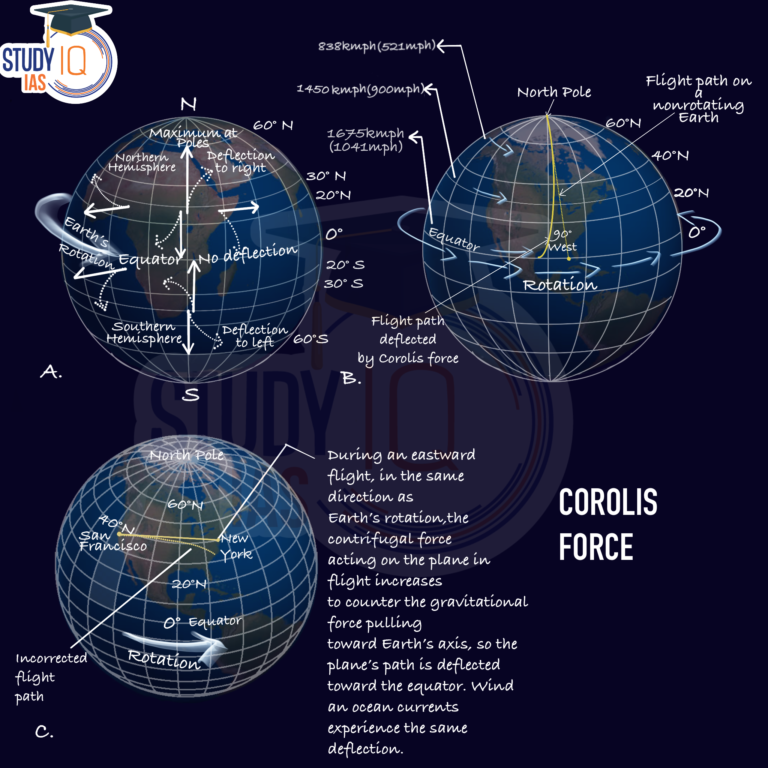
While the physics can seem complex, the result is a consistent and predictable rule for wind direction on Earth. This is the most critical takeaway for our study of meteorology.
- In the Northern Hemisphere, the Coriolis effect deflects moving objects (including wind) to the RIGHT of their path of motion.
- In the Southern Hemisphere, the Coriolis effect deflects moving objects to the LEFT of their path of motion.
The image below provides a clear visual summary of this principle.
4. Factors Influencing the Coriolis Effect
The strength of the Coriolis deflection is not the same everywhere or for all winds. Two main factors determine its magnitude:
- Latitude: The Coriolis effect is strongest at the poles and weakens as you move toward the Equator. It is zero at the Equator. This is why large-scale rotating storms like hurricanes almost never form within about 5 degrees of the Equator—there isn't enough rotational force to get them spinning.
- Wind Speed: The Coriolis effect increases with the speed of the moving object. A faster wind will experience a stronger deflection. A very slow-moving air parcel will be deflected only slightly.
To understand how these factors, especially latitude, combine with the Pressure Gradient Force to create our actual wind patterns, the following document provides an excellent, systematic explanation.
This excerpt from an FAA aviation weather manual explains the properties of the Coriolis force and how it interacts with the PGF.
Please read the section titled 'CORIOLIS FORCE' (it's the second major section on the first page). Focus on the key characteristics described: How it deflects air to the right in the Northern Hemisphere. How it is proportional to wind speed and varies with latitude (zero at Equator, max at poles). The description of how wind, initially driven by PGF, is deflected until the Coriolis force balances the PGF, causing it to flow parallel to isobars (see Figure 21).
The state of balance described in the reading, where the PGF is exactly opposed by the Coriolis force, results in a wind called the geostrophic wind. In the upper atmosphere, away from the friction of the surface, winds blow nearly parallel to isobars because of this balance.
Test your understanding!
Imagine a large, stationary body of air over the ocean at 45°N latitude. A low-pressure system develops to its east, and a high-pressure system is to its west.
- In which direction (North, South, East, or West) will the PGF initially push the air?
- Once the air starts moving, which way will the Coriolis effect deflect it?
- What is the resulting general direction of the wind?
Show answer
- The PGF will push the air from high pressure (west) to low pressure (east). So, the initial push is eastward.
- Since the location is in the Northern Hemisphere (45°N), the Coriolis effect will deflect the moving air to the right of its path. The right of an eastward path is south.
- The resulting wind will be a balance between the eastward PGF and the southward Coriolis deflection, resulting in a general southeasterly wind that attempts to flow parallel to the isobars.
5. Coriolis Effect and Global Winds
Now, let's see how this deflection shapes the major wind systems on our planet. The constant flow of air in the global circulation cells, which we will study in detail soon, is perpetually deflected by the Coriolis effect.
What is global circulation? | Part Three | The Coriolis effect & winds
This video from the Met Office directly connects the Coriolis effect to the formation of some of the world's most persistent winds.
Watch the following segments to see the application of this concept: (0:27 - 0:55): A quick review of the deflection rule in both hemispheres. (0:55 - 1:44): A crucial explanation of why air moving from the equator poleward deflects right (in the NH) and appears to 'get ahead' of the slower-moving surface. (4:45 - 5:15): A clear example of how this deflection creates the 'Trade Winds'. Air flowing from the high-pressure belts back toward the Equator is deflected west, forming the Northeast Trades in the Northern Hemisphere and the Southeast Trades in the Southern Hemisphere.
The formation of the trade winds is a perfect example of the PGF and Coriolis effect working together on a global scale. Air is pushed by the PGF from the subtropical high-pressure belts (around 30° latitude) towards the low pressure at the Equator. As it moves, the Coriolis effect deflects it to the right in the Northern Hemisphere (creating northeasterly winds) and to the left in the Southern Hemisphere (creating southeasterly winds).
Conclusion
Today, we've added the second crucial force that governs wind. While the Pressure Gradient Force provides the initial "push," the Coriolis effect provides the "turn." Without it, our weather would be unrecognizably different—a simple north-south flow of air instead of the complex, rotating high and low-pressure systems that dominate our maps.
Key Takeaways:
- The Coriolis effect is an apparent force caused by observing motion on a rotating Earth, where rotational speed varies with latitude.
- It causes a deflection to the right in the Northern Hemisphere and to the left in the Southern Hemisphere.
- The strength of the effect is zero at the Equator and maximum at the poles. It also increases with wind speed.
- In the upper atmosphere, the Coriolis force balances the PGF, causing wind to flow parallel to isobars. This is the reason winds circulate counter-clockwise around lows and clockwise around highs in the Northern Hemisphere (and the opposite in the Southern).
Preview of the Next Lesson:
We now have the two main ingredients for large-scale atmospheric motion: the PGF and the Coriolis effect. In our next lesson, we will see how their interaction across the globe prevents a simple single-cell circulation between the equator and poles. Instead, they create distinct global pressure belts—semi-permanent zones of high and low pressure that form the very foundation of our planet's climate system.