Hello! Welcome to the tenth module of our course.
In our last module, we focused on the Earth's internal, or endogenetic, forces. We saw how plate tectonics build immense structures like mountain ranges and volcanoes. Now, we shift our focus to the exogenetic forces—those that originate on or near the Earth's surface and work to wear those structures down. This entire field of study is called geomorphology.
This lesson marks the beginning of our journey into geomorphology. We will start with the very first step in reshaping the landscape: the breakdown of rock. Our goal is to differentiate between physical and chemical weathering processes and the factors influencing them. We'll explore how rock, seemingly solid and permanent, is constantly being altered by the air, water, and life around it.
1. Weathering: The First Step in Denudation
Before landforms can be sculpted by rivers or glaciers, the solid rock must first be broken down into smaller, transportable pieces. This initial process of disintegration and decomposition is called weathering. It's crucial to distinguish weathering from erosion:
- Weathering: The in-situ (in place) breakdown of rock. The rock is altered, but the resulting material does not move.
- Erosion: The transport of weathered material away from its original location by agents like water, wind, or ice.
Weathering, erosion, and the downslope movement of material under gravity (mass wasting) are collectively known as denudation, the overall process of lowering the Earth's surface.
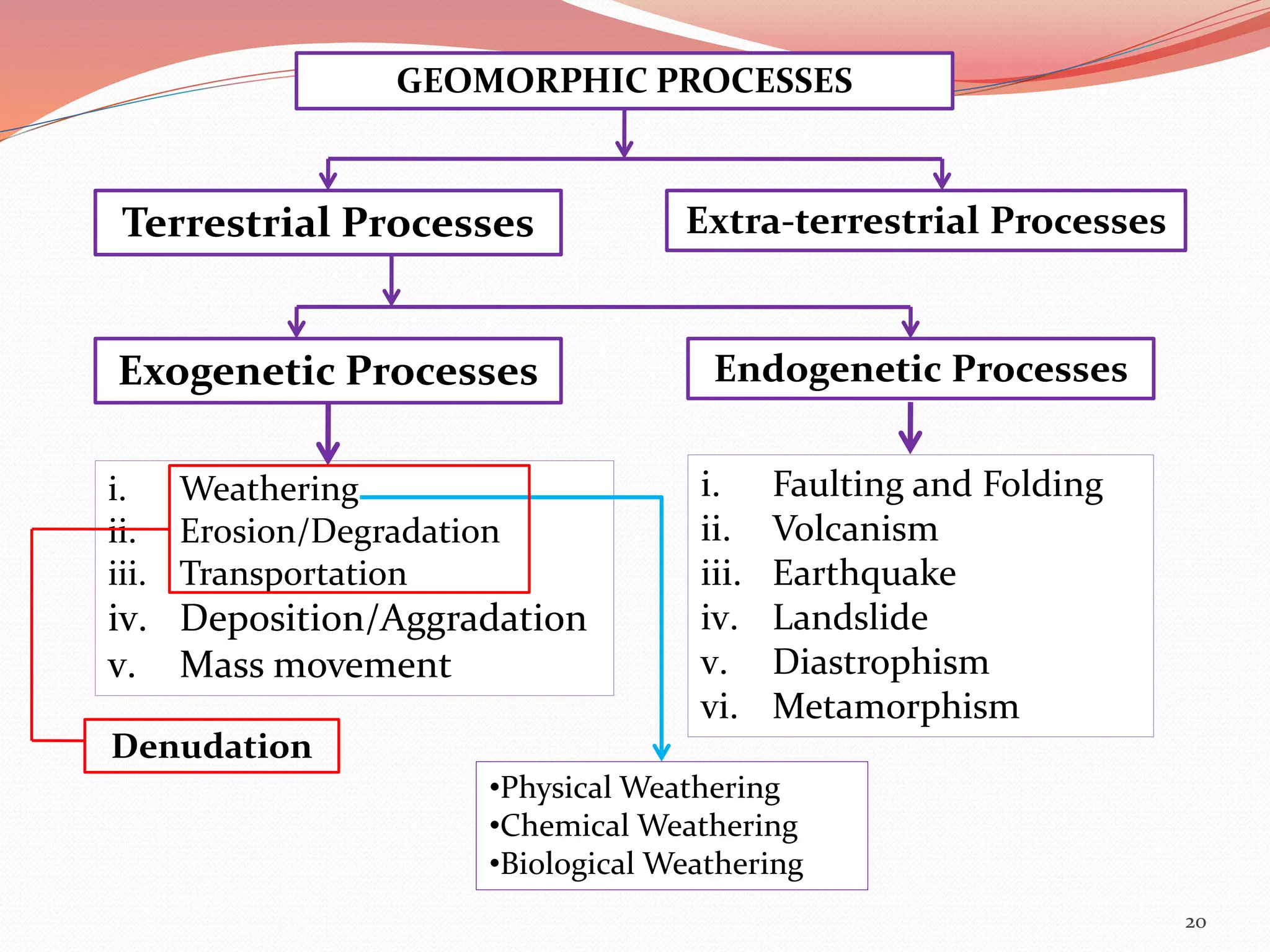
To get a clear overview of these concepts, let's watch the beginning of a video from TheGeoecologist.
Weathering: Types and Characteristics| Denudational Process-1 | Geomorphology | Dr. Krishnanand
This video introduces the concept of denudational processes and clearly defines weathering, distinguishing it from erosion and mass wasting. It also highlights why weathering is so important for the rock cycle and soil formation.
Please watch from the beginning until 07:11. Focus on: The definition of weathering as in-situ disintegration or alteration. The key difference between weathering (no movement) and erosion (movement). The role of weathering as the first step in creating sediments for sedimentary rocks and forming soil.
As the video explained, without weathering, the Earth's continents would be vast expanses of solid bedrock, and there would be no soil to support life.
2. Factors That Influence Weathering
The rate and type of weathering that occurs in a place are not random. They are controlled by a specific set of environmental factors. Understanding these factors is key to understanding global patterns of landforms.
Let's explore these factors in the next segment of the video.
Weathering: Types and Characteristics| Denudational Process-1 | Geomorphology | Dr. Krishnanand
This part of the video systematically details the seven major factors that control the speed and nature of weathering processes.
Watch from 12:47 to 22:41. As you watch, make a note of each factor and a brief summary of how it influences weathering. The factors discussed are: tectonic setting, rock composition, rock structure, topography, vegetation, biological activity, and climate.
Let's recap the two most critical factors from that list:
- Rock Composition and Structure: Some minerals, like quartz, are very resistant to weathering. Others, like calcite (in limestone) or feldspar, break down much more easily. Furthermore, rocks with many cracks and joints present more surface area to weathering agents and break apart faster.
- Climate (Temperature and Precipitation): Climate is arguably the single most important factor. As a general rule:
- Chemical weathering is dominant in warm, wet climates (like the tropics).
- Physical weathering is dominant in cold, dry climates.
Test your understanding!
Imagine two locations: the Amazon Rainforest (hot and humid) and a high-altitude peak in the Himalayas (cold, with temperatures cycling around freezing). Which type of weathering would you expect to be dominant in each location, and why?
Show answer
- Amazon Rainforest: Strong chemical weathering would dominate. The high temperatures accelerate chemical reactions, and the abundant rainfall provides the water needed for processes like hydrolysis and solution.
- Himalayas: Strong physical (mechanical) weathering, particularly frost wedging, would dominate. The daily or seasonal cycling of temperatures above and below 0°C would cause water in rock cracks to repeatedly freeze and thaw, breaking the rock apart.
3. Types of Weathering
Now we come to the core of our lesson: differentiating the main weathering processes. They are broadly grouped into three categories: physical, chemical, and biological.
A. Physical (Mechanical) Weathering
Physical weathering breaks rock into smaller fragments, called clasts, without changing its chemical composition. Think of it as smashing a rock with a hammer—you get smaller pieces of the same rock.
To learn about the main processes of physical weathering, let's consult a clear, well-structured text.
ROCKS AND PROCESSES OF WEATHERING
This document from the Ghanaian education curriculum provides excellent, straightforward descriptions of several key physical weathering processes.
Please read the section titled 'Physical (or Mechanical Weathering)' (pages 13-15). Focus on understanding the mechanism of each process: Exfoliation (pressure release) Freeze-thaw action (frost/ice wedging) Haloclasty (salt crystal growth)
Of these processes, frost wedging is one of the most effective and widespread. When water enters cracks in a rock and freezes, it expands by about 9%. This expansion exerts immense pressure, widening the crack. Repeated cycles of freezing and thawing can eventually split the rock apart.

B. Chemical Weathering
Chemical weathering involves chemical reactions that decompose rock, altering its minerals and forming new ones. The rock is essentially rotted from the inside out. The main agents are water, oxygen, and acids.
The Crash Course video provides some fantastic, easy-to-understand examples of these chemical processes.
What is Weathering? Crash Course Geography #22
This segment uses relatable analogies like a rusting bicycle and fizzy drinks to explain complex chemical weathering processes.
Watch from 05:05 to 07:46. Pay attention to the explanations of: Oxidation: The 'rusting' of iron-rich minerals. Carbonation: How weak carbonic acid in rainwater dissolves rocks like limestone, creating features like caves (karst topography).
Let's formalize the main types of chemical weathering:
- Oxidation: The reaction of minerals (especially iron) with oxygen. This is what causes the reddish-brown staining you see on many rocks and is essentially the process of rusting.
- Dissolution/Carbonation: Carbon dioxide from the atmosphere dissolves in rainwater to form a weak carbonic acid. This acid is very effective at dissolving certain minerals, most notably calcite in limestone. The chemical reaction is:
- Hydrolysis: A complex reaction where water molecules directly react with and alter the minerals in a rock, often breaking down hard minerals like feldspar into soft clay minerals.
C. Biological Weathering
This is weathering caused by living organisms. It's often considered a third category, but in reality, it involves both physical and chemical mechanisms.
- Physical: A tree root growing into a crack and forcing it apart (root wedging). A burrowing animal digging and breaking up rock.
- Chemical: Lichens or mosses growing on a rock surface secrete weak acids that slowly dissolve the minerals beneath them (chelation).
4. The Interplay of Weathering Processes
It's vital to understand that physical and chemical weathering work together in a powerful feedback loop.
This brief text perfectly explains the synergistic relationship between mechanical and chemical weathering.
Please read the paragraph that begins 'Mechanical weathering increases the rate of chemical weathering...' found just before the 'Influences on Weathering' heading.
As the text explains, physical weathering breaks a large rock into many smaller pieces. This dramatically increases the total surface area exposed to the elements. With more surface area available, chemical weathering can attack the rock much more quickly. This weakened, chemically altered rock is then more susceptible to being broken apart by physical processes, and the cycle continues.
Conclusion
In this lesson, we have taken our first step into the world of geomorphology by examining the processes that break down solid rock. We have learned that weathering is the crucial preparatory stage for the erosion and shaping of landscapes.
Key Takeaways:
- Weathering is the in-place physical disintegration or chemical decomposition of rock. It is distinct from erosion, which involves movement.
- Weathering is influenced by several factors, most importantly climate and rock type.
- Physical (mechanical) weathering breaks rock into smaller pieces without changing its chemistry. Key processes include frost wedging, exfoliation, and salt crystal growth.
- Chemical weathering decomposes rock by altering its minerals. Key processes include oxidation (rusting), carbonation (dissolving), and hydrolysis.
- Physical and chemical weathering work together: physical weathering increases surface area, which accelerates the rate of chemical weathering.
Preview of the Next Lesson:
Now that we understand how rock is broken down into loose material (called regolith), we must ask: what happens to that material next? In our next lesson, we will explore mass wasting, the processes by which gravity pulls this weathered debris downslope in events ranging from slow soil creep to catastrophic landslides.