Hello! Welcome back to our study of geomorphology.
In our last lesson, we explored weathering—the process that breaks down solid rock into loose material. We learned that this loose blanket of rock fragments and soil covering the bedrock is called regolith. But what happens to this material once it's been loosened? It doesn't just sit there forever, especially on a slope. This brings us to our topic for today.
This lesson focuses on mass wasting (also known as mass movement), the downslope movement of rock, regolith, and soil under the direct influence of gravity. We will aim to describe the major mass wasting processes and introduce the conceptual model of the cycle of erosion. Mass wasting is the crucial link between weathering (which creates the debris) and erosion by rivers (which transport it away).
1. The Balance of Forces on a Slope
To begin, we need to answer a fundamental question: Why does material on a slope sometimes stay put and sometimes move? It's all about a balance of forces. Gravity is constantly pulling everything towards the Earth's center. On a slope, we can think of this force as having two components:
- Shear Stress (Driving Force): The component of gravity that acts parallel to the slope, pulling material downhill.
- Normal Force (Resisting Force): The component of gravity that acts perpendicular to the slope, holding material in place. This force creates friction.
Mass wasting occurs when the driving force (shear stress) overcomes the resisting forces (like friction and the material's internal strength, or shear strength).
This first video provides an excellent introduction to these core concepts and the key factors that can tip the balance towards slope failure.
Geology 101 with Willsey, Episode #32: Mass Wasting Basics
This video explains the fundamental physics of slope stability. Pay close attention to the diagrams illustrating the forces on a slope and the excellent practical demonstration showing how material properties and water content affect stability.
Please watch from the beginning to 20:36. Focus on: The balance between the driving force (shear stress) and the resisting force (normal force). The concept of the 'angle of repose'—the steepest angle at which loose material remains stable. Notice how this changes with water content in the sand pile demonstration (starting at 03:52). The other key factors controlling slope stability: vegetation, material type, and the orientation of rock layers ('dip slopes').
The Critical Role of Water
As you saw in the video's demonstration, water has a complex and critical effect on slope stability:
- A little water: Surface tension can increase cohesion between grains, making the material stronger (like building a sandcastle).
- Too much water (saturation): Water fills the pore spaces, pushing the grains apart. This reduces friction, lubricates the material, and adds significant weight to the slope, all of which dramatically increase the likelihood of failure.
2. Triggers of Mass Wasting
A slope might be stable for years, but a specific event can trigger a sudden failure. These triggers can be natural or human-induced.
Geology 101 with Willsey, Episode #32: Mass Wasting Basics
Now that we understand the underlying factors, let's look at the 'triggers' that can initiate a mass wasting event. This final segment of the video you just started distinguishes between natural and human-caused triggers.
Watch from 20:36 to the end (27:36). Take note of the examples for both natural triggers (like heavy rain, earthquakes, and wildfires) and human-caused triggers (like road construction and deforestation).
3. Classifying Mass Wasting Processes
Mass wasting events are not all the same. Geologists classify them based on three main criteria:
- Type of Material: Was it solid rock, or unconsolidated debris (a mix of rock, soil, and vegetation), or primarily earth/mud?
- Type of Motion: Did the material fall, slide, or flow?
- Speed of Motion: Was it imperceptibly slow or catastrophically fast?
The following video provides a systematic overview of the most common types of mass wasting, giving clear examples of each.
Geology 101 with Willsey, Episode #33: Types of Mass Wasting Processes
This video walks us through the main types of mass wasting, from catastrophic rockfalls to slow, persistent creep. As you watch, focus on the defining characteristic for each process.
Watch from 01:48 to 24:34. This covers all the major types. Try to identify the key feature for each one: Rockfall: Speed and free-fall motion. Slump: The characteristic curved failure surface and rotational movement. Rock Slide: Movement along a planar (flat) failure surface. Debris Flow & Earthflow: The fluid, flowing motion due to high water content. Creep: Its extremely slow speed and the tell-tale evidence it leaves behind (like tilted trees).
To help you consolidate this information, the diagram below provides a fantastic summary of these classifications.

Test your understanding!
You are examining a hillside after a heavy rainstorm. You notice a large, curved scar at the top of the hill, and a jumbled mass of earth that has moved downslope, with some trees now tilted backward toward the hillside. Which type of mass wasting has most likely occurred?
Show answer
This is a classic description of a slump. The key features are the curved (arcuate) head scarp and the rotational movement of the material, which causes the backward tilt of objects on the surface.
4. The Cycle of Erosion
Now that we've examined the specific processes of weathering and mass wasting, we can place them into a broader, long-term conceptual model called the cycle of erosion. This is a classic idea in geomorphology, first proposed by William Morris Davis in the 1880s. While modern geology incorporates more complex factors like plate tectonics, Davis's model is still a useful starting point for understanding how landscapes evolve.
The model suggests that landscapes pass through stages of evolution:
- Youth: Following tectonic uplift, a landscape has steep slopes and high elevation. Rivers have high energy and focus on cutting downward, creating deep, narrow, V-shaped valleys. Mass wasting is very active on the steep valley walls, widening the valley at the top.
- Maturity: As the river's gradient lessens, it begins to meander and cut sideways (lateral erosion). The valley becomes wider, and a floodplain develops.
- Old Age: After a very long time without further uplift, the landscape is worn down to a nearly flat plain, called a peneplain.
Weathering, Mass Wasting, Erosion, and Landscape Change
This document briefly explains how mass wasting and river action work together to shape valleys, which is the core of the 'youthful' stage in Davis's cycle of erosion.
Please read the section 'Erosion' on page 18, focusing on the paragraph describing the combined effect of streams and mass wasting in creating V-shaped valleys (Figure 22 is a good visual). Then, read the 'Conclusion' on page 32, which introduces the historical work of Davis and his concept of landscape change.
The key insight is that mass wasting is the dominant process that shapes valley walls, while rivers are responsible for carving the valley floor and carrying the debris away.
5. Application: Mapping Landslide Hazards
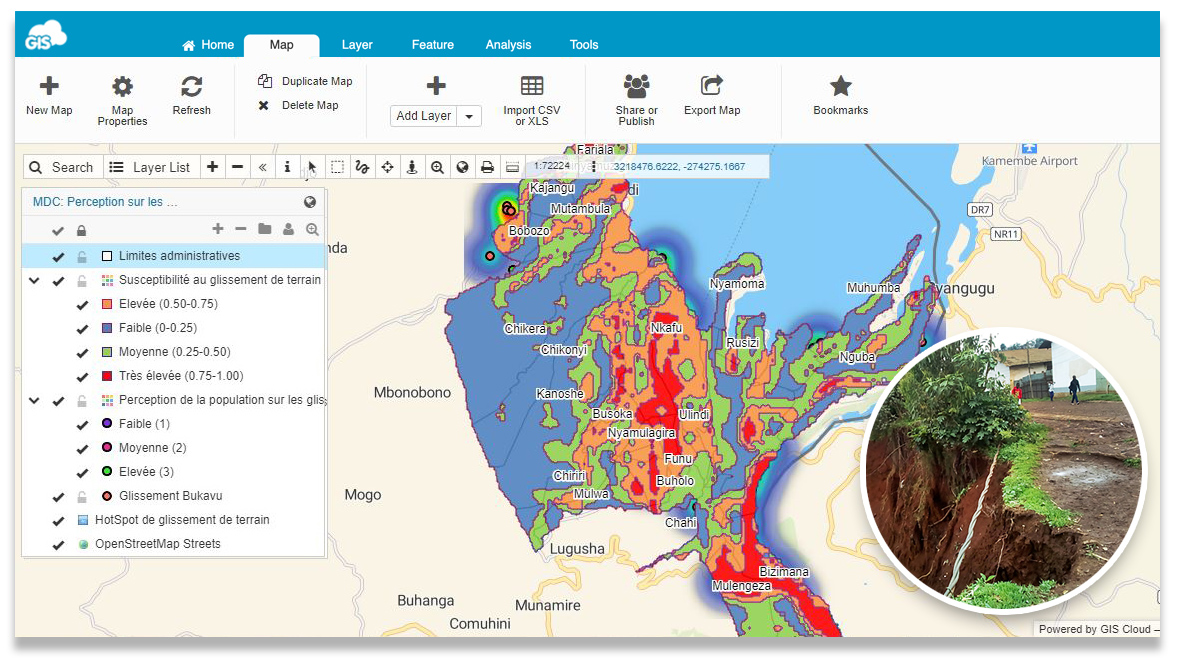
Your interest in mapping and GIS has a direct and important application here. Geographers and geologists use their understanding of these processes to save lives and property. By analyzing factors like slope steepness, geology (rock type), soil conditions, and rainfall patterns in a GIS, they can create maps that show areas of high landslide risk.
Conclusion
Today we've seen how gravity relentlessly pulls weathered material downslope, shaping the land in ways that can be either slow and subtle or sudden and catastrophic.
Key Takeaways:
- Mass wasting is the downslope movement of material due to gravity, occurring when driving forces (shear stress) exceed resisting forces (shear strength).
- Key factors influencing slope stability are the slope angle, material properties, vegetation, and especially the amount of water.
- Mass wasting processes are classified by material, motion, and speed into categories like falls, slides (slumps, rock slides), and flows (debris flows, creep).
- These processes are a fundamental part of the cycle of erosion, working with rivers to sculpt landscapes, particularly by widening V-shaped valleys in "youthful" terrain.
Preview of the Next Lesson:
We've covered the breakdown of rock (weathering) and its movement down a slope (mass wasting). The next logical step is to see what happens when this material reaches a channel. In our next lesson, we will dive into fluvial processes, exploring how rivers and streams act as the planet's most important conveyor belts, eroding, transporting, and depositing sediment to create a vast array of landforms.