Hello! Welcome back to our exploration of Earth's atmosphere.
In our last lesson, we looked at the atmosphere's composition and its layered structure. We learned about the different gases that make up the air and journeyed through the troposphere, stratosphere, and beyond. This gave us a picture of the stage upon which our weather and climate play out.
Today, we'll investigate the engine that drives everything on that stage. We'll be addressing the learning outcome: Explain the processes of solar radiation (insolation) and terrestrial radiation. You'll discover how energy from the Sun reaches Earth and how our planet, in turn, radiates its own energy back out. This exchange is the most fundamental process in climatology, setting the foundation for the global heat balance we will discuss next.
1. The Sun's Energy Reaches Earth
The ultimate source of almost all energy on Earth is the Sun. But how does that energy travel across 150 million kilometers of empty space to warm our planet? The answer is radiation.
To get a clear picture of this, let's watch a short video that introduces the concept and defines our first key term: Insolation.
Insolation, terrestrial radiation and heat budget
This video from DeltaStep begins by explaining the three ways heat can be transferred and then clearly defines insolation and terrestrial radiation.
Please watch the video from the beginning until 07:30. The first part (until 04:29) reviews the basic physics of heat transfer, which is a helpful refresher. The key part for us starts around 06:19, where it defines insolation. Focus on understanding that radiation is the transfer of energy through waves and that insolation is specifically the incoming solar radiation that reaches Earth.
As the video explained, insolation (a term derived from incoming solar radiation) is the solar energy that reaches Earth's surface. This energy travels from the Sun in the form of electromagnetic waves.
A critical characteristic of this incoming energy is its wavelength. Because the Sun is extremely hot (about 5,778 K at the surface), it emits energy primarily in the form of shortwave radiation. This includes ultraviolet (UV) light, visible light, and near-infrared radiation. The atmosphere is largely transparent to these short waves, allowing a significant portion of them to pass through and reach the ground.
To delve a bit deeper into this, let's read about how solar radiation interacts with the atmosphere.
The following text from the LibreTexts platform provides a more detailed look at shortwave radiation, introducing important related concepts like albedo.
Please read the section titled 'Shortwave radiation'. Pay attention to the definitions of 'direct' vs. 'diffuse' radiation and, most importantly, the concept of 'albedo'. The table provides excellent examples of how different surfaces reflect sunlight.
From the reading, we can summarize the journey of insolation:
- Direct Radiation: Travels in a straight line from the Sun to the surface.
- Diffuse Radiation: Is scattered by gases and particles in the atmosphere, reaching the surface from all directions (this is why you can see during the day even in the shade).
- Reflection (Albedo): A portion of the incoming radiation is reflected away by clouds and the Earth's surface. The albedo is a measure of how reflective a surface is. A surface with high albedo (like fresh snow, ~80-90%) reflects most of the energy, while a surface with low albedo (like asphalt, ~4%) absorbs most of it.
2. The Earth Radiates Energy Back
What happens to the solar energy that isn't reflected? It's absorbed by the Earth's surface (land and water), causing the planet to heat up.
Now, here's the crucial part: any object with a temperature above absolute zero radiates energy. Having been warmed by the Sun, the Earth itself becomes a radiating body. This process is called terrestrial radiation.
Because the Earth is much cooler than the Sun, it radiates energy at a much longer wavelength. This is known as longwave radiation.
Let's return to the DeltaStep video to see how it defines and contrasts terrestrial radiation with insolation.
Insolation, terrestrial radiation and heat budget
This next segment of the video focuses on terrestrial radiation and highlights the key differences between it and insolation.
Watch the video from 07:30 to 11:10. Focus on the definition of terrestrial radiation and the comparison between the two types of radiation, especially the difference in their wavelengths (shortwave vs. longwave).
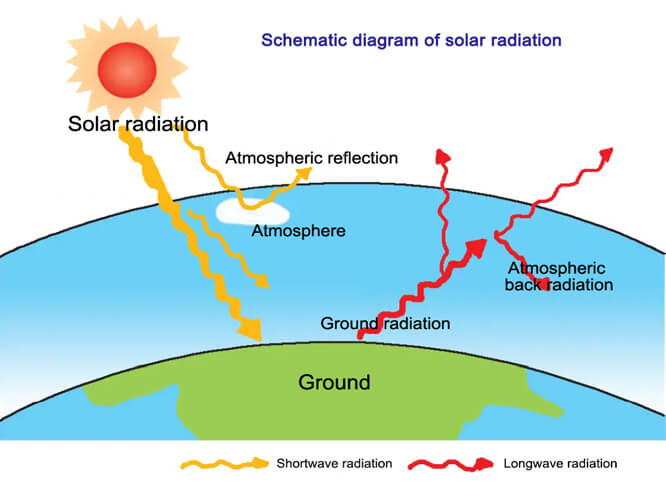
The most important takeaway is this: The Sun heats the Earth with shortwave radiation, and the Earth, in turn, heats the atmosphere from below with longwave radiation.
Gases in the atmosphere, particularly the greenhouse gases we discussed in the last lesson (like water vapor and CO₂), are very effective at absorbing this outgoing longwave radiation. This process traps heat in the lower atmosphere and is fundamental to the greenhouse effect, which keeps our planet at a habitable temperature.
Let's read a short passage that reinforces this critical concept.
SOLAR RADIATION, HEAT BALANCE AND TEMPERATURE
This excerpt from an NCERT textbook chapter clearly explains how the Earth radiates heat and how this longwave radiation heats the atmosphere.
Find and read the paragraph under the heading 'Terrestrial Radiation'. It's a concise and clear explanation of this process and its effect on the atmosphere.
3. Comparing Solar and Terrestrial Radiation
To solidify your understanding, let's summarize the key differences in a table.
| Feature | Solar Radiation (Insolation) | Terrestrial Radiation |
|---|---|---|
| Source | The Sun | The Earth's surface (land and oceans) |
| Wavelength | Shortwave (UV, visible light) | Longwave (Infrared) |
| Direction | Incoming (towards Earth) | Outgoing (from Earth's surface) |
| Atmospheric Interaction | Atmosphere is largely transparent. | Atmosphere (esp. greenhouse gases) is a strong absorber. |
| Primary Effect | Heats the Earth's surface. | Heats the atmosphere from below. |
This dual process is elegantly shown in the following diagram.

Test your understanding!
On a sunny day, you walk barefoot from a grassy lawn onto a black asphalt road. You immediately notice the asphalt is much hotter than the grass.
Using the concepts from this lesson (insolation, albedo, terrestrial radiation), explain why the asphalt is so much hotter.
Show answer
Both the grass and the asphalt receive the same amount of insolation (incoming solar radiation). However, they have different albedos.
- Albedo and Absorption: The black asphalt has a very low albedo, meaning it reflects very little sunlight and absorbs most of the solar energy. The green grass has a higher albedo, reflecting more sunlight and absorbing less energy.
- Heating: Because it absorbs more energy, the asphalt's surface temperature increases much more than the grass's.
- Terrestrial Radiation: As both surfaces heat up, they emit terrestrial (longwave) radiation. Since the asphalt is much hotter, it radiates energy more intensely, which is what you feel as heat on the soles of your feet.
Conclusion
Today, you've learned about the fundamental energy exchange that powers our planet's climate system. We have untangled the flow of energy from the Sun to the Earth and back out towards the atmosphere.
Key Takeaways:
- Insolation is the incoming shortwave radiation from the Sun that heats the Earth's surface.
- Terrestrial radiation is the outgoing longwave radiation emitted by the Earth after it has been warmed by insolation.
- The atmosphere is largely transparent to incoming shortwave radiation but is very effective at absorbing outgoing longwave radiation. This is why the atmosphere is primarily heated from below by the Earth, not directly by the Sun.
- The concept of albedo, or surface reflectivity, helps explain why different surfaces heat up at different rates.
Preview of the Next Lesson:
Now that we understand the two main streams of energy—incoming solar and outgoing terrestrial—we can put them together. In the next lesson, we will explore the Earth's heat budget. We'll examine this process quantitatively, looking at the percentages of energy that are reflected, absorbed, and re-radiated to see how the planet maintains a stable long-term energy balance.