Hello! Welcome to the first lesson of our third module, "The Atmosphere: Composition and Energy Balance."
In our previous module, we explored the world of cartography, learning how to read, interpret, and understand the maps that represent Earth's surface. Now, as promised, we shift our focus from the ground to the sky, beginning our journey into Climatology. I know this is a topic you're particularly interested in, and this module will build a solid foundation for understanding the complex processes that drive our weather and climate.
Today, we will address our first learning outcome for this module: Describe the composition and vertical structure (layers) of the atmosphere. We'll start by examining the invisible mixture of gases that surrounds our planet and makes life possible. Then, we will journey upwards from the surface, discovering how the atmosphere is organized into distinct layers, each with its own unique properties.
1. What's in the Air? The Composition of the Atmosphere
The atmosphere is the envelope of gases held to the Earth by gravity. While it may seem like empty space, it is a dynamic and complex mixture of gases, water, and tiny suspended particles that are essential for life.
To begin, let's get a clear breakdown of the main components.
STRUCTURE AND COMPOSITION OF THE ATMOSPHERE
The following text from a geography curriculum resource provides a straightforward list of the primary gases in the atmosphere and their proportions.
Please read the section titled 'Proportion and Role of Atmospheric Gases'. It begins just after the pie chart diagram (Fig 8.2). Focus on the names of the main gases and their approximate percentages.
As you've just read, the atmosphere is composed of two main types of gases:
A. Permanent Gases:
These gases have concentrations that remain stable and are well-mixed throughout the lower atmosphere.
- Nitrogen (N₂): ~78%. It is relatively inert but crucial for life as a key component of proteins.
- Oxygen (O₂): ~21%. Essential for respiration, which releases energy for most living organisms.
- Argon (Ar): ~0.9%. An inert gas that has little direct impact on weather or life.
B. Variable Gases and Components:
These are present in smaller, fluctuating amounts, but they have a profound impact on weather and climate.
To understand the crucial role these variable components play, let's watch an excerpt from a detailed climatology lecture.
Atmosphere: Structure and Composition | Climatology | Dr. Krishnanand
This video by Dr. Krishnanand of TheGeoecologist explains the significance of variable gases like carbon dioxide, ozone, and methane, as well as water vapor and aerosols.
Watch the segment from 18:26 to 27:18. Pay close attention to how each component influences our planet, such as the greenhouse effect, ozone's dual role, and the function of aerosols in cloud formation.
From the video, we can summarize the key variable components:
- Water Vapor (H₂O): The most abundant variable gas. It is the source of all clouds and precipitation and is also a powerful greenhouse gas, meaning it traps heat.
- Carbon Dioxide (CO₂): A critical greenhouse gas that helps regulate Earth's temperature. Its concentration is rising due to human activities like burning fossil fuels.
- Ozone (O₃): Has a dual nature. In the upper atmosphere, it's "good," absorbing harmful ultraviolet (UV) radiation. Near the surface, it's "bad," acting as a pollutant.
- Methane (CH₄): Another potent greenhouse gas, released from sources like agriculture and fossil fuel extraction.
- Aerosols: Tiny solid or liquid particles suspended in the air (e.g., dust, salt, smoke). They are essential as they provide surfaces—called condensation nuclei—for water vapor to condense upon to form clouds.
2. The Vertical Structure of the Atmosphere
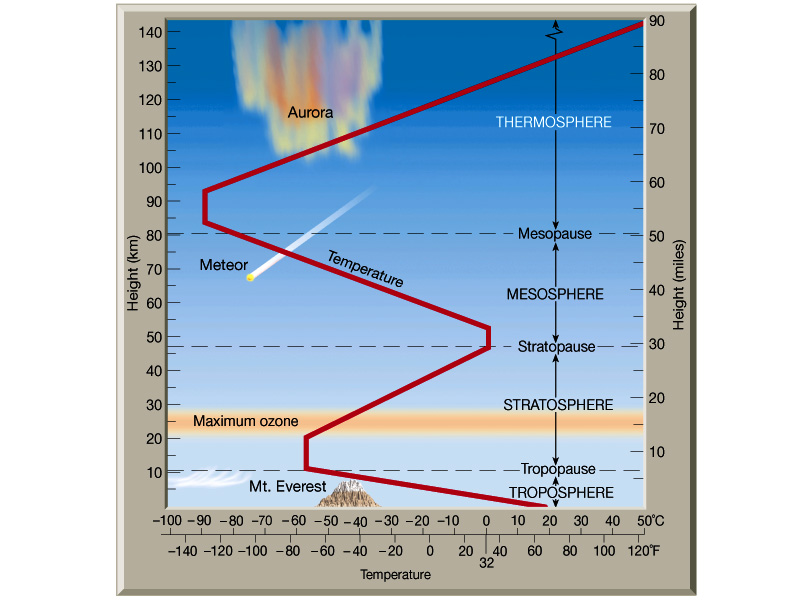
The atmosphere is not a uniform block of air; it's structured in layers, almost like an onion. The most common way to define these layers is by how temperature changes with altitude.
This graph is our roadmap for the journey upwards. It shows the four main layers and how temperature (the red line) behaves in each one.
Now, let's explore each of these layers in detail.
Atmosphere: Structure and Composition | Climatology | Dr. Krishnanand
We'll return to Dr. Krishnanand's lecture. He provides a clear, step-by-step tour through each atmospheric layer, explaining the defining characteristics of each.
Watch the video from 03:30 to 17:18. Follow along with the temperature graph, noting why the temperature decreases or increases in each successive layer.
Let's consolidate what you've just learned into a summary table. The boundaries between these layers are called "pauses" (Tropopause, Stratopause, etc.), which are transition zones.
| Layer | Altitude Range (approx.) | Temperature Trend | Key Characteristics |
|---|---|---|---|
| Troposphere | 0 - 12 km | Decreases with altitude | Contains ~80% of atmospheric mass. Where all weather, clouds, and life exist. Temperature drop is called the lapse rate. |
| Stratosphere | 12 - 50 km | Increases with altitude | Contains the ozone layer, which absorbs UV radiation and heats this layer. Calm and stable, ideal for jet aircraft. |
| Mesosphere | 50 - 85 km | Decreases with altitude | The coldest layer. Most meteors burn up here, creating "shooting stars." |
| Thermosphere | 85 - 400+ km | Increases with altitude | Very thin air, but molecules are heated to extreme temperatures by solar radiation. Contains the ionosphere, which enables radio communication. Auroras occur here. |
| Exosphere | 400 - 10,000 km | The outermost layer where the atmosphere gradually fades into the vacuum of space. |
An Alternative View: The Homosphere and Heterosphere
Besides temperature, the atmosphere can also be layered based on its chemical composition.
- Homosphere (0 - 80 km): From the Greek homo for "same," this region includes the troposphere, stratosphere, and mesosphere. Here, turbulent mixing keeps the proportions of permanent gases relatively uniform (78% N₂, 21% O₂, etc.).
- Heterosphere (above 80 km): From the Greek hetero for "different," this region includes the thermosphere and exosphere. Here, the air is so thin that mixing stops. Gases settle into layers based on their atomic weight, with heavier gases like oxygen and nitrogen at the bottom and lighter gases like helium and hydrogen at the top.
Test your understanding!
For each of the following phenomena, identify the atmospheric layer in which it primarily occurs:
- The formation of rain clouds.
- The beautiful light display of an aurora.
- The absorption of the majority of the Sun's harmful UV radiation.
- The burning up of a meteor.
- Long-distance radio communication signals bouncing off charged particles.
Show answer
- Troposphere: This is the layer where virtually all weather occurs.
- Thermosphere: Auroras are caused by charged particles from the sun interacting with the ionosphere, which is part of the thermosphere.
- Stratosphere: The ozone layer, located in the stratosphere, is responsible for this.
- Mesosphere: The friction between a meteor and air molecules in this layer causes it to heat up and vaporize.
- Thermosphere: This refers to the function of the ionosphere.
Conclusion
In this lesson, we have taken our first step into the world of climatology by examining the air that envelops our planet. You now have a foundational understanding of what our atmosphere is made of and how it is structured.
Key Takeaways:
- The atmosphere is primarily composed of permanent gases (nitrogen and oxygen) and a small but crucial amount of variable components (water vapor, CO₂, ozone).
- These variable components, especially greenhouse gases, play a disproportionately large role in regulating Earth's climate and enabling life.
- The atmosphere is vertically divided into four main layers based on temperature: the Troposphere (cooling with height), Stratosphere (warming), Mesosphere (cooling), and Thermosphere (warming).
- Each layer has distinct functions, from hosting our weather in the troposphere to protecting us from UV radiation in the stratosphere and creating auroras in the thermosphere.
Preview of the Next Lesson:
Now that we know the composition and structure of the atmosphere, the next logical question is: how does it get its energy? In our next lesson, we will explore the Earth's heat budget. We'll learn about solar radiation (insolation), how the Earth emits its own radiation, and the fundamental balance of energy that sets the stage for all weather and climate patterns.