Hello! Let's build on what we learned last time.
In our previous lesson, we distinguished between the two main streams of radiation: incoming shortwave radiation from the Sun (insolation) and outgoing longwave radiation from the Earth (terrestrial radiation). We established that the Sun heats the ground, and the ground, in turn, heats the atmosphere from below.
Today, we will put those two streams together to create a planetary energy account. We will address the learning outcome: Define the Earth's heat budget and explain its global variation. First, we'll see how, on a global scale, the energy Earth receives is balanced by the energy it loses, keeping the planet's temperature stable. Then, we'll discover that this balance isn't uniform across the globe, leading to a fascinating system of heat transfer.
1. The Global Heat Budget: A Balanced Account
For Earth's average temperature to remain stable over long periods, the amount of energy it absorbs from the Sun must equal the amount of energy it radiates back to space. This balance between incoming and outgoing energy is known as the Earth's heat budget. When this balance is achieved, we say the Earth is in radiative equilibrium.
To get an intuitive feel for how this accounting works, let's start with a simple model that tracks 100 units of incoming solar energy.
Heat Budget of Earth | Climatology Geography | IAS, UPSC, SSC CGL, CDS, NDA
The video 'Heat Budget of Earth' by Amit Sengupta provides a clear, step-by-step breakdown of what happens to incoming solar radiation. It uses simple percentages to make the concept easy to follow.
Please watch the entire video (it's less than 3 minutes). Pay close attention to the three main paths for incoming energy: reflection, absorption by the atmosphere, and absorption by the surface. Then, see how the energy radiated back out balances the budget.
The video presents a simplified but very effective model. Let's summarize the key figures:
- Incoming Energy: 100 units
- Energy In: 65 units are absorbed by the Earth system (14 by the atmosphere + 51 by the surface).
- Energy Out: 35 units are reflected back to space immediately. This reflected portion is known as Earth's albedo. The 65 units that were absorbed are eventually radiated back to space (17 directly from the surface + 48 from the atmosphere).
The result: 65 units in = 65 units out. The budget is balanced.
Now, let's look at a more detailed model based on modern satellite measurements. The exact numbers differ slightly from the simplified model, which is common as scientific measurements and models are refined over time. The fundamental principle of balance, however, remains the same.
Climate and Earth’s Energy Budget
The article 'Climate and Earth’s Energy Budget' from NASA Earth Observatory provides a comprehensive and authoritative look at this topic. We'll focus on the sections that quantify the energy budget and explain the key processes.
Please read the following three sections from the article: 'Earth's Energy Budget', 'Surface Energy Budget', and 'The Atmosphere's Energy Budget'. Focus on the diagrams, which provide an excellent visual summary of the energy flows. Notice how the energy absorbed by the surface (48%) is removed by evaporation, convection, and radiation. This is a key concept we will build upon.
The NASA article confirms the balance but with slightly different figures: about 71% of energy is absorbed by the Earth system, and 29% is reflected. This absorbed energy is then radiated back to space, maintaining the equilibrium.
Crucially, the article highlights how the surface, which absorbs the majority of the solar energy (48%), balances its own budget. It loses this energy through:
- Evaporation (25%): Energy is used to turn liquid water into water vapor.
- Convection (5%): Heat is transferred as warm air rises.
- Thermal Radiation (net 17%): The ground radiates heat upwards.
This shows that the heat budget isn't just about radiation; it also involves the movement of heat through air and water.
Test your understanding!
Imagine a scenario where large-scale melting of polar ice caps occurs. The white, reflective ice is replaced by darker, open ocean water. How would this change affect Earth's albedo, and what would be the initial impact on the heat budget?
Show answer
- Effect on Albedo: The albedo of the Earth would decrease. Dark ocean water has a much lower albedo (it's less reflective) than bright white ice.
- Impact on Heat Budget: With a lower albedo, the Earth would reflect less solar radiation and absorb more. This would disrupt the radiative equilibrium. The incoming energy would temporarily be greater than the outgoing energy, leading to a net warming of the Earth system until a new, warmer equilibrium is reached.
2. Global Variation: A Latitudinal Imbalance
We've established that on a planetary scale, the heat budget is balanced. But is the energy distributed evenly across the globe? Far from it.
As we've touched on before, the amount of insolation a location receives is primarily dependent on its latitude.
- The Tropics (low latitudes): Receive intense, direct solar radiation year-round. This results in an energy surplus, where more energy is received than is lost to space.
- The Poles (high latitudes): Receive weak, slanted solar radiation and are covered in reflective ice and snow (high albedo). This results in an energy deficit, where more energy is radiated away than is received from the Sun.
This imbalance is the fundamental driver of our planet's weather and ocean circulation.
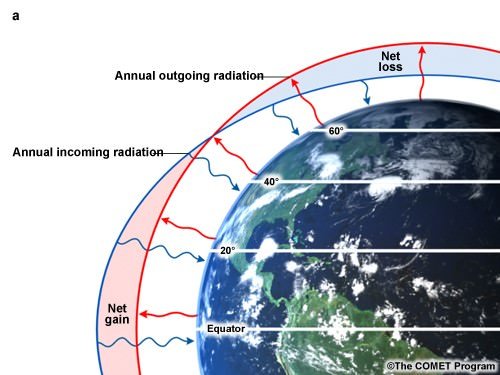
If this imbalance were left uncorrected, the tropics would get progressively hotter and the poles progressively colder, making much of the planet uninhabitable. So, how does the Earth system achieve a balance? It transfers heat from the areas of surplus to the areas of deficit.
To see how this works, let's watch a video dedicated to this concept.
Latitudinal Heat Balance | Climatology | Dr. Krishnanand
The video 'Latitudinal Heat Balance' from TheGeoecologist clearly explains the concepts of energy surplus and deficit and, most importantly, the mechanisms that transfer heat across the globe.
Please watch from 01:54 to 07:18. This segment explains which parts of the Earth have an energy surplus versus a deficit and then describes the two primary 'messengers' that carry heat from the tropics to the poles.
As the video explains, the Earth acts like a giant "heat engine," constantly working to even out temperature differences. The two primary agents responsible for this massive heat transfer are:
- The Atmosphere: Global wind systems and weather patterns transport enormous amounts of heat. For example, warm air from the tropics moves towards the poles, while cold polar air moves towards the equator.
- The Hydrosphere: Ocean currents are incredibly effective at transporting heat. A prime example is the Gulf Stream, which carries warm water from the tropics far into the North Atlantic, significantly warming the climate of Western Europe.
This continuous transfer of heat from the tropics to the poles is what maintains the overall temperature balance of the Earth's surface.
To reinforce this crucial idea, here is a concise text summary.
Temperature Distribution on Earth & Heat Budget
This short excerpt from PMF IAS provides a clear, text-based summary of the latitudinal heat balance, reinforcing what you saw in the video.
Please read the section titled 'Latitudinal Heat Balance'. It neatly summarizes the concept of surplus/deficit regions and the role of the atmosphere and oceans in transferring heat.
Conclusion
In this lesson, we moved from the simple exchange of radiation to a full accounting system for our planet's energy. We saw how energy flows are balanced on a global scale but are fundamentally imbalanced across different latitudes, creating the engine that drives our climate.
Key Takeaways:
- The Earth's heat budget is the balance between incoming solar radiation (shortwave) and outgoing terrestrial radiation (longwave). On a global average, this budget is in radiative equilibrium.
- About 29-35% of solar radiation is reflected (albedo), while the rest is absorbed by the atmosphere and surface. This absorbed energy is eventually radiated back to space.
- Spatially, the heat budget is not balanced. The tropics have an energy surplus, while the poles have an energy deficit.
- This latitudinal imbalance is corrected by a massive transfer of heat from the equator to the poles, carried out by atmospheric winds and ocean currents.
Preview of the Next Lesson:
We've now seen that heat is transferred from the surface to the atmosphere (through convection and evaporation) and from the tropics to the poles (through large-scale circulation). In our next lesson, we will zoom in on the specific physical processes of heat transfer in the atmosphere: conduction, convection, and advection. Understanding these micro-scale processes is key to understanding weather phenomena.