Hello! I hope you're ready to continue our journey into the atmosphere.
In our last lesson, we established the concept of the Earth's heat budget. We learned that while the planet's energy account is balanced globally, there's a significant surplus of energy in the tropics and a deficit at the poles. This imbalance drives the large-scale movement of heat through the atmosphere and oceans. We briefly mentioned that processes like convection are responsible for moving heat from the Earth's surface into the atmosphere.
Today, we will focus on the specific physical mechanisms that transfer heat. Our goal is to describe the atmospheric heating processes: conduction, convection, and advection. Understanding these three fundamental processes is like learning the grammar of weather; they are the rules that govern how thermal energy moves, creating the atmospheric conditions we experience every day.
The Three Modes of Heat Transfer
In the atmosphere, heat energy is constantly on the move. As we learned, the primary source of this energy is the Sun, which heats the Earth's surface. That heat is then transferred from the ground into the air and distributed throughout the atmosphere. This happens in three main ways.
To start, let's get a quick overview of two of these processes, conduction and convection, and how they relate to the atmosphere.
Heat Transfer in the Atmosphere - How Heat Affects Earth's Temperature
The video 'Heat Transfer in the Atmosphere' provides a simple and clear introduction to the concept of heat transfer and how conduction and convection work in our atmosphere. It sets the stage for our detailed discussion.
Please watch from the beginning to 07:16. Focus on the definitions of conduction and convection and the examples used to illustrate them (the hot pan and boiling water).
Now, let's break down each of the three processes in more detail.
1. Conduction: Heat by Direct Contact
As the video explained, conduction is the transfer of heat through a substance by molecular activity, without any net movement of the material itself. Imagine holding one end of a metal spoon while the other end is in a hot cup of tea. The heat travels up the spoon to your hand, molecule by molecule.
In the context of the atmosphere, conduction is only significant in the very thin layer of air—just a few centimeters thick—that is in direct contact with the Earth's surface.

Air is a very poor conductor of heat; in other words, it is a good insulator. This is why a double-paned window, with a layer of air trapped between the glass, is effective at keeping a house warm. Because air is such a poor conductor, conduction cannot be responsible for heating the vast majority of the atmosphere. It's simply the first step in a chain reaction, passing the heat from the ground to the very lowest layer of air.
CAIE AS Physical Geography - Atmosphere & Weather
Let's read a concise definition of conduction from the resource 'CAIE AS Physical Geography'.
Please read the paragraph under the heading 'Surface and sub-surface absorption'. It defines conduction and explains its role in transferring heat into the ground.
2. Convection: Heat by Vertical Movement
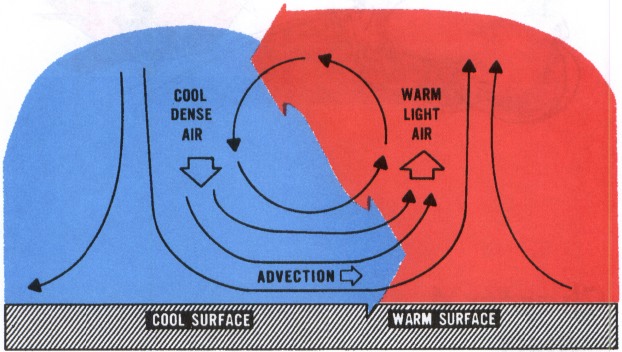
Once the lowest layer of air is warmed by conduction, it becomes less dense than the cooler air above it. As you know from basic physics, less dense fluids rise. This is the principle of convection: the transfer of heat by the mass movement or circulation of a substance.
In the atmosphere:
- Air heated by conduction expands and becomes less dense.
- This warm, light air rises.
- As it rises, it carries heat with it, warming higher levels of the atmosphere.
- At higher altitudes, this air cools, becomes denser, and sinks back toward the surface, where it can be heated again.
This continuous vertical circulation, known as a convection current or convection cell, is the primary mechanism for transferring heat vertically through the atmosphere. It is a much more efficient process for moving heat than conduction. The boiling pot of water from the video is the classic analogy for this process.
3. Advection: Heat by Horizontal Movement
While convection describes the vertical transfer of heat, the atmosphere also moves horizontally. This horizontal movement of air is what we commonly call wind. The process of transferring heat through this horizontal movement is called advection.
Essentially, advection is heat transfer by wind.
This process is critical for balancing the Earth's heat budget, which we discussed in the last lesson. Advection is how warm air from the tropics is transported toward the poles, and cold air from the poles is transported toward the equator. A warm wind blowing on a cool day is a direct experience of advection.
Let's read a text that clearly distinguishes between convection and advection.
Heat Transfer: Conduction, Convection and Latent Heat
The note 'Heat Transfer: Conduction, Convection and Latent Heat' from Texas A&M University provides excellent, clear-cut definitions that distinguish vertical from horizontal heat transfer.
Please read the section until the discussion of water phases begins. Pay close attention to the bullet points defining conduction, convection, and especially the distinction made between convection (vertical) and advection (horizontal).
The distinction is simple but crucial:
- Convection = Vertical transport of heat (warm air rising, cool air sinking).
- Advection = Horizontal transport of heat (wind blowing from one place to another).
Test your understanding!
Match the atmospheric phenomenon to the primary heat transfer process involved:
| Phenomenon | Process |
|---|---|
| 1. A warm breeze from the south raises the temperature. | A. Conduction |
| 2. A hot asphalt surface heats the air just above it. | B. Convection |
| 3. A thermal (a rising column of warm air) forms. | C. Advection |
Show answer
- A warm breeze from the south raises the temperature. -> C. Advection (Horizontal movement of warm air).
- A hot asphalt surface heats the air just above it. -> A. Conduction (Direct contact between the surface and the air).
- A thermal (a rising column of warm air) forms. -> B. Convection (Vertical movement of heated air).
The Complete Process: Heating the Atmosphere from Below
Now, let's put these three processes together with radiation to understand the step-by-step sequence that heats our atmosphere.
- Radiation: Incoming shortwave solar radiation (insolation) passes through the mostly transparent atmosphere and is absorbed by the Earth's surface, warming the ground.
- Conduction: The ground heats the very thin layer of air in direct contact with it.
- Convection: This pocket of warm, less dense air rises, transferring heat vertically into the troposphere. Cooler, denser air sinks to take its place, creating a convection current.
- Advection: Winds transport these air masses horizontally across the Earth's surface, distributing the heat over large areas.
This entire sequence shows how the atmosphere is fundamentally heated from the ground up, a key concept in climatology.
Conclusion
In this lesson, we dissected the physical processes that move heat through the atmosphere. By understanding these mechanisms, we can begin to build a mental model of the atmosphere as a dynamic, churning fluid, constantly working to redistribute energy.
Key Takeaways:
- Conduction is heat transfer by molecular collision. In the atmosphere, it is only effective at the interface between the ground and the air.
- Convection is heat transfer by the vertical movement of a fluid. It is the primary way heat is moved upward from the surface into the troposphere, as warm air rises and cool air sinks.
- Advection is heat transfer by the horizontal movement of a fluid, which we know as wind. It is crucial for moving heat across different latitudes.
- These processes work in a sequence: Radiation heats the ground, conduction heats the air in contact with the ground, convection carries that heat upward, and advection spreads it horizontally.
Preview of the Next Lesson:
Now that we understand how heat is transferred, we are ready to explore why temperatures vary so much across the globe. In the next lesson, we will analyze the factors affecting the spatial distribution of temperature on Earth's surface, such as latitude, altitude, land-sea distribution, and ocean currents. We will see how conduction, convection, and advection manifest in these large-scale patterns.