Hello! Welcome back to our module on "Exploring Mandala Styles."
In our last lesson, you learned how to weave traditional floral and geometric motifs into a perfectly balanced, symmetrical mandala. You mastered the art of creating harmony through repetition and mathematical precision, much like building a website on a strict, predictable grid system.
Today, we're going to learn how to artfully break that grid. This lesson is about designing mandalas with asymmetrical elements or interrupted patterns for a modern aesthetic. We'll move beyond perfect radial symmetry to explore a more dynamic and expressive form of balance, transforming your mandalas from classic patterns into unique pieces of fiber art.
1. Understanding Asymmetry in Design
Before we pick up a hook, it's important to understand the design principle we're aiming for. In the context of art and design, asymmetry is not a mistake or a lack of balance; it's a different type of balance.
- Radial Symmetry (What you know): Elements radiate from a central point, creating a feeling of harmony, stability, and tradition. Every slice of the "pie" is the same.
- Asymmetrical Balance (Our goal): Elements are not mirrored or identical across a central axis. Instead, balance is achieved by distributing the "visual weight" of different shapes, colors, and textures unevenly. This creates energy, movement, and a modern, less predictable feel.
To get a clear picture of these concepts, let's look at a short article that explains them in a crochet context.
Understanding Balance in Crochet Design
The article 'Understanding Balance in Crochet Design' from Crochet Kitten gives a fantastic visual overview of the different types of balance. We'll focus on the contrast between radial and asymmetrical balance.
Please read the sections titled 'Asymmetrical Balance' and 'Radial Balance'. As you read, notice how radial balance is described as 'spinning out from a central point', which is the basis for our mandalas so far. Then, pay close attention to the description of asymmetrical balance as more 'dynamic' and 'tricky', achieved by thoughtfully distributing visual weight.
The key is to make your asymmetrical choices look intentional, not accidental. It's the difference between a deliberately off-center layout in web design that draws the user's eye, and a CSS error that just makes a page look broken.
2. The Techniques of Asymmetry: Freeform & Interrupted Patterns
So, how do we intentionally break the radial symmetry of a mandala? The main approach is called freeform crochet. It's an intuitive and pattern-free method where you build the fabric organically, letting the shapes evolve as you go.
We'll watch some videos that demonstrate the core techniques. While these videos show the creation of completely freeform pieces, we will later discuss how to apply these techniques to a circular mandala base.
Building and Interrupting Organically
First, let's see how to intuitively build shapes, change height, and even work along the side of your stitches to create unexpected forms.
Freeform Crochet ~ An Introduction
The video 'Freeform Crochet ~ An Introduction' by Crochet with Patricia is a masterclass in this intuitive style. We'll focus on the specific techniques she uses to create non-circular, organic shapes.
Please watch the following segments: Building & Shaping (12:43 - 16:44): Observe how she fluidly changes stitch height (single, half-double, double, treble crochet) to create curves. Crucially, notice how she assesses whether the fabric is flat and adds increases intuitively rather than by a fixed formula. This is the key to controlling freeform shapes. Creating an Interruption (16:44 - 22:32): This is a critical technique. Watch how she stops working in the round, changes color, and begins crocheting along the side of a tall stitch post. This creates a straight edge right through the middle of the circular form—a perfect example of an 'interrupted pattern'.
Adding Extensions and Changing Direction
Another way to introduce asymmetry is by adding extensions to your shape or by stopping and reversing direction. This is sometimes achieved using a technique called "short rows," where you only work across a portion of the stitches before turning.
This next video demonstrates this beautifully.
Beginner Freeform Crochet - No Patterns, No Limitations, Pure Creative Expression!
In 'Beginner Freeform Crochet' by HappyBerry Crochet, the presenter shows some very clear and accessible ways to break out of a simple shape.
Focus on these two powerful techniques for creating asymmetry: Adding Chains Mid-Row (2:13 - 4:21): Watch how she stops mid-row, makes a chain, works back along it, and then seamlessly continues on the main piece. This creates an instant asymmetrical extension. Changing Direction (18:22 - 20:34): Here, she demonstrates how to stop, turn your work, and crochet back in the opposite direction for a few stitches before continuing on. This builds up texture and mass in one specific area, breaking the symmetry of the piece.
As you can see from these videos, the core techniques for asymmetry are:
- Intuitive increases/decreases to control shape without a formula.
- Working along the sides of stitches to create new angles and edges.
- Adding chains to create extensions.
- Using "short rows" (working back and forth over a section) to build up one area.
3. Applying Asymmetry to a Mandala
Now, let's synthesize these ideas. How do you take the structured, radial-based mandala and apply these wild, freeform techniques? You don't just throw away the rules; you integrate the chaos in a controlled way.
Here’s a strategic approach:
- Start Symmetrically: Crochet the first few rounds of your mandala (e.g., rounds 1-5) using the normal, radially symmetric increase formula. This creates a stable, predictable center.
- Introduce the Interruption: In the next round, instead of working all the way around, apply a freeform technique.
- Option A: The Extension. Work about halfway around the circle. Then, chain 10, work stitches back down the chain, and rejoin the circle. You've just created an asymmetrical "tab" sticking out from your mandala.
- Option B: The Short Rows. Work a third of the way around. Then, chain 1, turn your work, and crochet back over the stitches you just made. Do this for a few rows to build up a "hill" on one side of your mandala.
- Incorporate the New Shape: In the subsequent round, you will crochet all the way around again, but this time you will work around the new asymmetrical feature you just created. This integrates the "interruption" into the overall design.
The result is a piece that has the soul of a mandala but with a modern, unexpected twist.
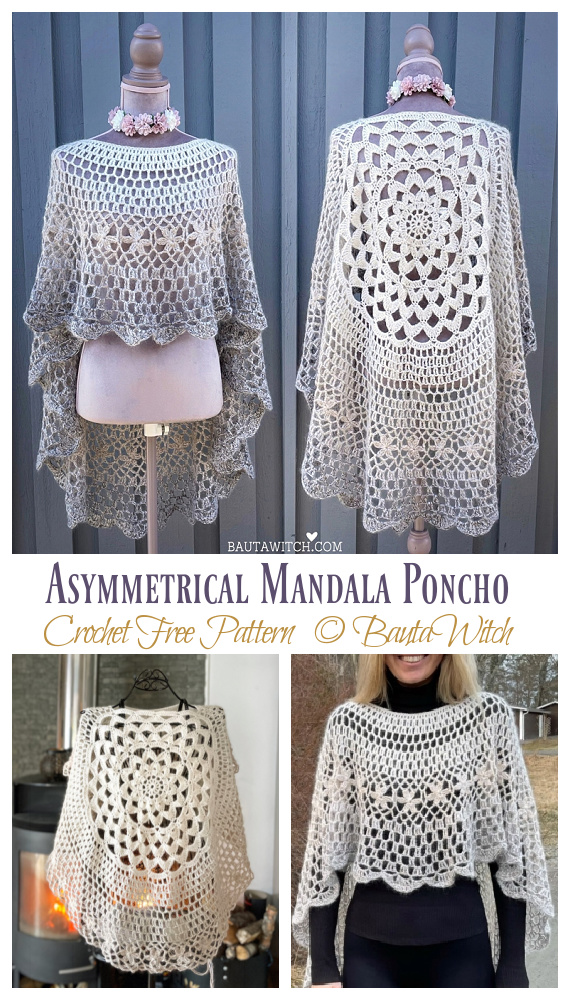
Test your understanding!
You've crocheted a flat, symmetrical, 6-round mandala based on 8-point geometry. It currently has 48 stitches. You want to make Round 7 asymmetrical.
Describe one specific way you could use a freeform technique to interrupt the pattern in Round 7. What would you do?
Show answer
There are many possible answers! Here is one example:
"I would start Round 7 by crocheting normally for 12 stitches (one quarter of the way around). Then, I would ch 1, turn, and work 12 single crochets back the way I came. I would repeat this back-and-forth for 3 more rows. This creates a small, rectangular extension. To begin Round 8, I would crochet along the 12 stitches of the 'top' of my new rectangle, down the raw edge of its side, and then continue around the remaining 36 original stitches of Round 6."
This uses the "short rows" or "changing direction" technique to build up one section asymmetrically.
Conclusion
You've now unlocked a new level of creative freedom in your design journey. By understanding and applying the principles of asymmetrical balance, you can move beyond traditional patterns and create truly unique, modern mandalas.
Key Takeaways:
- Asymmetry is intentional balance, not chaos. It creates dynamism and visual interest.
- Freeform crochet is the primary method for creating asymmetrical and interrupted patterns.
- Key techniques include intuitive increases, changing stitch height, working along stitch posts, adding chain extensions, and using short rows.
- You can apply these techniques to a traditional mandala by starting with a symmetrical center and then strategically interrupting the pattern in later rounds.
In our next lesson, we'll explore another powerful modern design concept: creating minimalist designs by strategically using negative space. This will add yet another tool to your designer's toolkit, allowing you to create impact not just with the stitches you make, but with the spaces you leave empty.