Hello! Welcome back to our exploration of modern mandala styles.
In our last lesson, we broke free from perfect symmetry to create dynamic, modern designs using asymmetrical elements and interrupted patterns. You learned how to think like a freeform artist, intentionally adding extensions and changing directions to create visual movement.
Today, we're exploring another powerful principle of modern design: minimalism. We will focus on how to create minimalist designs by strategically using negative space. This concept is central to many fields of design, including web design. Just as whitespace is used in a web layout to guide the eye, create focus, and lend elegance to the page, open spaces in crochet can be used to define shapes and create a sophisticated, uncluttered aesthetic.
By the end of this lesson, you will understand how to use the absence of stitches as a powerful design tool, allowing you to create intricate patterns with simplicity and intention.
1. Understanding Negative Space in Design
Before we apply this to crochet, let's establish a clear definition. In any visual composition, we can identify two types of space:
- Positive Space: The area occupied by the main subject or elements of the design. In our case, this is the yarn itself—the stitches you make.
- Negative Space: The empty or open area around and between the positive spaces. In crochet, these are the holes and gaps created by chains and openwork stitches.
A masterful design uses the interplay between these two spaces. Sometimes the negative space is just a background, but in minimalist design, the negative space often becomes a crucial part of the design itself, forming shapes and guiding the viewer's eye.
To solidify this concept, let's review a formal definition.
The document 'Creative Arts and Design' from the University of Tennessee provides a clear and concise explanation of space as an element of design.
Please read the section under 'Activity 3' that defines 'Space'. It starts after the discussion of 'Form' and ends before the discussion of 'Texture'. Pay close attention to the definitions of 'Positive Space' and 'Negative Space' and look at the famous vase/profile illusion example, which perfectly illustrates how the brain can interpret both spaces as the main subject.
This concept of figure-ground relationship, where the brain decides what is the object and what is the background, is a core principle in psychology and visual perception. In crochet, we can consciously design for this effect.
The image below provides a perfect crochet-specific example of this principle.

2. Techniques for Creating Negative Space
Creating negative space in a mandala is about intentionally leaving holes. The primary tools for this are chain stitches and skipped stitches. By combining these, you can create everything from simple, airy textures to complex, lace-like patterns where the holes are the main attraction.
Core Techniques:
- Chain Spaces: This is the most fundamental technique. Instead of placing a stitch in every stitch of the round below, you chain one or more times and skip the corresponding number of stitches. For example:
(dc in next st, ch 1, sk 1 st)creates a simple mesh. - Filet-Inspired Grids: As seen in the "Positive vs Negative" image, you can use a grid of solid blocks (e.g.,
4 dc) and open blocks (e.g.,dc, ch 2, sk 2, dc) to form images. While you don't need to do strict filet crochet, the idea of using a grid to map out solid vs. open areas is incredibly useful for planning a minimalist design. - Lacy Stitches: Combine chains with taller stitches (like treble or double treble crochet) to create larger openings. V-stitches (
dc, ch 1, dcin the same stitch), fans, and shells separated by chain spaces are excellent for creating significant negative space.
The goal of a minimalist design is not just to have holes, but to use those holes to create a deliberate and clean pattern.
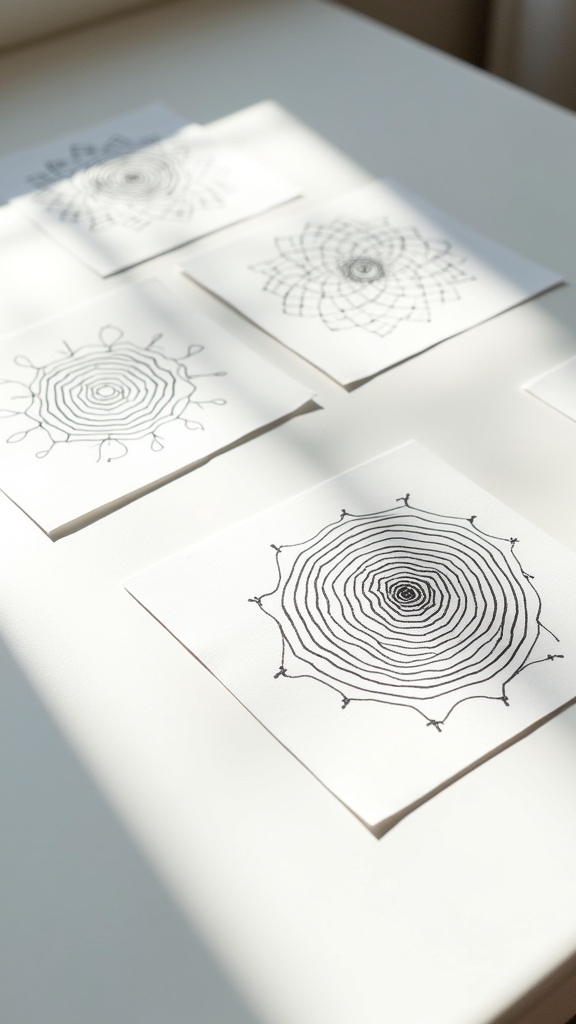
Several designers specialize in this airy, modern style. The article "35+ Mandala Crochet Patterns" highlights a couple of examples. For instance, in describing one pattern, it notes, "The negative space on this one shows the background through the back." Later, it highlights another: "Here is a gorgeous mandala pattern with a simple design. It shows off a pretty shape utilizing negative space." This shows how designers are consciously using this principle.
3. Designing a Minimalist Round
Let's put this into practice. When designing a round that uses negative space, your process involves planning the placement of both stitches and gaps to create a cohesive whole.
Step 1: Define the Motif and its Space
Decide whether your motif will be formed by positive space (stitches) or negative space (holes). For a minimalist design, using negative space to create the motif is often very effective.
Step 2: Map the Motif to the Round's Stitch Count
Your design must still follow the rules of circular crochet to lie flat. The total number of stitches you make plus the number of stitches you skip should align with the required stitch count for that round.
Example Design Process:
Let's say we are working on Round 8 of an 8-pointed mandala. The previous round (Round 7) had 64 stitches. To keep it flat, Round 8 needs to have 72 stitches (an increase of 8 stitches). We want to create eight simple "spokes" of negative space radiating from the center.
- Our Goal: Create 8 evenly spaced
ch 3gaps. - Math: The round has 72 "slots" for stitches. A
ch 3, sk 3section uses up 4 "slots" (one for the stitch before the chain, and three for the skipped stitches). Wait, that's not quite right. Ach 3, sk 3sequence replaces 3 stitches with 3 chains. The stitches you work into are separate. - Let's try again:
- Round 7 has 64 stitches. Round 8 needs 72 stitches. This means we need 8 increases.
- We have 8 sections in our mandala. So we need one increase per section.
- Let's create 8 openwork "spokes." A spoke could be
ch 3, sk 3. - The remaining stitches from the previous round are
64 - (8 spokes * 3 skipped sts) = 64 - 24 = 40stitches to work into. - Our increase pattern per section is
(2 dc in next st, 4 dc). This gives us6 dcworked over5stitches of the previous round. Total stitches made:6 dc * 8 repeats = 48. That doesn't add up.
Let's simplify. The key is that the total stitch count for the round needs to accommodate the design. Let's design the round instruction first, then check the math.
- Design Idea: A section of solid stitches, followed by an open spoke.
- Per Section (8 repeats): We need to work across 8 stitches from the round below (
64 / 8 = 8). We also need to add one increase. - Let's try this instruction for one repeat:
ch 3, sk 2 sts, 2 sc in next st, sc in next 4 sts.- Stitches used from previous round:
2 skipped + 1 for the 2sc + 4 for the scs = 7. This doesn't work; we need to use 8.
- Stitches used from previous round:
- Let's try again:
ch 3, sk 3 sts, 2 dc in next st, dc in next 4 sts.- Stitches used from previous round:
3 skipped + 1 (for 2dc) + 4 = 8. This works perfectly! - Stitches in new round: The
ch-3counts as adcplusch 2, or just as a gap depending on the pattern style. Let's count the stitches made:2 dc + 4 dc = 6 dc. And we have ach-3space. - Total for Round 8:
8 repeats * 6 dc = 48 dcand 8ch-3spaces. This round is more open and has fewer stitches than the one before, creating a lacy effect. The flatness is maintained by the length of the chains corresponding to the skipped stitches. The increases(2 dc in next st)ensure the circumference is expanding appropriately.
- Stitches used from previous round:
This methodical approach—defining the space, doing the math, and writing the instruction—is key to designing intentional negative space.
Test your understanding!
You are designing Round 5 of a mandala. Round 4 has 48 stitches. Your design for Round 5 requires you to create 6 large, open, hexagonal holes using negative space, separated by small groups of solid stitches. Which of the following instructions is the most plausible for one of the 6 repeats in Round 5?
A) (dc in next 8 sts)
B) (ch 9, sk 7 sts, sc in next st)
C) (2 dc in next st, dc in next 7 sts)
Show answer
The most plausible answer is B) (ch 9, sk 7 sts, sc in next st).
Here's why:
- Round 4 has 48 stitches, so each of the 6 sections covers
48 / 6 = 8stitches. - Option B uses
7 skipped stitches + 1 sc = 8stitches from the previous round, so the math is correct for one section. - The
ch 9creates a large chain space, which is exactly what you need for a large hole (negative space), while the singlescacts as a small, solid "spoke" separating the holes. - Options A and C create solid fabric, which is the opposite of creating a hole with negative space.
Conclusion
Today you've added a subtle yet powerful concept to your design repertoire. By learning to see and shape the "empty" parts of your work, you can create minimalist mandalas that are both simple and profoundly beautiful.
Key Takeaways:
- Minimalist design values simplicity and intention. In crochet, this is achieved by making every stitch—and every empty space—count.
- Negative space is the open area in your work, defined by your positive space (the stitches).
- Your primary tools for creating negative space are chain spaces, skipped stitches, and open lace stitches.
- Like any other element, negative space must be incorporated mathematically to ensure your mandala lies flat. Always account for skipped stitches in your round counts.
In our next lesson, we will explore how to apply different color strategies, from traditional palettes to contemporary bold contrasts. You'll find that a minimalist design, with its clear shapes defined by negative space, provides the perfect canvas for thoughtful and impactful color choices.