Hello! Welcome to the final lesson in our module on "Corporate Formation and Capitalization."
In our last lesson, we established the fundamental principle of the time value of money (TVM) and saw how Net Present Value (NPV) helps companies decide whether to accept or reject individual projects. We learned that to make sound financial decisions, we must "discount" future cash flows to find their value in today's terms.
Today, we will scale up that exact concept. Instead of valuing a single project, we will value an entire company using the Discounted Cash Flow (DCF) model. The learning outcome for this lesson is to interpret a basic discounted cash flow (DCF) model to understand the framework for corporate valuation.
A DCF analysis answers the question: "What is the intrinsic value of this entire business based on the future cash it's expected to generate?" As a future corporate lawyer, understanding this framework is critical. DCF models are a cornerstone of mergers and acquisitions (M&A), investment decisions, and are often at the heart of legal disputes concerning a company's fair value.
1. The Big Picture: What is a DCF Model?
At its core, a DCF model is a direct application of the time value of money principle you've just learned. It operates on a simple premise: a company's value is the sum of the present values of all the cash it will generate for its investors in the future.
The process involves three main phases:
- Forecasting: Projecting the company's future cash flows for a specific period (e.g., 5-10 years).
- Discounting: Bringing all those future cash flows back to their present value using an appropriate discount rate.
- Valuing the long-term: Estimating the company's value for the period beyond the initial forecast horizon.
The sum of these discounted cash flows gives us the company's "intrinsic value"—a value based on its own operational performance, independent of market sentiment or speculation.
This infographic provides a great high-level overview of the sequential steps we will explore.
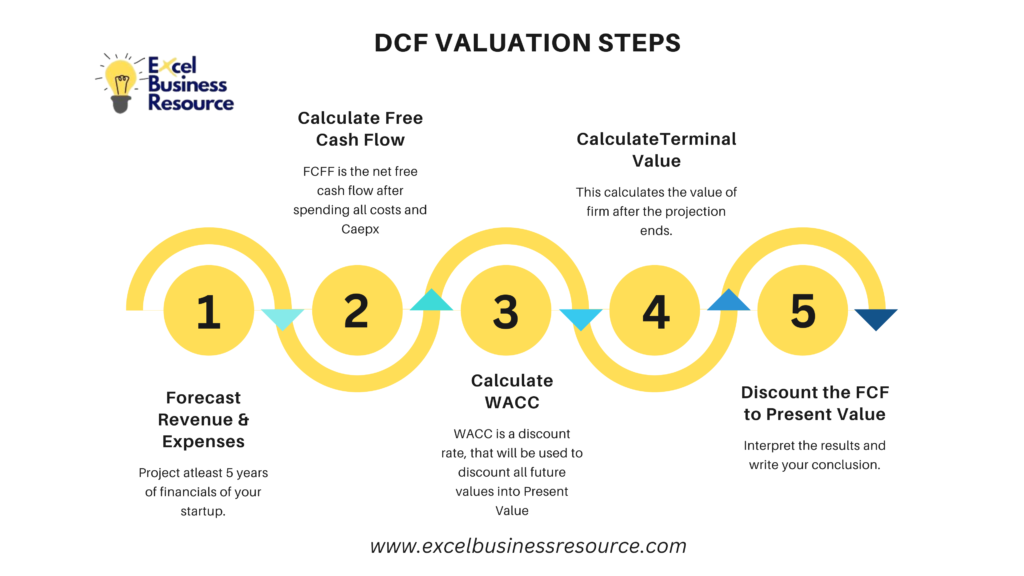
To begin, let's watch a short video that provides a clear, high-level walkthrough of this entire process.
Walk Me Through a DCF - Investment Banking Interview Question
The video 'Walk Me Through a DCF' from Financeable Training gives a concise, five-step framework for understanding the DCF model. This will serve as our roadmap for the rest of the lesson.
Watch the segment from 00:37 to 01:26. Focus on grasping the five main stages of the process: calculating Stage 1 cash flows, calculating terminal value (Stage 2), discounting to get enterprise value, and then working to equity value.
Now, let's break down each of these steps in more detail.
2. The Five Steps of a DCF Valuation
We will use the five-step framework from the video to structure our analysis. For a more detailed look at each calculation, we'll refer to another excellent video that includes practical Excel demonstrations. The goal is not for you to build the model yourself, but to understand what each component represents.
Step 1: Projecting Unlevered Free Cash Flow (UFCF)
The first step is to estimate the cash the business will generate. For valuation, we use Unlevered Free Cash Flow (UFCF). This represents the cash flow generated by the company's operations that is available to all capital providers, both debt holders and equity holders. It's "unlevered" because it's calculated before considering interest payments on debt.
The common formula is:
Let's break that down:
- EBIT(1-T): Earnings Before Interest and Taxes, adjusted for taxes. This is the company's core operating profit.
- + D&A (Depreciation & Amortization): These are non-cash expenses. We add them back because no actual money left the company.
- - CapEx (Capital Expenditures): Cash spent on long-term assets like machinery or buildings. This is a real cash outflow needed to maintain and grow the business.
- - ΔNWC (Change in Net Working Capital): Represents cash invested in short-term operational assets like inventory.
This forecast is typically made for a 5-10 year period, often called "Stage 1" or the explicit forecast period.
Discounted Cash Flow | DCF Model Step by Step Guide
The video 'Discounted Cash Flow | DCF Model Step by Step Guide' by Kenji Explains provides a clear breakdown of the UFCF formula and its components.
Watch from 02:36 to 04:30. Don't worry about the Excel details. Focus on the conceptual explanation of what Free Cash Flow is and why each component (EBIT, taxes, D&A, CapEx, Working Capital) is included in the calculation.
Step 2: Determining the Discount Rate (WACC)
Once we have our future cash flows, we need a discount rate to bring them to the present. In the last lesson, we used a simple interest rate. For a company with both debt and equity financing, we use the Weighted Average Cost of Capital (WACC).
The WACC represents the blended, average rate of return that a company must pay to all its investors (both lenders and shareholders). It accounts for the fact that equity is riskier (and thus has a higher cost) than debt.
Discounted Cash Flow | DCF Model Step by Step Guide
The next segment of the Kenji Explains video breaks down the concept and formula for WACC.
Watch from 06:18 to 08:32. Focus on understanding that WACC is a 'weighted average' of the cost of equity and the after-tax cost of debt. You don't need to memorize the formulas, but understand the principle.
Step 3: Calculating the Terminal Value
A company is expected to operate long past our 5-10 year forecast period. The Terminal Value (TV) is a single number that represents the value of all the company's cash flows from the end of the forecast period into perpetuity. This is often the largest single component of a DCF valuation.
There are two common methods to calculate it:
- Perpetuity Growth Method: Assumes the company's cash flows will grow at a slow, stable rate (e.g., the rate of GDP growth) forever.
- Exit Multiple Method: Assumes the company is "sold" at the end of the forecast period for a multiple of its earnings (e.g., 7x EBITDA), based on what similar companies are worth.
Discounted Cash Flow | DCF Model Step by Step Guide
This next section of the Kenji Explains video explains both methods for calculating Terminal Value.
Watch from 09:36 to 11:27. Understand the purpose of Terminal Value and the basic idea behind the two calculation methods.
Step 4: Discounting and Summing to Find Enterprise Value
Now we put it all together. We take each year's projected UFCF and the Terminal Value and discount them back to the present using the WACC.
The sum of all these present values gives us the company's Enterprise Value (EV). This represents the total value of the company's core business operations, attributable to all investors.

The following video segment demonstrates this discounting process.
Discounted Cash Flow | DCF Model Step by Step Guide
Watch how the projected cash flows and the terminal value are discounted and summed up to arrive at the Enterprise Value.
Watch from 12:04 to 13:50. Observe how the 'discount factor' gets smaller for cash flows further in the future, reflecting the time value of money. Notice that Enterprise Value is simply the sum of all the discounted cash flows.
Step 5: Calculating Equity Value and Share Price
Enterprise Value tells us what the whole business is worth. But as a shareholder (or a lawyer advising them), you often want to know what the owners' stake is worth. This is the Equity Value.
The calculation is a simple bridge:
- We subtract debt because it must be paid back to lenders before shareholders get anything.
- We add cash because it's an asset that belongs to the owners.
If you then divide the Equity Value by the number of shares outstanding, you get an implied value per share.
Discounted Cash Flow | DCF Model Step by Step Guide
This final short clip shows the simple adjustment from Enterprise Value to Equity Value.
Watch from 13:50 to 15:08. Focus on the straightforward formula used to move from the value of the business (EV) to the value for the owners (Equity Value).
Test your understanding!
A DCF analysis of a company has resulted in a calculated Enterprise Value of $500 million.
The company's balance sheet shows:
- Total Debt: $120 million
- Cash and Cash Equivalents: $20 million
What is the company's Equity Value?
Show answer
Using the formula: Equity Value = Enterprise Value - Debt + Cash
- Equity Value = $500 million - $120 million + $20 million
- Equity Value = $400 million
This $400 million represents the total value attributable to the company's shareholders.
3. The Lawyer's Perspective: Strengths and Weaknesses
A DCF model is a powerful tool, but it's not a crystal ball. For a lawyer, understanding its limitations is as important as understanding its mechanics. A valuation presented in a legal dispute can be attacked based on the assumptions that go into it.
Discounted Cash Flow: Complete Guide to DCF Valuation
This article from Ramp, 'Discounted Cash Flow: Complete Guide to DCF Valuation,' provides an excellent discussion of the model's strategic advantages and critical limitations.
Please read the six-step workflow section to solidify your understanding of the process. Then, focus carefully on the section 'Strategic advantages & limitations of DCF analysis'. Pay close attention to the limitations, such as 'Uncertain projections' and 'Terminal value sensitivity,' as these are often points of contention in legal settings.
As the article highlights, the primary weakness of a DCF is that it is highly sensitive to its assumptions. A small change in the growth rate or the WACC can lead to a huge change in the final valuation. This is famously known as the "Garbage In, Garbage Out" problem. When you see a DCF valuation in a legal document, your first questions should be about the assumptions: How did they arrive at this growth rate? Is this discount rate reasonable for an investment of this risk?
Conclusion
Congratulations on completing the "Corporate Formation and Capitalization" module! You have journeyed from choosing a business structure, to understanding how companies raise capital, and finally to learning how they are valued.
Key Takeaways from this Lesson:
- A Discounted Cash Flow (DCF) model estimates a company's intrinsic value by calculating the present value of its future cash flows.
- The process involves five key steps:
- Projecting Unlevered Free Cash Flow (UFCF) for a forecast period.
- Determining the Weighted Average Cost of Capital (WACC) as the discount rate.
- Calculating a Terminal Value to represent all future cash flows beyond the forecast.
- Discounting all cash flows to find the Enterprise Value.
- Adjusting for debt and cash to find the Equity Value.
- The greatest strength of a DCF is its focus on a company's fundamental ability to generate cash.
- Its greatest weakness is its extreme sensitivity to assumptions, making it a frequent subject of debate in legal and financial contexts.
In our next module, "Corporate Governance and Fiduciary Duties," we will shift our focus from the financial architecture of the corporation to its human element. We will explore the roles and responsibilities of the board of directors and officers who run the company, setting the stage for understanding the legal duties that govern their actions.