Hello! Welcome to your next lesson in the "Corporate Formation and Capitalization" module.
In our last lesson, we explored the strategic trade-offs between debt and equity financing. We learned that the goal of choosing a capital structure is to find the optimal balance that minimizes costs and risks while maximizing the value of the firm.
Today, we will dive into a concept that is the absolute foundation of valuation in finance: the time value of money (TVM). The learning outcome for this lesson is to explain the principle of the time value of money (TVM) and its application in valuation.
This principle is not just an abstract financial theory; it is the engine that powers nearly all corporate valuation. Understanding that a dollar today is worth more than a dollar tomorrow is the essential first step before we can determine what a project, an investment, or an entire company is worth. This lesson will provide the crucial groundwork for our next topic, where we will build a basic corporate valuation model.
1. The Core Principle: Why Time Is Money
Let's start with a simple question: would you rather receive $1,000 today or $1,000 one year from now?
The intuitive answer for almost everyone is to take the money today. This intuition is correct and forms the basis of the time value of money. A sum of money is worth more the sooner it is received. There are three main reasons for this, as outlined in the article from Harvard Business School Online that we'll look at shortly:
- Opportunity Cost: Money you have today can be invested and earn a return (like interest in a savings account), growing to a larger amount in the future.
- Inflation: The purchasing power of money tends to decrease over time. The $1,000 you receive in a year will likely buy less than $1,000 does today.
- Uncertainty: There is always a risk that a promised future payment will not be received. Having the money in hand today is certain.
These factors mean we can't compare money across different time periods directly. We need a way to translate future cash into its equivalent present-day value, or vice-versa. This is done using two key techniques: compounding and discounting.
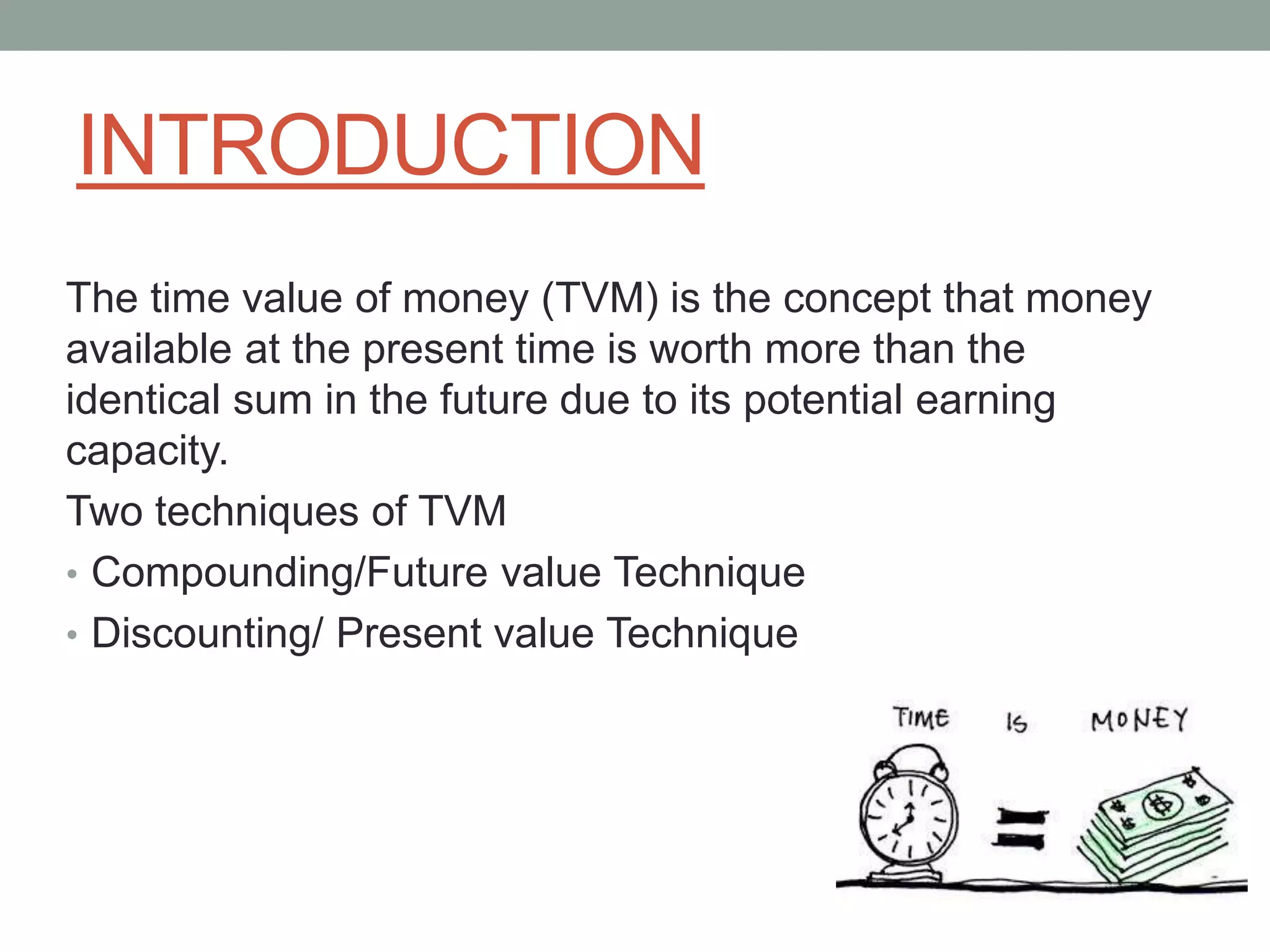
To get a feel for this core concept, let's start with a short, clear video explanation.
The Time Value of Money (Explained)
The video 'The Time Value of Money (Explained)' from the channel Marko - WhiteBoard Finance provides an excellent introduction to the concept using a simple lottery example.
Please watch from the beginning until 02:02. Focus on the explanation for why you wouldn't automatically wait to receive a larger sum of money in the future.
2. Calculating Future and Present Value
As the video and image suggest, TVM involves two related calculations:
- Future Value (FV): Calculating the future worth of a sum of money you have today. This process is called compounding. It's like asking, "If I invest $100 today at a 5% interest rate, how much will I have in three years?"
- Present Value (PV): Calculating the current worth of a sum of money you will receive in the future. This process is called discounting. This is the more common operation in corporate valuation and answers the question, "How much is the promise of receiving $100 in three years worth to me today?"
The formulas to do this are quite straightforward. For a single sum of money, assuming interest is applied annually, they are:
Future Value Formula:
Present Value Formula:
Where:
- FV = Future Value
- PV = Present Value
- i = The interest rate (for FV) or discount rate (for PV) per period. This rate represents the opportunity cost of money.
- t = The number of time periods (e.g., years).
Let's return to the video to see how these formulas are applied in practice.
The Time Value of Money (Explained)
The next segment of the video demonstrates how to use these formulas to calculate both future and present value.
Watch from 02:02 to 06:38. Pay close attention to how the same variables are rearranged to solve for either PV or FV. Notice how the interest rate (or discount rate) and time are the key factors determining the difference between present and future values.
3. TVM in Action: Making Business Decisions
These formulas are not just mathematical exercises; they are fundamental tools for corporate decision-making. Imagine a company has to choose between several investment opportunities, each with different costs and future payoffs. How can it decide which is best? It must compare them on a level playing field by calculating the present value of each option.
The following article from Harvard Business School Online provides a perfect, practical example of this process.
Time Value of Money (TVM): A Primer
This article demonstrates how a manager would use the present value formula to compare different projects and make a financially sound decision.
Please read the sections titled 'Time Value of Money Formula' and 'Calculating TVM Manually: An Example'. Focus on how calculating the present value allows for a direct, 'apples-to-apples' comparison of projects with different timelines and payouts (Project A, B, and C).
4. Application in Valuation: Net Present Value (NPV)
The method you saw in the HBS article—comparing the present value of future cash benefits to an initial cost—is formalized in one of the most important concepts in corporate finance: Net Present Value (NPV).
NPV is calculated as:
NPV = (Present Value of all future cash inflows) - (Initial Investment Cost)
The decision rule for NPV is simple and powerful:
- If NPV is positive (> 0), the project is expected to create value for the company and should be accepted.
- If NPV is negative (< 0), the project is expected to destroy value and should be rejected.
NPV is the primary tool companies use to evaluate everything from buying a new piece of machinery to launching a new product line or even acquiring another company.
This next short video explains the concept of NPV very effectively.
Net Present Value (NPV) explained
The video 'Net Present Value (NPV) explained' from The Finance Storyteller clearly illustrates how NPV works as a decision-making tool.
Please watch the entire video. Focus on how it builds on the PV concept, the step-by-step calculation of NPV, and the clear decision rule for accepting or rejecting a project.
Test your understanding!
A corporation is considering two mutually exclusive projects. It can only choose one.
- Project Alpha: Requires an initial investment of $100,000 today. It is expected to generate a single cash inflow of $150,000 in 3 years.
- Project Beta: Requires an initial investment of $100,000 today. It is expected to generate a single cash inflow of $130,000 in 2 years.
The company's discount rate for projects of this risk level is 10%. Calculate the Net Present Value (NPV) for each project. Based on your calculations, which project is the better investment and why?
Show answer
First, we need to calculate the Present Value (PV) of the future cash inflow for each project.
Project Alpha:
- PV = $150,000 / (1 + 0.10)^3
- PV = $150,000 / (1.10)^3
- PV = $150,000 / 1.331
- PV ≈ $112,697
Now, we calculate the NPV:
- NPV (Alpha) = $112,697 - $100,000 = $12,697
Project Beta:
- PV = $130,000 / (1 + 0.10)^2
- PV = $130,000 / (1.10)^2
- PV = $130,000 / 1.21
- PV ≈ $107,438
Now, we calculate the NPV:
- NPV (Beta) = $107,438 - $100,000 = $7,438
Conclusion: Both projects have a positive NPV, meaning both would create value for the company. However, since they are mutually exclusive, the company should choose the one with the higher NPV. In this case, Project Alpha is the better investment because it is expected to create more value ($12,697) in today's dollars compared to Project Beta ($7,438).
Conclusion
In this lesson, we established the fundamental principle of the time value of money and saw how it is applied in a corporate context. Understanding this is non-negotiable for anyone involved in business or corporate law, as it underpins every major financial decision.
Key Takeaways:
- The Time Value of Money (TVM) is the principle that a sum of money is worth more today than the same sum in the future due to opportunity cost, inflation, and uncertainty.
- Compounding is the process of finding the Future Value (FV) of a present sum.
- Discounting is the process of finding the Present Value (PV) of a future sum. This is the cornerstone of valuation.
- The discount rate is a critical variable that reflects the risk and opportunity cost associated with a future cash flow.
- Net Present Value (NPV) is a direct application of TVM, used to evaluate projects by comparing the present value of future cash inflows to the initial investment. A positive NPV indicates a value-creating investment.
We have now laid the final piece of foundational knowledge. In our next and final lesson of this module, we will use the concept of discounting to interpret a Discounted Cash Flow (DCF) model, one of the most widely used methods for determining the total value of a corporation.