Hello! Welcome to the next lesson in our module on Corporate Formation and Capitalization.
In our last few lessons, we've broken down the two fundamental ways a corporation can fund itself: by selling ownership (equity financing, through common and preferred stock) and by borrowing money (debt financing, through bonds and credit agreements). You now have a solid understanding of the legal characteristics of these instruments.
Today, we move from the "what" to the "why." This lesson addresses the crucial strategic question that every corporate leader and their legal counsel must face: how do you choose between these options? Our learning outcome is to evaluate the trade-offs between equity and debt financing for a corporation's capital structure.
Understanding this strategic balancing act is essential for a corporate lawyer. Your future clients won't just ask you to draft the documents; they will rely on your advice to help structure these financing decisions in a way that supports their business goals while managing legal and financial risks.
1. Capital Structure: The Core Concept
A company's capital structure is simply its mix of debt and equity. A company can be funded entirely by equity, mostly by debt, or—most commonly—a combination of the two.

The central challenge for any company is to find the optimal capital structure—the mix that best supports its operations and growth. To get a quick overview of this concept and the key trade-offs, please start with this short video.
Capital Structure: Debt vs. Equity Explained
The video 'Capital Structure: Debt vs. Equity Explained' from the Corporate Finance Institute provides a concise introduction to capital structure and the basic dynamics of debt versus equity.
Please watch the entire video. It's very short. Pay close attention to the definition of capital structure and the direct comparison of debt and equity characteristics.
As the video highlighted, this isn't an arbitrary choice. It's a strategic decision that balances competing priorities. Let's break down these trade-offs in more detail.
2. The Fundamental Trade-Offs: A Detailed Look
The decision between debt and equity revolves around a few key tensions. We'll explore them using a framework that contrasts their primary advantages and disadvantages.
To begin, please watch the first part of this lecture by Professor Aswath Damodaran, a leading expert in corporate finance. He provides a very clear distinction between debt and equity.
Session 17: Optimal Financing Mix I - The Trade Off
In this clip from his corporate finance course, Professor Damodaran lays out the fundamental differences between debt and equity claims.
Watch from 00:00:06 to 00:02:12. Focus on the five ways he differentiates debt from equity: the nature of the claim, tax deductibility, bankruptcy priority, role in management, and maturity.
Building on that foundation, let's organize the trade-offs into four key areas.
A. Control vs. Cost
This is often considered the primary trade-off.
- Debt Financing: When a company takes on debt, its existing owners retain full ownership and control. A lender does not get a vote on the board of directors or a say in the company's strategic direction (though they can impose restrictions via covenants, as we saw in the last lesson). The "cost" is the fixed, legal obligation to make periodic interest payments and repay the principal.
- Equity Financing: When a company issues equity, it is selling an ownership stake. This dilutes the ownership of the existing shareholders. New investors become part-owners, often gaining voting rights and influence over the company's governance. The "cost" is a share of the company's future profits and growth, but there is no legal obligation for repayment. Equity investors are paid only when the company is successful.
B. Risk vs. Reward
The risk profile of debt and equity is a mirror image for the company and the investor.
- Debt: For the company, debt is higher risk. The obligation to make fixed payments exists regardless of profitability. A downturn in business can lead to a default, potentially triggering bankruptcy. From a legal standpoint, this is a critical risk you would advise a client on. For the investor (lender), debt is lower risk because they have a contractual right to repayment and priority in a bankruptcy.
- Equity: For the company, equity is lower risk. There are no mandatory payments, so it provides a "cushion" during tough times. For the investor, equity is higher risk. They are last in line to be paid in a bankruptcy and may lose their entire investment if the company fails. This higher risk means they expect a higher potential reward (i.e., significant appreciation in stock value).
C. Tax Implications
This is a major financial and legal consideration where debt has a clear advantage.
Professor Damodaran explains the two main benefits of debt. Pay close attention to his explanation of the tax benefit.
Session 17: Optimal Financing Mix I - The Trade Off
Let's return to Professor Damodaran's lecture, where he explains the two primary benefits of using debt.
Watch from 00:06:48 to 00:08:26. Focus on his explanation of the tax benefit and the 'added discipline' benefit.
As he states, the single biggest advantage of debt is that interest payments are tax-deductible. This means they are treated as a business expense, which reduces the company's taxable income. In contrast, dividends paid to equity shareholders are paid from after-tax profits and are not deductible. This "tax shield" effectively lowers the cost of debt financing.
D. Flexibility vs. Discipline
Finally, there's a trade-off between operational freedom and managerial accountability.
Now, watch the next clip, where Professor Damodaran discusses the costs associated with debt, which provides the other side of this trade-off.
Session 17: Optimal Financing Mix I - The Trade Off
This clip outlines the three major costs associated with debt, which act as a counterbalance to its benefits.
Watch from 00:08:26 to 00:11:24. Focus on the concepts of bankruptcy costs, agency costs (conflicts between lenders and owners), and the loss of future flexibility.
- Debt: The "added discipline" Damodaran mentions forces management to be efficient, as they must generate enough cash to service the debt. However, this comes at the cost of reduced flexibility. As we saw in the previous lesson on credit agreements, debt often comes with restrictive covenants that limit a company's ability to take risks, sell assets, or make other strategic moves.
- Equity: Equity financing offers greater flexibility. With no required payments and fewer restrictions, management has more freedom to pursue long-term, high-risk projects. The trade-off is less built-in financial discipline.
The following table provides a concise summary of these core differences.
Capital Structure Scenarios: Debt vs. Equity
The webpage 'Capital Structure Scenarios' offers a very clear comparison table that summarizes the points we've just discussed.
Please read the sections 'Advantages and Disadvantages of Debt Financing' and 'Advantages and Disadvantages of Equity Financing' and review the 'Debt vs. Equity Comparison Table'. This will reinforce your understanding of the core trade-offs.
3. Finding the Optimal Balance: The Trade-Off Theory
Given these competing factors, how does a company find its ideal capital structure? Corporate finance theory provides a powerful framework called the Trade-Off Theory.
The theory states that the optimal capital structure is the point where the benefits of debt are maximized relative to its costs.
- Benefit of More Debt: The primary benefit is the tax shield. Each dollar of interest paid saves the company money on taxes, which increases the overall value of the firm.
- Cost of More Debt: As a company takes on more debt, its risk of financial distress and potential bankruptcy increases. Bankruptcy isn't just a legal process; it's incredibly costly. It involves direct costs (legal and administrative fees) and indirect costs (lost customers, fleeing employees, and damaged supplier relationships).
The optimal capital structure is achieved at the debt level where the marginal benefit of the tax shield is exactly offset by the marginal cost of increased financial distress.
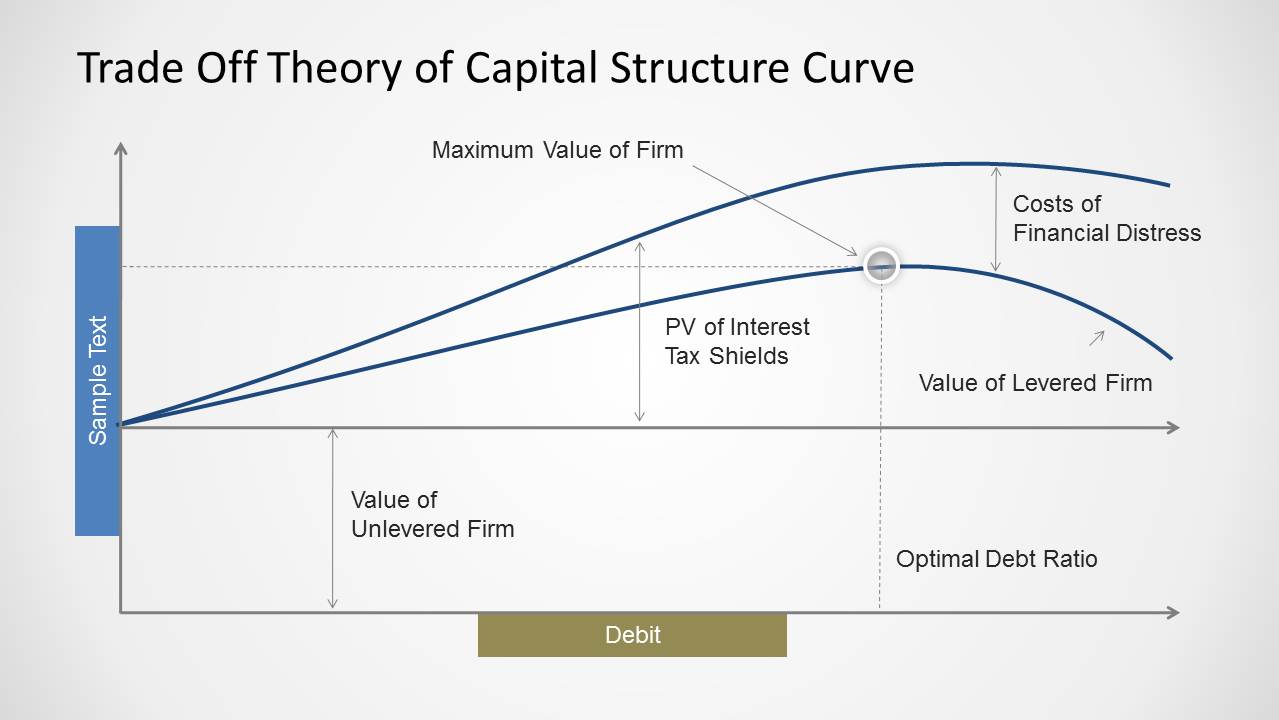
This is why the decision matters so much. The right balance maximizes firm value, while too much debt can destroy it.
Test your understanding!
A mature, highly profitable company in a stable industry (e.g., a utility company) currently has no debt. Its Chief Financial Officer (CFO) suggests borrowing money to buy back some of its stock. From a tax perspective, why might this be a good idea? According to the Trade-Off Theory graph, what risk does the company face if it borrows too much?
Show answer
From a tax perspective, this is a good idea because the interest on the new debt will be tax-deductible. This creates a "tax shield" that lowers the company's overall tax bill and, all else being equal, increases its total value.
The risk, according to the Trade-Off Theory, is that if the company borrows too much, the costs of potential financial distress will begin to outweigh the tax benefits. Even a stable company can face unexpected economic shocks. Excessive debt could make it difficult to make payments during a downturn, increasing the risk of bankruptcy and its associated costs, which would ultimately decrease the firm's value.
4. A Practical Framework for the Decision
Theory provides the "why," but real-world context determines the "how." The right capital structure is not one-size-fits-all. It depends on the company's specific situation.
The following article offers a superb diagnostic framework for making this decision.
Debt vs. Equity: Choosing Growth Without Losing the Wheel
The article 'Debt vs. Equity: Choosing Growth Without Losing the Wheel' provides a CEO's checklist for making the financing decision. This is exactly the kind of strategic thinking a corporate lawyer needs to understand.
Please read the sections 'The Fundamental Trade-Off: Control vs. Cost' and 'The Five-Dimensional Diagnostic: A CEO's Checklist'. Focus on the five key factors and the 'CEO Question' for each one.
Let's summarize that excellent framework. The choice depends on:
- Stage of Business: Early-stage, pre-profit startups with uncertain futures rely on equity ("exploring"). Mature, profitable companies with predictable cash flows can handle debt ("executing"). Professor Damodaran also explains this concept through the "corporate life cycle."
- Health of Cash Flow: Can the company comfortably handle a fixed monthly payment? If cash flow is volatile or negative, debt is dangerous. Stable, predictable cash flow makes debt a viable option.
- Growth Trajectory & Exit Strategy: Is the goal hyper-growth toward an IPO (a "rocket ship")? This requires patient equity capital. Is the goal long-term, stable profitability (a "cathedral")? Debt allows founders to retain ownership and future profits.
- Tolerance for Dilution & External Influence: Does the founder want a strategic partner (equity investor) or a silent creditor (lender)? This is a question of control and autonomy.
- Market Conditions & Asset Base: When interest rates are high, debt is more expensive. Companies with few tangible assets (like software companies) may find it hard to get loans and rely more on equity, whereas companies with machinery or real estate can use them as collateral for debt.
To see this in action, consider this simple case study comparing two financing scenarios.
Capital Structure Scenarios: Debt vs. Equity
Let's return to 'Capital Structure Scenarios' to see a concrete example.
Please read the section 'Scenario Analysis for Capital Structure Optimization'. Notice how the debt-heavy 'Scenario A' and equity-heavy 'Scenario B' impact monthly payments, ownership, and risk.
This case study clearly illustrates the trade-offs: Scenario A (high debt) preserves ownership but creates high cash flow pressure and risk. Scenario B (high equity) provides flexibility but at the cost of significant ownership dilution.
Conclusion
Today we moved beyond the mechanics of debt and equity to understand the strategic thinking behind choosing a capital structure. As a corporate lawyer, your role is not just to execute the transaction but to advise on a path that aligns with the client's goals and risk tolerance.
Key Takeaways:
- Capital Structure is the mix of debt and equity a company uses to finance its assets.
- The choice between debt and equity involves fundamental trade-offs between Control vs. Cost, Risk vs. Reward, Tax Benefits vs. Flexibility, and Discipline vs. Dilution.
- Debt offers a powerful tax advantage and allows owners to retain control, but it introduces fixed payments and bankruptcy risk.
- Equity is flexible, patient capital that doesn't need to be repaid, but it requires giving up ownership and a share of future profits.
- The Trade-Off Theory explains that the optimal capital structure balances the tax benefits of debt against the rising costs of financial distress to maximize firm value.
- In practice, the right choice depends on the company's stage, cash flow stability, growth plans, and market conditions.
In our next lesson, we will introduce a concept that is fundamental to nearly all of corporate finance and valuation: the time value of money (TVM). Understanding that a dollar today is worth more than a dollar tomorrow is the essential building block for our next major topic: figuring out what a company is actually worth.