Hello! Welcome to the first lesson in our fifth module, "Corporate Governance and Fiduciary Duties."
In the previous module, we focused on the financial and structural architecture of a corporation. We explored how a company is formed, how it raises capital through equity and debt, and how it's valued using models like Discounted Cash Flow (DCF). We've effectively built the corporate "machine."
Now, we shift our focus to the people who operate that machine. This module is about the "who"—the directors and officers responsible for steering the corporation. Today's lesson addresses a foundational question: What does a board of directors actually do? Our learning outcome is to describe the role and general responsibilities of a corporate board of directors.
Understanding this is paramount for a future corporate lawyer. The board is the central governing body, and much of corporate law practice revolves around advising directors on their powers, duties, and potential liabilities.
1. The Core Purpose of a Board: Bridging the Gap
Before we dive into what a board does, we need to understand why it exists. In a small company, the owner is often also the manager. But in a large corporation, the owners (thousands of shareholders) are separate from the people who run the company day-to-day (the managers).
This creates what is known as the agency problem: the potential for a conflict of interest between the owners (the "principals") and the managers (the "agents"). The managers might be tempted to act in their own self-interest (e.g., increasing their own pay or job security) rather than in the best interest of the shareholders (e.g., maximizing long-term company value).
The board of directors is the primary mechanism designed to solve this problem. It is a group of individuals, elected by the shareholders, whose fundamental purpose is to oversee management and ensure the company is run for the benefit of its owners.
The basics of Corporate Governance
This short video, 'The basics of Corporate Governance' by Practice Tests Academy, does an excellent job of explaining this fundamental 'divorce between ownership and control' and why it makes corporate governance necessary.
Please watch the first part of the video, from the beginning to 01:49. Focus on understanding the core conflict between shareholder objectives and director objectives that the board is meant to resolve.
2. The Board's Mandate: Key Roles and Responsibilities
While the board's overarching mandate is to govern the corporation on behalf of shareholders, this translates into several specific areas of responsibility. A board's role is one of oversight and strategic guidance, not day-to-day management, which is delegated to the company's executives.
As the legal resource from Wolters Kluwer puts it, "Generally, the board of directors is responsible for making major business and policy decisions and the officers are responsible for carrying out the board’s policies and for making the day-to-day decisions."
We can group the board's primary responsibilities into five key areas, as shown in the infographic below.
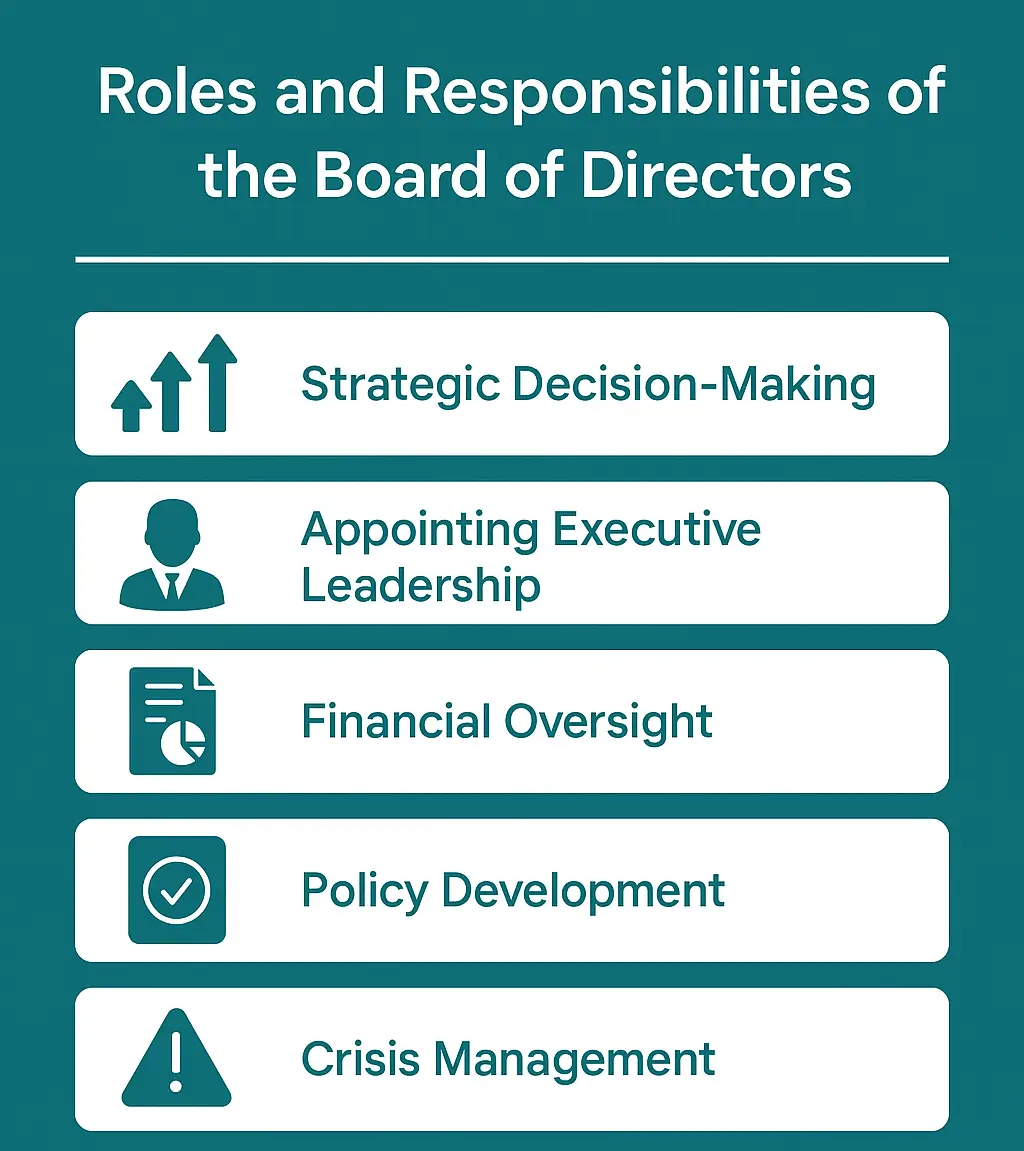
Let's explore these functions in more detail.
Board of Directors: Definition and Role
The article 'Board of Directors: Definition and Role' from Investopedia provides an excellent, detailed breakdown of these responsibilities.
Please read the section titled 'Role of a Board of Directors.' As you read the bulleted list, connect each point back to one of the five core functions in the infographic above (e.g., 'hiring and dismissal of senior executives' falls under 'Appointing Executive Leadership').
To summarize the key functions from another perspective, a board is expected to:
- Set Strategic Direction: The board establishes the company's vision and long-term strategy, ensuring it pursues sustainable growth and profitability while considering risks and stakeholder interests.
- Ensure Accountability: The board holds management accountable for performance. This includes overseeing financial reporting, ensuring the company has effective internal controls, and communicating progress to shareholders.
- Maintain Leadership and Culture: The board is responsible for hiring, evaluating, and, if necessary, firing the CEO. It also oversees succession planning and works to ensure the company fosters an ethical, value-based culture.
3. The Board's Structure: The "Who" and "How"
Now that we know what a board does, let's look at how it's structured. Corporate boards are not all the same, and their composition is critical to their effectiveness.
Board Structures: Unitary vs. Dual Boards
Globally, there are two main models for board structure.
- Unitary Board: This is a single board composed of both executive directors (senior managers of the company, like the CEO) and non-executive directors (outsiders who are independent of management). This model is common in the U.S., the U.K., and most of the Commonwealth. It promotes direct information flow and collaboration between managers and independent overseers.
- Dual Board (or Two-Tier Board): This system features two separate boards: a supervisory board (composed entirely of non-executives) and a management board (composed entirely of executives). The supervisory board oversees the management board. This model, common in countries like Germany and the Netherlands, creates a very clear separation between oversight and management.
The following video explains these structures and their respective pros and cons.
The video 'Directors & Board Structure' by Dr. Foo Yin Fah provides a clear comparison between the unitary and dual board systems.
Watch the segment from 02:12 to 06:55. Focus on the key differences in composition, appointment, and the flow of information between the two structures.
Key Roles on a Unitary Board
Since you'll primarily encounter the unitary board system in a U.S. or U.K. corporate law context, let's examine its key players.

- Chairperson: The leader of the board. The Chair runs board meetings, sets the agenda, and ensures the board functions effectively. For good governance, it is widely considered best practice for this role to be held by an independent, non-executive director, separate from the CEO.
- Chief Executive Officer (CEO): The top executive in the company, responsible for running the day-to-day business and implementing the strategy set by the board. The CEO reports to the board.
- Non-Executive Directors (NEDs): Independent directors who do not hold management positions. Their primary role is to bring outside perspective, challenge management's thinking, and monitor the company's performance on behalf of shareholders.
- Company Secretary: An officer who assists the board with administrative and compliance matters, such as scheduling meetings, taking minutes, and advising on governance rules. This role often requires a legal background.
Test your understanding!
A major corporation announces that its long-serving CEO will also take on the role of Chairperson of the board. Based on what you've learned, why might corporate governance experts and shareholder advocacy groups criticize this decision?
Show answer
They would likely criticize this move because combining the roles of CEO and Chairperson concentrates too much power in one person. The board's key responsibility is to oversee the CEO and management. If the CEO is also leading the board, it compromises the board's independence and ability to effectively challenge and monitor the CEO's performance. The person running the company is also in charge of the group that's supposed to be supervising them, creating a clear conflict of interest.
Conclusion
In this lesson, we have established the foundational role of the corporate board of directors. You have learned that the board is not involved in daily operations but rather serves as the crucial oversight body that connects the company's owners with its managers.
Key Takeaways:
- The board of directors exists primarily to solve the agency problem that arises from the separation of ownership (shareholders) and control (management).
- The board's role is one of strategic oversight, not day-to-day management.
- The core responsibilities of a board include: setting strategic direction, hiring and overseeing the CEO, ensuring financial integrity and risk management, and setting major corporate policies.
- The most common board structure in the U.S. and U.K. is the unitary board, which includes both executive and independent non-executive directors.
- Key roles like the Chairperson and CEO are ideally kept separate to ensure independent oversight.
Now that we understand what the board is responsible for, the next logical question is: To what legal standard are they held? In our next lesson, we will delve into the heart of corporate law by examining the fiduciary duties of care and loyalty. These are the legal duties that directors owe to the corporation and its shareholders, and they form the basis for holding directors accountable for their actions.