Hello! Welcome to your second lesson in the "Corporate Governance and Fiduciary Duties" module.
In our last lesson, we established that a corporation's board of directors acts as the crucial oversight body, representing the shareholders' interests and guiding the company's strategic direction. We learned what the board does. Today, we address the critical follow-up question: To what legal standard are directors held when they perform their duties?
This lesson introduces one of the most fundamental concepts in corporate law: fiduciary duty. Our learning outcome is to define fiduciary duty in the corporate context, including its two core components: the duty of care and the duty of loyalty. Understanding these duties is essential for a corporate lawyer, as nearly all legal challenges against director actions are based on an alleged breach of one or both of them.
1. What is a Fiduciary? The Foundation of Trust
At its heart, a fiduciary relationship is one of trust. A fiduciary is a person who has a duty to act for another's benefit in matters connected to their relationship. In the corporate world, directors are fiduciaries for the corporation and its shareholders.
This concept has deep roots in the law of agency, where an "agent" (like an employee or a director) acts on behalf of a "principal" (an employer or a shareholder). Because the principal entrusts the agent with power and responsibility, the law imposes special duties on the agent to ensure they act in the principal's best interests.
Corporate Law Fiduciary Duties of Directors (Review)
To understand this foundational link between agency law and corporate duties, watch the first part of the video 'Corporate Law Fiduciary Duties of Directors (Review)' by Business Law Education. It clearly explains why directors are considered agents of the shareholders.
Please watch from the beginning to 02:49. Focus on the concept of directors as 'stewards' or 'caretakers' for the shareholders, who are the true owners.
This broad fiduciary duty is traditionally broken down into two main pillars. Think of them as the twin obligations that guide every decision a director makes.
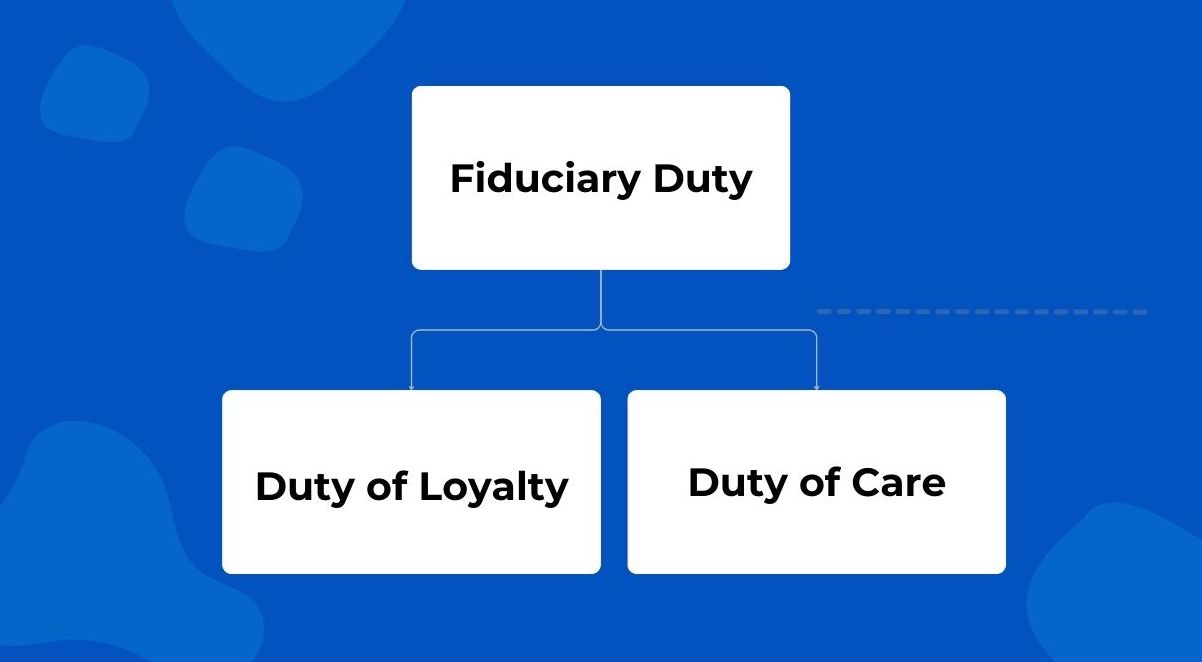
Let's get a quick, clear overview of both duties before we analyze each one in more detail.
The Five Minute Legal Master Series: Fiduciary Duties of Officers or Directors of a Corporation
The 'Five Minute Legal Master Series' offers a concise and accessible explanation of both the duty of loyalty and the duty of care. It's a great starting point for understanding the core ideas.
Please watch the entire video (it's under 5 minutes). Pay close attention to how it distinguishes the duty of loyalty (avoiding conflicts of interest) from the duty of care (being informed and deliberative).
Now that you have a high-level understanding, let's dissect each duty with more legal precision.
2. The Duty of Loyalty: Undivided Allegiance
The Duty of Loyalty is often considered the more stringent of the two duties. It addresses a director's motivations and potential conflicts of interest.
At its core, the Duty of Loyalty requires a director to act in good faith and in a manner they reasonably believe to be in the best interests of the corporation and its shareholders, not in their own personal interest. It demands that a director must not engage in "self-dealing" or put their personal interests ahead of the corporation's.
Delaware courts, whose rulings are highly influential in U.S. corporate law, have described this duty in famously strong terms. In the landmark case Guth v. Loft, Inc., the court stated that the duty of loyalty demands an "undivided and unselfish loyalty to the corporation, [demanding] that there... be no conflict between duty and self-interest."
Fiduciary Duties of the Board of Directors
For a practical legal definition, let's turn to the 'Fiduciary Duties of the Board of Directors' practice note from Practical Law. It clearly defines the duty and the types of actions that would constitute a breach.
Please read the section titled 'Duty of Loyalty'. Focus on how it is defined as both an affirmative duty (to protect the corporation's interests) and a negative obligation (to refrain from conduct that would harm the corporation).
Examples of a breach of the Duty of Loyalty include:
- A director causing the corporation to enter into a contract with another company owned by the director's spouse, without disclosing the conflict and on terms unfavorable to the corporation.
- A director learning of a lucrative opportunity (e.g., a chance to acquire a smaller company) through their board position and pursuing that opportunity for their own personal gain instead of for the corporation.
- A director using confidential corporate information, like a customer list, to start a competing business.
3. The Duty of Care: The Prudent Person Standard
While the Duty of Loyalty is about a director's motivation (the "why"), the Duty of Care is about their process (the "how").
The Duty of Care requires that a director, when making decisions, acts with the level of care that an ordinarily careful and prudent person would use in a similar position and under similar circumstances. It is fundamentally a duty to be informed and to make decisions with appropriate deliberation.
Fiduciary Duties of the Board of Directors
Let's return to the 'Fiduciary Duties of the Board of Directors' practice note to examine its definition of this duty.
Please read the section titled 'Duty of Care'. Note the specific standard of care and, importantly, what the duty does not require (e.g., a duty to always maximize profits). This is a critical nuance.
Key points to remember about the Duty of Care:
- It's about process, not outcome. A director can comply with the duty of care and make a decision that, in hindsight, turns out to be wrong. The key is whether the decision-making process was sound.
- The standard is objective. A director is held to the standard of a "reasonably prudent director," not to their own personal level of knowledge or expertise. Someone with no financial background who joins a board is expected to get up to speed and act with the same care as any other director in that role.
- It requires being informed. A director must review all reasonably available material information before making a decision. Simply "rubber-stamping" a CEO's recommendation without independent review is a classic breach of this duty.
Test your understanding!
A corporation's board is considering acquiring a smaller tech company. Director A has a significant, undisclosed ownership stake in the target tech company. Director B doesn't read any of the financial reports or expert analyses provided to the board, and instead spends the board meeting texting. Both vote to approve the acquisition.
Which duty has each director most likely breached, and why?
Show answer
- Director A has most likely breached the Duty of Loyalty. The problem is a conflict of interest. Director A stands to benefit personally from the acquisition, so their loyalty is divided between their own financial interests and the corporation's best interests.
- Director B has most likely breached the Duty of Care. The problem is a failure in the decision-making process. Director B failed to become informed and act with the diligence of a reasonably prudent person. Their vote was not based on a careful consideration of the facts.
Conclusion
Today, we've defined the legal bedrock of a director's responsibility: fiduciary duty. This duty ensures that those entrusted with the power to manage a corporation are held accountable to act in its best interests.
Key Takeaways:
- Directors are fiduciaries who owe a duty of trust and responsibility to the corporation and its shareholders.
- This fiduciary duty is comprised of two core components: the Duty of Loyalty and the Duty of Care.
- The Duty of Loyalty requires directors to act with "undivided and unselfish loyalty," putting the corporation's interests ahead of their own and avoiding conflicts of interest.
- The Duty of Care requires directors to be informed and deliberative in their decision-making, acting with the prudence that a reasonable person would in similar circumstances.
We have now defined what these two duties are. In our next lesson, we will build on this foundation to further distinguish between the duty of care and the duty of loyalty. We will explore more nuanced scenarios and begin to understand how courts analyze whether a director's conduct has met these critical legal standards.