Hello! Welcome to the final lesson in our module on Business and Economic Foundations.
In our last lesson, we explored the four main market structures and saw how firms in monopolies and oligopolies can wield significant market power. This often leads to higher prices and lower output than would exist in a competitive market, which is generally not good for consumers or the economy as a whole.
Today, we will address the logical next question: What can be done about this? This lesson will focus on the economic reasons why governments intervene in markets. You will learn to evaluate the economic rationale for government regulation of markets and antitrust enforcement. We will explore when intervention is justified, the tools governments use, and the potential pitfalls of intervention itself. This is a crucial topic, as it forms the theoretical underpinning for major areas of corporate law you will encounter, including antitrust, securities, and industry-specific regulation.
1. The Core Rationale: Correcting Market Failures
The primary economic justification for government intervention is the existence of a market failure. A market failure occurs when an unregulated market, left to its own devices, fails to allocate resources efficiently, leading to a worse outcome for society than is possible.
To understand this concept more formally, let's start with a foundational reading.
This chapter from an Economic Report of the President provides a clear, high-level overview of the economic principles behind regulation. It defines market failure and outlines the main reasons for government intervention.
Please read the introduction of this chapter (pages 239-240). Focus on the definition of market failure and the three main examples given: imperfect information, negative externalities, and natural monopoly. Also, note the discussion on why government intervention itself can be inefficient.
As the reading highlights, while markets are usually efficient, they can fail. In this course, we are primarily concerned with two major sources of market failure:
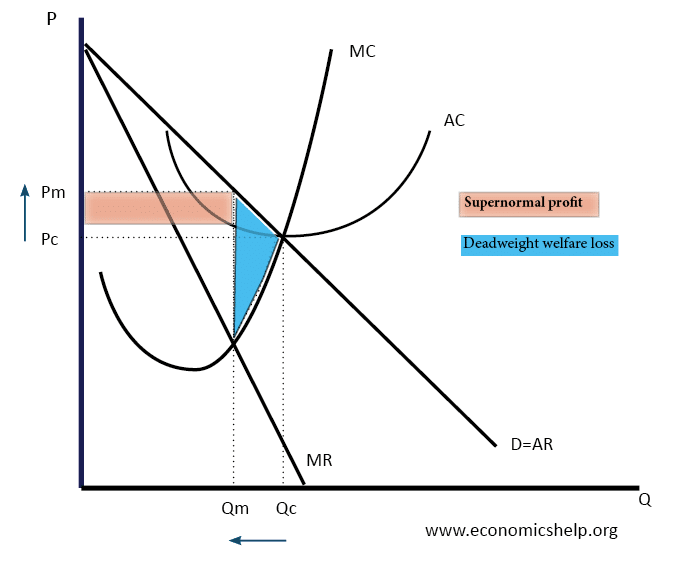
- Lack of Competition (Monopoly Power): As we saw last lesson, a monopolist can raise prices above the competitive level by restricting output. This creates a loss of economic efficiency known as deadweight loss.
- Imperfect or Asymmetric Information: This occurs when one party in a transaction has more or better information than the other. A classic example in corporate law is that a company's managers (the agents) know far more about the firm's health and prospects than its shareholders (the principals).
Visualizing the Cost of Monopoly
The concept of deadweight loss can seem abstract, but it represents a real loss of value to society. The graph below illustrates this loss. A competitive market would produce at quantity and price . A monopolist, however, will maximize its profit by producing less () and charging a higher price (). The orange area is the monopolist's excess profit. The blue triangle represents the deadweight welfare loss: transactions that would have occurred in a competitive market (benefiting both some consumers and the producer) but do not happen under the monopoly. This loss is the core economic argument against monopoly.
To combat these market failures, governments primarily use two tools: antitrust law and direct regulation.
2. Toolkit #1: Antitrust Enforcement
Antitrust laws are designed to protect and promote competition. Rather than telling a firm what price to charge, they set the rules of the game to ensure the market remains competitive.
To get a dynamic overview of what antitrust law is and how it works, let's watch a segment from Crash Course.
Monopolies and Anti-Competitive Markets: Crash Course Economics #25
This video from Crash Course Economics explains the history and application of antitrust laws in a very accessible way, using famous real-world examples.
Please watch the section from 03:28 to 05:42. Pay attention to the purpose of the Sherman Act and how government agencies like the Department of Justice (DOJ) and Federal Trade Commission (FTC) regulate horizontal and vertical mergers to prevent monopolization. The examples of AT&T/T-Mobile and Microsoft are classic case studies.
As the video explained, antitrust laws are a cornerstone of market regulation. For your future legal studies, it's helpful to know the main statutes that govern this area in the United States.
Antitrust Law and Democratic Capitalism
This article from Georgetown Law provides a concise primer on the key U.S. antitrust statutes.
Please read the introduction and the section 'Key Principles of Antitrust Law'. Focus on understanding the distinct purpose of the three main acts: the Sherman Act (prohibiting monopolization and cartels), the Clayton Act (addressing specific anti-competitive practices and mergers), and the FTC Act (a broader prohibition on unfair competition).
In essence, antitrust law provides the legal framework to:
- Break up monopolies or punish firms for illegally acquiring or maintaining monopoly power.
- Prosecute cartels for price-fixing and other forms of collusion.
- Block mergers and acquisitions that would "substantially lessen competition" and harm consumers.
3. Toolkit #2: Direct Regulation
While antitrust law promotes competition, direct regulation involves the government stepping in to dictate the terms of conduct, often in markets where competition isn't feasible or desirable. This is often called a "command-and-control" approach.
Y1 31) Regulation and Market Failure
This video from EconplusDal clearly defines regulation and explains its 'command-and-control' nature.
Please watch the first two minutes of this video (00:00 to 02:02). Focus on the definition of regulation as a non-market-based approach and the different forms of 'commands' the government can use (e.g., bans, limits, caps).
There are two classic scenarios in corporate and economic law where direct regulation is used:
A. Natural Monopolies
Some markets, like local water or electricity distribution, are natural monopolies. It would be incredibly inefficient to have multiple companies laying their own pipes and wires throughout a city. In these cases, the government typically allows a single firm to operate but directly regulates the prices it can charge to prevent it from exploiting its monopoly position. The Crash Course video you watched earlier briefly covers this concept.
B. Information Asymmetries and Corporate Governance
To address information imbalances, particularly between a public company's management and its investors, the government imposes extensive disclosure regulations. The most significant piece of U.S. legislation in this area in recent decades is the Sarbanes-Oxley Act of 2002 (SOX), passed in response to major accounting scandals. SOX is a prime example of regulation aimed at correcting an information-based market failure. The "Economic Regulation" paper you read earlier has an excellent section on this.
If you need a refresher, please re-read the section titled "Corporate Governance Reform" (pages 249-251) in the 'Economic Regulation' resource (LINK). It details how SOX uses regulation to improve information accuracy and management accountability.
Test your understanding!
Imagine the following scenarios. For each one, decide whether the government's primary response would likely be antitrust enforcement or direct regulation. Briefly explain why.
- The two largest office supply companies in the country announce a plan to merge into one giant firm.
- Your local cable company, the only provider in town, wants to double its monthly subscription fee.
- A group of international airline executives are recorded secretly agreeing to raise ticket prices on transatlantic flights by 20%.
Show answer
- Antitrust Enforcement. This is a merger review issue. The FTC and DOJ would analyze the merger under the Clayton Act to determine if it would substantially lessen competition in the office supply market, potentially leading to higher prices. They might sue to block the merger.
- Direct Regulation. This is a natural monopoly scenario. Since it's inefficient to have competing cable lines, the local government might have a franchise agreement that gives it the power to approve or deny rate hikes to protect consumers from monopoly pricing.
- Antitrust Enforcement. This is a classic example of price-fixing, which is an illegal anti-competitive agreement under the Sherman Act. The DOJ would investigate and likely bring criminal charges against the executives and civil charges against the airlines.
4. Evaluating the Solution: The Problem of Government Failure
So far, we've focused on the rationale for intervention. But "evaluation" requires looking at the other side. Government intervention is not a magic bullet and can create its own set of problems, collectively known as government failure.
Regulation can be costly, have unintended consequences, and be influenced by political pressure rather than the public interest. A wise policymaker—and a good lawyer—must weigh the potential benefits of fixing a market failure against the potential costs of government failure.
Y1 31) Regulation and Market Failure
Let's return to the EconplusDal video, which does an excellent job summarizing the significant drawbacks and potential for government failure when using regulation.
Please watch the section on the issues with regulation, from 03:11 to 05:46. Focus on the main arguments against regulation: high administrative and enforcement costs, the risk of setting rules too strictly or too leniently, and unintended consequences like creating black markets or causing firms to shut down.
The core trade-off is this: is the problem of an unregulated market (the market failure) worse than the problem of a regulated one (the government failure)? There is no single right answer; it is the central and ongoing debate in law and economics.
Conclusion
Today we connected the dots between the market structures we've learned about and the legal frameworks designed to address their shortcomings. You now have a theoretical lens to understand why so much of corporate law exists.
Key Takeaways:
- The main economic rationale for government intervention is to correct market failures, such as monopolies and information asymmetries, which lead to inefficient outcomes like deadweight loss.
- Antitrust laws (e.g., the Sherman and Clayton Acts) are a primary tool used to promote competition by prohibiting monopolization, blocking anti-competitive mergers, and punishing cartels.
- Direct regulation is a "command-and-control" approach used when competition is not feasible (as in a natural monopoly) or to correct other failures like information gaps (as with the Sarbanes-Oxley Act).
- Evaluating intervention requires balancing the costs of market failure against the costs and risks of government failure, such as high enforcement costs and unintended consequences.
This lesson concludes our first module on the economic foundations of business. You now have a solid grasp of supply and demand, firm behavior, market structures, and the rationale for regulation.
In our next lesson, we will begin Module 2: Financial Accounting for Lawyers. We will shift our focus from the broad market to the inner workings of a single corporation, starting with the absolute bedrock of accounting: the accounting equation. This will be your first step in learning to "speak the language of business," an essential skill for any corporate lawyer.