Hello! Welcome to the first lesson in our second module, Financial Accounting for Lawyers.
In the previous module, we explored the economic landscape in which businesses operate, looking at market forces and the role of government. Now, we shift our focus from the external market to the internal workings of the corporation itself. To do this, we must learn to "speak the language of business," which is accounting. For a corporate lawyer, this is not just an abstract skill; it's essential for advising on mergers, financings, and ensuring regulatory compliance.
Today's lesson will introduce you to the absolute bedrock of all accounting: the accounting equation. By the end of this lesson, you will be able to apply the accounting equation (Assets = Liabilities + Equity) to understand how business transactions affect a company's financial structure. This single, elegant equation is the foundation for the balance sheet and the entire system of double-entry bookkeeping.
1. The Fundamental Equation of Business
At its core, accounting provides a framework to describe a company's financial reality. The most fundamental expression of this reality is the accounting equation. It states that what a business owns must equal the claims against those things.

Let's break down this simple but powerful idea.
The ACCOUNTING EQUATION For BEGINNERS
To start, let's watch a short, clear introduction to the accounting equation from the 'Accounting Stuff' channel. This will give you a great overview of the core concepts.
Please watch the video from the beginning until 01:59. Focus on the simple definitions for Assets, Liabilities, and Equity, and the common examples provided for each.
As the video explained, the equation is:
Let's formally define these terms:
-
Assets: These are the economic resources a company owns that have future economic value. Think of them as everything the company has at its disposal to generate future income.
- Examples: Cash, inventory (goods for sale), accounts receivable (money owed to the company by customers), buildings, and equipment.
-
Liabilities: These are a company's obligations or debts—what it owes to outside parties (creditors).
- Examples: Loans, accounts payable (money the company owes to its suppliers), and wages payable.
-
Equity: This represents the owners' stake in the company. It's the residual value remaining in the assets after all liabilities have been paid. For this reason, it's often called "net assets." In a corporation, this is referred to as Shareholders' or Stockholders' Equity.
- Equity can be thought of as the owners' claim on the company's assets. It's calculated as:
- Equity can be thought of as the owners' claim on the company's assets. It's calculated as:
This equation must always be in balance. This is not just a convention; it's a logical necessity. Every asset a company has must have a source—it was either financed by debt (a liability) or funded by the owners (equity).
2. The Equation in Action: Analyzing Transactions
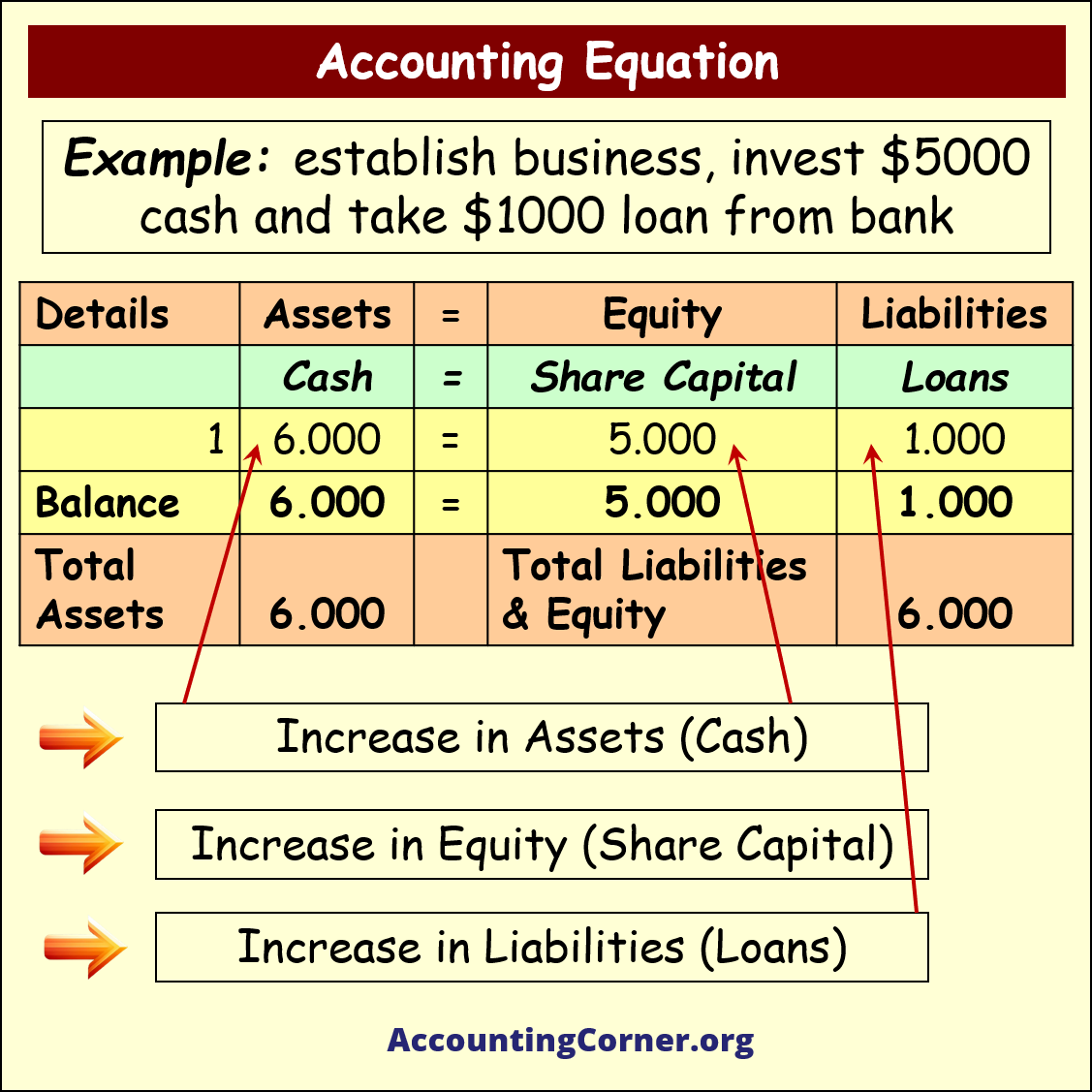
The true power of the accounting equation is revealed when we use it to analyze business transactions. Every transaction, no matter how complex, can be broken down into its effects on assets, liabilities, and equity. The key principle is double-entry accounting: every transaction affects at least two accounts, and in doing so, keeps the fundamental equation in balance.
Let's see how this works. A transaction can:
- Increase both an asset and a liability/equity account. (e.g., getting a bank loan increases Cash and increases Loans Payable).
- Decrease both an asset and a liability/equity account. (e.g., paying off a loan decreases Cash and decreases Loans Payable).
- Increase one asset and decrease another. (e.g., buying equipment with cash decreases Cash and increases Equipment).
The following reading provides excellent, clear examples of how to analyze common business transactions for a corporation.
Analyze Business Transactions Using the Accounting Equation
This resource from OpenStax's Financial Accounting textbook walks through six common transactions for a fictional corporation, 'Printing Plus'. It clearly demonstrates how each one affects the accounting equation.
Please read the section titled 'Reviewing and Analyzing Transactions' and the summary that follows it. For each of the six transactions, focus on identifying the two accounts affected and how the changes keep the equation (Assets = Liabilities + Equity) in balance.
Let's summarize the logic you just read about. Notice how after each transaction, the total on the left side of the equation still equals the total on the right.
| Transaction | Effect on Assets | Effect on Liabilities & Equity | Equation Remains Balanced? |
|---|---|---|---|
| 1. Issue stock for $20,000 cash | + $20,000 (Cash) |
+ $20,000 (Common Stock/Equity) |
Yes: $20,000 = $20,000 |
| 2. Buy equipment on account for $3,500 | + $3,500 (Equipment) |
+ $3,500 (Accounts Payable/Liability) |
Yes: An asset increases, and a liability increases. |
| 3. Receive $4,000 cash in advance | + $4,000 (Cash) |
+ $4,000 (Unearned Revenue/Liability) |
Yes: An asset increases, and a liability increases. |
| 4. Provide service on account for $5,500 | + $5,500 (Accounts Receivable) |
+ $5,500 (Service Revenue/Equity) |
Yes: An asset increases, and equity increases. |
| 5. Pay $300 utility bill with cash | - $300 (Cash) |
- $300 (Utility Expense/Equity) |
Yes: An asset decreases, and equity decreases. |
| 6. Pay $100 cash dividend | - $100 (Cash) |
- $100 (Dividends/Equity) |
Yes: An asset decreases, and equity decreases. |
Test your understanding!
A corporation purchases a delivery truck for $30,000. It pays $5,000 in cash and signs a note promising to pay the remaining $25,000 over the next three years.
How does this single transaction affect the accounting equation?
Show answer
This transaction has three effects, but still keeps the equation in balance:
- Assets increase: The company gains an asset, Equipment (the truck), worth $30,000.
- Assets decrease: The company uses cash, so the Cash asset decreases by $5,000.
- Liabilities increase: The company takes on a new debt, so Notes Payable (a liability) increases by $25,000.
The net effect on the equation is:
- Assets: +$30,000 (Truck) - $5,000 (Cash) = +$25,000
- Liabilities: +$25,000 (Notes Payable)
- Equity: $0 change
The equation remains perfectly balanced: +$25,000 (Assets) = +$25,000 (Liabilities) + $0 (Equity).
3. A Quick Look at the Expanded Equation
You may have noticed in the examples that things like revenues, expenses, and dividends all affected the "Equity" part of the equation. We can make this relationship more explicit with the expanded accounting equation.
This isn't a new concept, but rather a more detailed view of the Equity component. For a corporation, stockholders' equity is primarily composed of:
- Paid-in Capital: Money from the owners investing in the company (e.g., by purchasing stock).
- Retained Earnings: The cumulative profits the company has earned and kept (or "retained") over time.
Retained Earnings, in turn, is increased by Revenues and decreased by Expenses and Dividends (distributions of profit to shareholders).
Expanded Accounting Equation for a Corporation
This short article from AccountingCoach provides a clear summary of the expanded accounting equation for a corporation, showing exactly how revenues and expenses fit into the picture.
Please read just the section titled 'Expanded Accounting Equation for a Corporation'. Focus on how Paid-in Capital, Revenues, Expenses, and Dividends all combine to make up the Stockholders' Equity.
The expanded equation looks like this:
Assets = Liabilities + Paid-in Capital + Revenues – Expenses – Dividends
Understanding this expanded form is crucial because it shows how a company's day-to-day operations (captured by revenues and expenses) directly impact its overall financial position.
Conclusion
In this lesson, we established the foundational principle of all financial accounting. You've learned not just to state the accounting equation, but to use it as an analytical tool to deconstruct business transactions and see their impact on a company's structure.
Key Takeaways:
- The fundamental accounting equation is Assets = Liabilities + Equity. It must always remain in balance.
- Assets are resources the company owns, Liabilities are what it owes to others, and Equity is the owners' residual claim.
- Every business transaction has a dual effect that can be analyzed through the lens of the accounting equation. For example, a transaction might increase an asset and a liability, or decrease one asset while increasing another.
- The expanded accounting equation shows how equity is specifically affected by owner investments (paid-in capital), business operations (revenues and expenses), and distributions to owners (dividends).
This equation is more than just a formula; it is the logical framework for the primary financial statement that describes a company's financial health at a single point in time: the Balance Sheet. In our next lesson, we will build directly on today's concepts to learn how to read and interpret a balance sheet, a critical skill for any corporate lawyer.