Hello! Welcome back to our study of the economic foundations of corporate law.
In our last lesson, we focused on the firm's internal decision-making process, establishing the profit-maximization rule: produce where marginal revenue equals marginal cost (MR=MC). Now, we broaden our view to look at the external environment in which a firm operates. The nature of a firm's competition fundamentally shapes its strategy, its pricing power, and even the very shape of its marginal revenue curve.
Today's lesson addresses how economists classify these competitive environments. You will learn to distinguish between the four main market structures: perfect competition, monopoly, oligopoly, and monopolistic competition. This framework is not just an academic exercise; it's the bedrock of antitrust law. As a future corporate lawyer, you will constantly need to analyze the structure of a market to advise on issues ranging from pricing strategies to the legality of mergers and acquisitions.
1. The Spectrum of Competition
Economists view market structures as a spectrum, from the most intensely competitive to the least. To understand where a particular industry falls on this spectrum, we need a consistent set of criteria.
Let's begin with a video that outlines this spectrum and introduces the key characteristics we will use for our analysis.
CFA® Level I Economics - Characteristics of Market Structure
This concise video from PrepNuggets lays out the entire spectrum of market structures and the key characteristics used to define them.
Please watch this entire video (about 5.5 minutes). It introduces the four market structures and the five criteria we'll use to distinguish them: number of sellers, barriers to entry, product differentiation, nature of competition, and pricing power.
As the video explained, we can classify any market by asking a few key questions. This flowchart provides a simple visual model for this process.
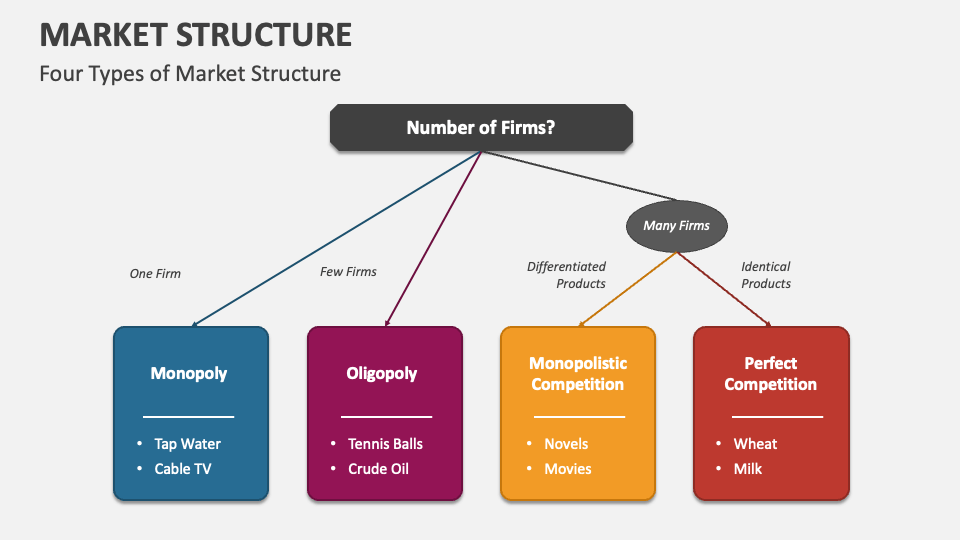
2. Exploring the Four Structures in Detail
Now that you have the basic framework, let's take a closer look at the defining features and examples of each market structure. The following reading provides a clear breakdown and includes a very helpful summary table that you can use as a reference.
This text from OpenStax provides clear definitions for each market structure and an excellent comparative table.
Please read the sections on 'Perfect Competition', 'Pure Monopoly', 'Monopolistic Competition', and 'Oligopoly'. Pay special attention to the 'Comparison of Market Structures' table (Table 1.3) at the beginning of the 'Perfect Competition' section. As you read, think about how each characteristic in the table applies to the descriptions.
3. Key Distinctions and Legal Relevance
After that reading, you should have a solid grasp of the four types. Let's synthesize the information and highlight the most critical distinctions, especially those relevant to law.
| Characteristic | Perfect Competition | Monopolistic Competition | Oligopoly | Monopoly |
|---|---|---|---|---|
| Number of Firms | Very many | Many | A few | One |
| Product Type | Identical | Differentiated | Identical or Differentiated | Unique |
| Barriers to Entry | None | Low | High | Very High / Blocked |
| Firm's Pricing Power | None (Price Taker) | Some | Some / Interdependent | Significant (Price Maker) |
| Legal Relevance | Theoretical benchmark | General consumer protection, trademark law | High: Antitrust, collusion, price-fixing, merger analysis | High: Antitrust, abuse of dominance, regulation |
| Example | Wheat, Corn | Restaurants, Clothing Stores | Airlines, Mobile Carriers | Local Water Utility, Patented Drug |
Perfect Competition: A Theoretical Benchmark
This is the ideal model of a frictionless free market. Firms are price takers, meaning they have zero power to influence the market price. The market price is their marginal revenue (P = MR). While no real-world market is truly "perfect," agricultural commodity markets come close and serve as a vital baseline for economic analysis.
Monopoly: The Power of One
A monopoly is defined by its high barriers to entry, which prevent any meaningful competition. These barriers are of great interest to lawyers:
- Natural Monopoly: One firm can supply the entire market at a lower cost than multiple firms (e.g., a water utility with one set of pipes). These are often regulated by the government.
- Technological/Legal Barriers: Control over a key resource (e.g., DeBeers and diamonds) or, more commonly, government-granted rights like patents and copyrights. A patent legally creates a temporary monopoly to reward innovation.
A monopoly isn't illegal in itself, but using monopolistic power to crush competition often is.
Monopolistic Competition: The Power of Brands
This is perhaps the most common market structure you encounter daily. The key feature is product differentiation. While many firms compete, each has a "mini-monopoly" over its unique version of the product (e.g., your favorite local pizza place). Competition happens through branding, quality, service, and advertising—not just price. Trademark law is particularly important here for protecting the brand identity that creates differentiation.
Oligopoly: The Strategic Dance
This is the most complex and, from a corporate law perspective, often the most interesting structure. With only a few dominant firms, the key feature is interdependence: each firm's profit depends not just on its own actions, but on the actions of its rivals. This creates a constant tension:
- Compete: Fiercely cut prices and innovate to steal market share, potentially driving profits down for everyone.
- Cooperate: Act together to limit output and keep prices high, essentially behaving like a collective monopoly.
This "cooperation," when formalized or even just implicitly understood, is known as collusion. An explicit agreement to fix prices or divide up the market is called a cartel, and it is a serious criminal offense under antitrust laws.
The following reading delves into this strategic tension and provides a powerful real-world case of illegal collusion.
Competition and Market Structures
The concept of 'interdependence' in an oligopoly makes it a fascinating and complex area, especially from a legal perspective. This reading explores the tension between competition and collusion and features a classic case study of an illegal cartel.
Please read the section on 'Oligopoly'. Focus on the concepts of 'Collusion or Competition?' and 'The Prisoner’s Dilemma', which provides a theoretical model for why collusion is both tempting and unstable. The case study on the 'Lysine Cartel' is a famous example of illegal price-fixing prosecuted by the Department of Justice.
The Lysine cartel case is a perfect illustration of why understanding market structures is critical for a corporate lawyer. The executives' conversations reveal a clear intent to subvert market competition, leading to criminal charges.
Test your understanding!
For each of the following industries, identify the most likely market structure (Perfect Competition, Monopolistic Competition, Oligopoly, or Monopoly). Briefly justify your answer based on the number of firms, product differentiation, and barriers to entry.
- The global market for large commercial aircraft (e.g., Boeing 787, Airbus A350).
- The market for tap water in your city.
- The market for restaurants in a large city.
Show answer
-
Oligopoly. There are only two major players in this market: Boeing and Airbus. The barriers to entry are incredibly high due to immense R&D costs, complex manufacturing, and established supply chains. The products are differentiated, but the firms are highly interdependent.
-
Monopoly. In virtually all cities, there is only one provider of tap water. The barrier to entry is the massive infrastructure cost of laying a duplicate network of pipes, making it a classic natural monopoly. The product is unique (there are no direct substitutes for piped water to your home), and the firm is the price maker, though typically regulated by the government.
-
Monopolistic Competition. There are many restaurants in a large city, and barriers to entry are relatively low (one can lease a space and start a restaurant without prohibitive costs). The key is product differentiation: restaurants compete on cuisine, ambiance, service, location, and brand reputation, not just price. Each has some pricing power within its niche.
Conclusion
Today we've mapped the competitive landscape of the economy. Understanding these four market structures provides a powerful lens for analyzing corporate behavior and strategy.
Here are your key takeaways:
- Market structures exist on a spectrum from perfect competition (many firms, identical products, no pricing power) to monopoly (one firm, unique product, significant pricing power).
- Monopolistic competition lies in between, with many firms selling differentiated products, competing on brand and quality.
- Oligopoly also lies in between, with a few dominant firms whose strategic decisions are interdependent, creating a temptation for illegal collusion.
- The key factors for distinguishing these structures are the number of firms, the degree of product differentiation, and the height of barriers to entry.
In our next lesson, we will build directly on this foundation. Now that we understand how market structures like monopoly and oligopoly can lead to high prices and reduced output, we will explore the economic and legal rationale for government intervention through regulation and antitrust enforcement. This will connect the economic theory we've learned directly to the legal framework you will study in law school.