Hello! Welcome to the first lesson in our module on Advanced Contract Law for Commerce.
In our preliminary discussions, you showed a solid grasp of fundamental contract principles like offer, acceptance, and consideration. This lesson builds directly on that foundation by introducing a crucial piece of commercial law that you will encounter constantly as a corporate lawyer: the Uniform Commercial Code (UCC).
Today, we will focus on Article 2 of the UCC, which governs contracts for the sale of goods. We'll explore why the UCC was created, when it applies, and how it modifies the common law contract rules you're familiar with to better suit the fast-paced world of business. By the end of this lesson, you will be able to analyze the core UCC provisions that govern how commercial sales contracts are formed and interpreted.
1. What is the UCC and When Does it Apply?
Imagine two companies, one manufacturing widgets and another wanting to buy them. They exchange emails, purchase orders, and invoices. Do they have a contract? What are its terms? What if one company is in New York and the other is in California? The UCC was created to answer these questions with a uniform, predictable set of rules across all states.
Its goal is to "simplify, clarify and modernize the law of commercial transactions." As a future corporate lawyer, the UCC will be one of your most important tools.
To start, let's watch an introductory video that explains the purpose of the UCC and Article 2.
Sales of Goods and the UCC: Module 1 of 5
This video from LawShelf provides an excellent overview of the UCC, its purpose, and the scope of Article 2. It will introduce you to key concepts we'll be discussing throughout the lesson.
Please watch the first part of the video (00:05 - 01:40). Focus on understanding why the UCC was created and the purpose of Article 2.
As the video explained, the UCC is a model code adopted by nearly every state. Article 2 specifically applies to transactions in goods. This brings up two critical definitions:
- Goods: The UCC defines goods as "all things which are moveable." This includes everything from office supplies and machinery to inventory and agricultural products. It does not include real estate, services (like legal or consulting work), or intellectual property.
- Merchants: The UCC has special rules for "merchants"—professionals who deal in goods of the kind being sold or hold themselves out as having special knowledge or skill. This distinction is based on the idea that business professionals should be held to a higher standard of commercial practice than a casual buyer or seller.
Mixed Contracts: Goods and Services
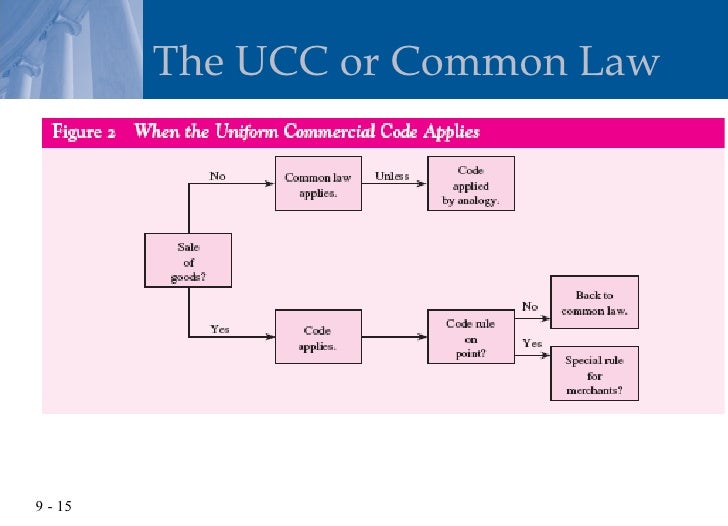
What happens in a transaction that involves both goods and services, like a contract to purchase and install a complex software system? Courts apply the "predominant purpose test" to determine whether the UCC or common law governs the entire contract. They ask: what was the buyer's primary purpose? To acquire the goods (the software) or to receive the service (the installation and training)? The answer determines which set of legal rules applies.
The following flowchart provides a simple visual guide for when the UCC applies.
2. Contract Formation: A More Flexible Approach
One of the UCC's major innovations is its flexible approach to contract formation. While common law requires an offer and a "mirror image" acceptance with definite terms, the UCC recognizes that business is often done more informally.
To explore this, let's dive into a key textual resource.
Chapter 4- The Uniform Commercial Code Sale of Goods
This chapter from Fullerton Law, titled 'The Uniform Commercial Code Sale of Goods,' provides a detailed, practical breakdown of Article 2. We'll focus on the sections covering how contracts are formed.
Please read the section 'FORMATION AND MODIFICATION OF CONTRACT,' starting from 'When Do You Have a Contract?' up to (but not including) 'Battle of the Forms.' Pay attention to how the UCC treats offers, acceptance, and the Statute of Frauds differently from common law.
Let's summarize the key points from your reading:
- Offer and Acceptance: An offer can be accepted in "any medium and manner, which is reasonable." A seller can accept a buyer's purchase order simply by shipping the goods.
- Firm Offers: A written offer from a merchant to buy or sell goods is irrevocable for a reasonable time (up to three months), even without payment or "consideration" to keep it open. This is a significant departure from the common law, which requires consideration for an option contract.
- Missing Terms: A contract is enforceable even if important terms like price, delivery time, or payment terms are missing. The UCC provides "gap-filler" provisions to supply these missing terms, which we will discuss later.
- Statute of Frauds: While contracts for the sale of goods worth $500 or more generally need to be in writing, the UCC includes several practical exceptions, such as for specially manufactured goods or when a party admits a contract exists. A written confirmation sent between merchants can also satisfy the requirement if the receiving party doesn't object within 10 days.
3. The "Battle of the Forms" (UCC § 2-207)
This is one of the most famous—and complex—parts of the UCC. In the real world, a buyer sends a purchase order with their terms and conditions, and the seller responds with an invoice or acknowledgment that includes their own conflicting terms. Under the common law's "mirror image rule," the seller's form would be a counteroffer, not an acceptance.
The UCC changes this entirely. Under Section 2-207, a response with new or different terms can still operate as a legal acceptance, forming a contract. The question then becomes: what are the terms of that contract?
The flowchart below visualizes this complex process.

Here is the general logic, which you can trace in the chart:
- A response with new terms still forms a contract unless the acceptance is expressly made conditional on the offeror agreeing to the new terms.
- If both parties are merchants, the additional terms in the acceptance automatically become part of the contract, UNLESS:
- The original offer expressly limited acceptance to its terms.
- The new terms materially alter the contract (e.g., changing warranties or liability).
- The offeror objects to the new terms within a reasonable time.
- If the terms are different (conflicting) rather than just additional, most courts apply the "knock-out rule." The conflicting terms in both forms are removed, and the UCC's "gap-filler" provisions supply the term instead.
The "Battle of the Forms" is a prime example of the UCC's practical, commerce-focused approach. It prevents parties from backing out of deals on technicalities and provides a framework for resolving term disputes.
Test your understanding!
A toy manufacturer emails a plastic supplier an offer to buy 1,000 pounds of red plastic pellets for $2,000, delivery on June 1st. The supplier emails back, "We accept your offer to buy 1,000 pounds of red plastic for $2,000. All invoices are due within 15 days of delivery." The original offer was silent on payment terms. Both parties are merchants.
Is the 15-day payment term part of the contract? Why or why not?
Show answer
Yes, the 15-day payment term is likely part of the contract.
Here's the analysis under UCC § 2-207:
- There is a definite expression of acceptance, so a contract is formed.
- The 15-day payment term is an "additional" term, as the original offer was silent on payment.
- Since both parties are merchants, the additional term becomes part of the contract unless one of the exceptions applies.
- A standard payment term like "net 15" is generally not considered a "material alteration." It's a common commercial practice. The offer did not limit acceptance to its terms, and no objection was made.
- Therefore, the term is incorporated into the contract.
4. Interpretation: Gap-Fillers and the Diminished Role of "Title"
The UCC's pragmatism extends to how it interprets contracts and resolves disputes.
Gap-Filler Provisions
As mentioned, the UCC can supply missing terms in a contract. If the parties intended to make a deal but forgot to agree on certain points, Article 2 provides default rules:
- Price: If the price is not settled, the price is a "reasonable price at the time for delivery."
- Place of Delivery: The default place is the seller's place of business.
- Time for Delivery: Goods must be delivered within a "reasonable time."
- Time for Payment: Payment is due at the time and place where the buyer is to receive the goods.
These rules ensure that a contract doesn't fail for indefiniteness, a common issue under strict common law.
The Big Shift: From "Title" to Specific Issues
Historically, sales law resolved almost every issue—who bears the risk if goods are destroyed in transit? can creditors seize the goods?—by first determining who had "title" to the goods. This was often a complex and abstract legal inquiry.
Article 2 makes a fundamental theoretical shift away from this approach. Instead of asking the single, broad question of "who has title?", the UCC provides specific rules for specific problems.
Uniform Commercial Code--Major Changes in Sales Law
To understand the 'why' behind this major shift, we'll read a short excerpt from a Kentucky Law Journal article. This text explains the UCC's move away from the abstract concept of 'title' toward a more direct, issue-specific approach.
Please read the two short sections titled 'Two-fold aspect of a sale' and 'Importance of title.' Focus on understanding why the traditional reliance on 'title' was problematic and what the UCC aims to achieve with its new approach.
As the article explains, the UCC "deemphasize[s] the importance of this conceptualistic approach." For example, on the crucial question of risk of loss, the UCC provides clear rules that do not depend on who has title:
- Shipment Contract: If the contract requires the seller to ship the goods via a carrier (like FedEx) but not to deliver them to a specific destination, the risk of loss passes to the buyer when the goods are delivered to the carrier. This is the default rule.
- Destination Contract: If the contract requires the seller to deliver the goods to a particular destination, the risk of loss passes to the buyer only when the goods are tendered at that destination.
- Merchant Seller (No Shipment): If you buy an item from a merchant and arrange to pick it up later, the risk of loss does not pass to you until you actually take physical possession of the item. This is because the merchant is in a better position to control and insure the goods.
Conclusion
This lesson provided an overview of the most important provisions of UCC Article 2. As you've seen, its rules are designed with the realities of business in mind, creating a more flexible and predictable legal environment for the sale of goods.
Key Takeaways:
- The UCC is a model code that modernizes and standardizes commercial law in the United States. Article 2 specifically governs contracts for the sale of goods.
- The UCC often has special rules for merchants, holding them to higher standards of commercial practice.
- Contract formation is more flexible under the UCC. A contract can exist even with missing terms, and the "Battle of the Forms" (UCC § 2-207) resolves disputes when offer and acceptance documents don't match.
- The UCC has moved away from the abstract concept of "title" to resolve disputes. Instead, it provides specific rules for specific issues, such as risk of loss.
In our next lesson, we will systematically compare these UCC rules with common law contract principles, further sharpening your ability to distinguish between them in various commercial scenarios.