Hello! Welcome to the final lesson of our module on Corporate Governance and Fiduciary Duties.
In our last lesson, we analyzed how shareholders use their voting rights, particularly in proxy fights, to exert influence and control over a corporation. This is a powerful mechanism for holding management accountable. But what happens when the board of directors or officers breach their duties in a way that harms the company itself, and the board is unwilling to act?
This brings us to our final topic in this module: the shareholder derivative suit. Today's lesson fulfills the learning outcome: Examine the nature and procedural requirements of shareholder derivative suits. We will explore how a shareholder can step into the shoes of the corporation to sue the very people entrusted with running it, ensuring there is a legal remedy for corporate wrongdoing even when the corporation’s own leadership fails to act.
1. The Nature of a Derivative Suit: Suing on Behalf of the Corporation
At its core, a shareholder derivative suit is a lawsuit brought by a shareholder on behalf of the corporation. The claim being asserted does not belong to the shareholder personally, but to the corporation itself. The shareholder is essentially acting as a representative to enforce the corporation's rights.
This is a crucial concept. Imagine a director embezzles funds from the company. The entity that has been directly harmed is the corporation, whose bank account is now lighter. Any recovery of those funds should go back to the corporation to make it whole.

Direct vs. Derivative Claims
The most important initial question in shareholder litigation is whether the claim is direct or derivative. This distinction determines who has the right to sue and who receives the remedy.
To solidify your understanding of this critical difference, please read the following introductory sections.
Understanding Derivative Lawsuits: A Shareholder's Guide
The article 'Understanding Derivative Lawsuits' provides an excellent starting point. The first sections define the concept and present a clear table comparing direct and derivative claims.
Please read the sections titled 'Definition and Key Characteristics' and 'Difference Between Direct and Derivative Claims.' Pay close attention to the table that contrasts the two types of lawsuits.
As you've just read, the key questions are:
- Who was harmed? If the corporation as a whole was harmed (e.g., loss of corporate assets, damage to reputation), the claim is derivative. If a shareholder was harmed in a unique way not shared by all shareholders (e.g., denied their personal right to vote), the claim is direct.
- Who gets the money? In a derivative suit, the recovery goes to the corporation. In a direct suit, the recovery goes to the individual shareholder.
To see how courts apply this distinction, let's look at the primary legal test used in Delaware, the most influential jurisdiction for U.S. corporate law.
Corporate Law: Director Liabilities, Shareholder Liabilities, and Securities Liabilities
The video 'Corporate Law: Director Liabilities...' explains the 'Tooley two-step,' which is the seminal test for distinguishing between direct and derivative claims.
Please watch the segment from 30:41 to 34:10. The speaker discusses how courts enforce director duties and introduces the 'Tooley two-step' analysis to determine whether a suit is direct or derivative.
The video introduces the two critical questions from the Tooley case:
- Who suffered the harm?
- Who would receive the benefit of the recovery?
If the answer to both is "the corporation," the suit is derivative. This framework is the starting point for almost any shareholder lawsuit analysis.
Test your understanding!
A corporation's board of directors approves a deal to sell a major corporate asset to the CEO's brother at a price far below market value. The corporation's value subsequently drops. A shareholder is furious. Would a lawsuit challenging this transaction be direct or derivative? Why?
Show answer
This would be a derivative lawsuit. The harm—selling a corporate asset for too little—was done to the corporation itself, which lost value as a result. All shareholders suffered this loss proportionally through the decline in the value of their shares. The remedy would be to recover the financial loss for the corporation's treasury, not to pay damages to the individual suing shareholder.
2. The Procedural Gauntlet of a Derivative Suit
Because a derivative suit allows a single shareholder to initiate litigation on behalf of the entire corporation, the law places several procedural hurdles in their way. These rules are designed to prevent frivolous lawsuits and to ensure that the board of directors, as the corporation's primary managers, retains control over corporate affairs whenever possible.
We'll walk through these requirements step-by-step.
shareholder derivative suit | Wex - Cornell Law School
The Wex Legal Dictionary entry for 'shareholder derivative suit' provides a concise and authoritative summary of the procedural requirements.
Read the bulleted list under the heading 'To bring a derivative suit, the shareholder must:'. This section outlines the key procedural steps.
Let's break down the process, which is also visualized in the diagram below.
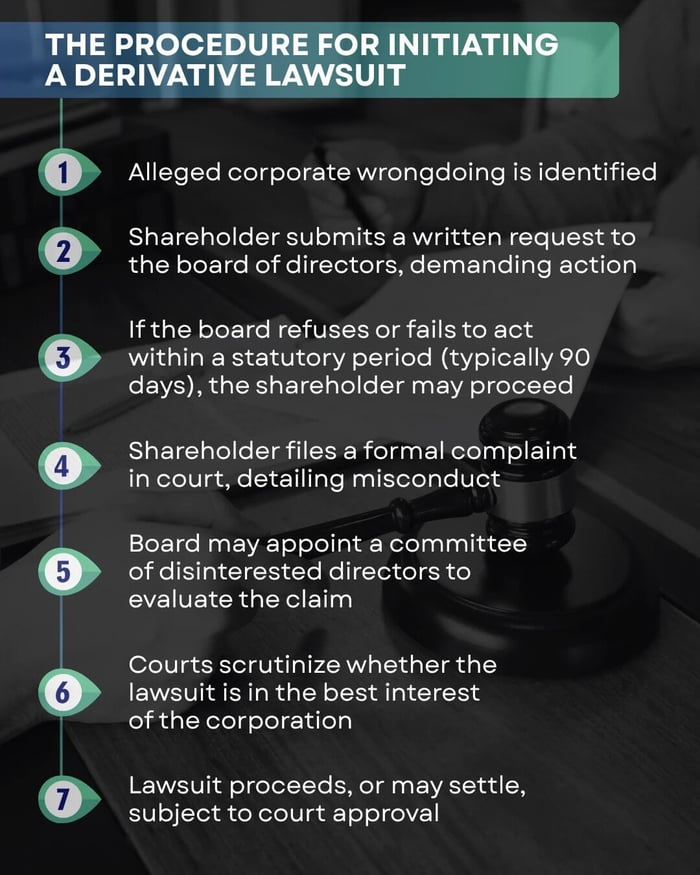
Step 1 & 2: Standing and Pre-Suit Demand
As outlined in the Wex article and the chart, a shareholder must first have standing to sue. This generally means:
- Contemporaneous Ownership: You must have owned shares at the time of the alleged wrongdoing.
- Continuous Ownership: You must remain a shareholder throughout the entire litigation.
- Fair Representation: You must be able to fairly and adequately represent the interests of the corporation, not just pursuing a personal vendetta.
Next, and most critically, comes the pre-suit demand. In most cases, the shareholder must first make a formal written demand to the board of directors, asking them to investigate the wrongdoing and take legal action themselves. The shareholder must then wait (typically 90 days) to see if the board acts. This respects the board's authority to manage the corporation, including its legal claims.
Step 3, 4 & 5: Board Response, Demand Futility, and the SLC
What if the board is the problem? If a majority of the board is implicated in the wrongdoing, making a demand that they sue themselves would be pointless. This is the concept of demand futility. If a shareholder can prove to the court that a demand would have been futile, they can skip the demand requirement and file the lawsuit directly.
When a derivative suit is filed (either after a demand is rejected or by claiming futility), the board's response is crucial. The board will often appoint a Special Litigation Committee (SLC). This is a committee of independent directors—those with no connection to the alleged wrongdoing—to investigate the claims.
The role of the SLC is central to the derivative suit process. Let's return to the video to understand its function.
Corporate Law: Director Liabilities, Shareholder Liabilities, and Securities Liabilities
This next segment of the 'Corporate Law' video explains the role of the Special Litigation Committee and the importance of its independence.
Please watch the segment from 34:10 to 37:05. Focus on what an SLC is, why it's formed, and what 'independence' means in this context.
As the video explains, the SLC has the power to decide whether the lawsuit should proceed or be dismissed. If the court is satisfied that the SLC was truly independent and conducted a reasonable, good-faith investigation, it will typically defer to the SLC's decision under the business judgment rule. This makes the SLC a powerful tool for boards to regain control of litigation.
Step 6 & 7: Judicial Review and Resolution
Ultimately, the court oversees the entire process.
- It decides whether demand was futile.
- It scrutinizes the independence of the SLC.
- It must approve any dismissal or settlement of the case, ensuring that the resolution is fair to the corporation and all of its shareholders.
If the suit is successful or settles, any financial recovery goes to the corporation's treasury. However, the court will typically order the corporation to reimburse the shareholder who initiated the suit for their legal fees and costs, recognizing that their efforts benefited all shareholders.
Conclusion
In this lesson, we have dissected the shareholder derivative suit, a vital but complex mechanism of corporate accountability. It serves as a last resort for shareholders to enforce the corporation's rights when its own fiduciaries fail to do so.
Key Takeaways:
- Nature of the Suit: A derivative suit is brought by a shareholder on behalf of the corporation to remedy a harm done to the corporation. Any recovery benefits the company.
- Direct vs. Derivative: The crucial Tooley test distinguishes these claims by asking who was harmed and who receives the benefit of the remedy.
- Procedural Hurdles: To bring a derivative suit, a shareholder must have standing, make a pre-suit demand on the board, or prove that such a demand would be futile.
- The Board's Role: The board can respond to a derivative claim by forming a Special Litigation Committee (SLC) of independent directors to investigate and recommend whether to pursue or dismiss the suit.
This lesson concludes our module on Corporate Governance and Fiduciary Duties. We have covered the roles of directors and officers, their fundamental duties of care and loyalty, the power of shareholder voting, and now, the ultimate legal tool for enforcing those duties.
In our next module, we will shift our focus to the lifeblood of business: commercial transactions. We'll begin by analyzing the Uniform Commercial Code (UCC) and how its rules for the sale of goods differ from the common law principles of contract you may already be familiar with.