Hello! Welcome back.
In our last lesson, we introduced the Uniform Commercial Code (UCC) and explored some of its key features, like its flexible approach to contract formation and the "Battle of the Forms." You learned that UCC Article 2 provides a specific legal framework for transactions involving the sale of goods.
Today, our goal is to solidify your understanding by directly comparing and contrasting these UCC rules with the common law principles of contract that you're already familiar with. Distinguishing between these two bodies of law is one of the most fundamental skills for a commercial or corporate lawyer. Every time you analyze a contract, your first question must be: "What law governs this transaction?" The answer determines the set of rules you'll apply.
By the end of this lesson, you will be able to distinguish between UCC rules and common law contract principles across several key areas, including formation, modification, and performance.
1. The Gateway Question: Is it a Contract for Goods?
Before you can analyze any contract issue, you must first determine whether you're playing by UCC rules or common law rules. This is not a trivial step; as you'll see, the outcome of a dispute can be completely different depending on which law applies.
To start, let's watch a short video that powerfully illustrates why this "gateway" determination is so critical.
Contract Law Gateway Issue: Common Law vs. Article 2 of the Uniform Commercial Code (UCC) [PREVIEW]
This video from Studicata, titled 'Contract Law Gateway Issue,' effectively explains why identifying the correct governing law (UCC or Common Law) is the essential first step in any contract analysis.
Watch the video from 01:24 to 08:23. Pay close attention to the 'chess vs. checkers' analogy and how the 'predominant purpose test' is used for mixed contracts involving both goods and services.
As the video emphasized, the dividing line is clear:
- The UCC (Article 2) governs contracts for the sale of goods—tangible, movable items.
- Common Law governs contracts for services, real estate, and intangible assets.
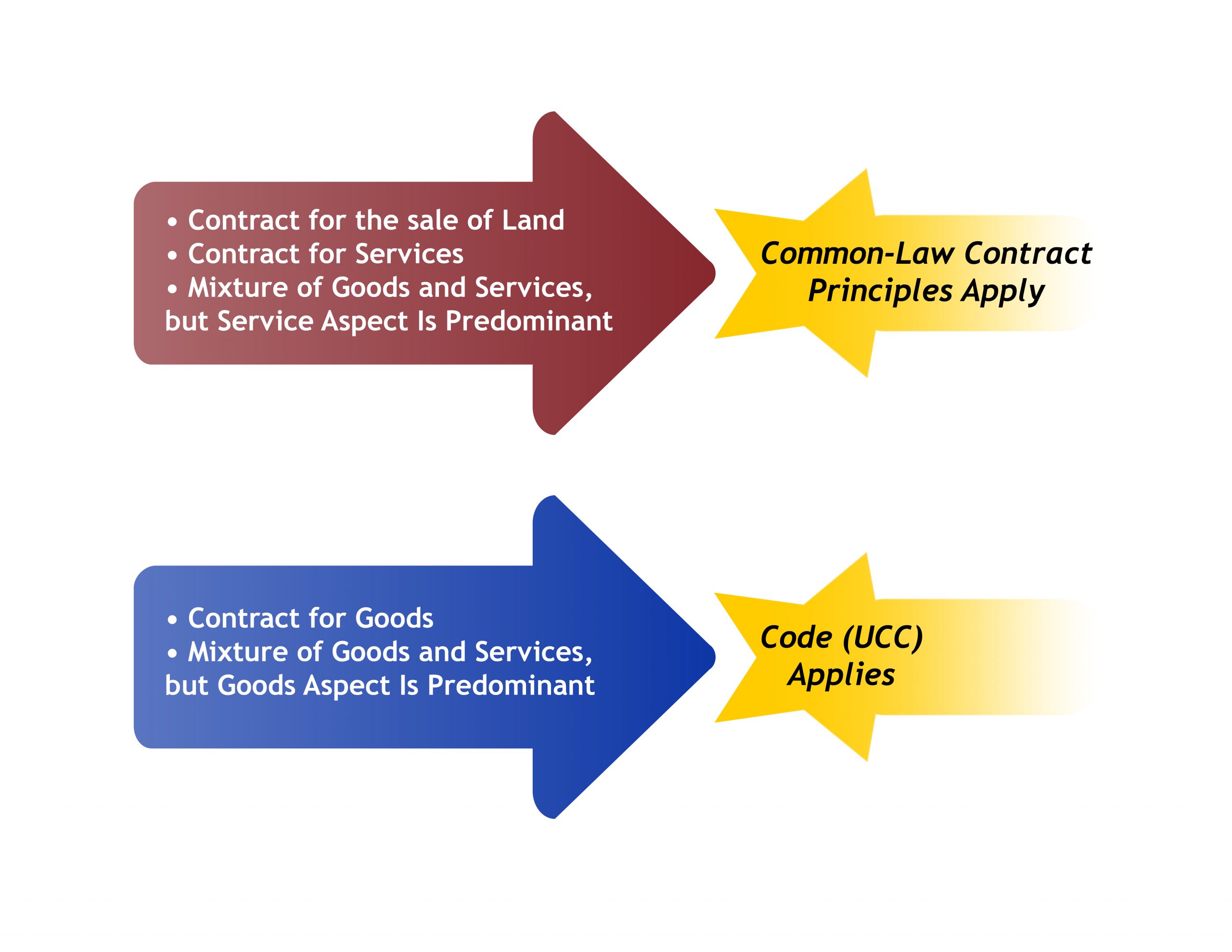
For "mixed contracts" involving both goods and services (like buying a custom-built machine and having it installed), you must apply the predominant purpose test. You ask: what is the main reason for this contract? Is it to acquire the good, or to receive the service? The answer determines the governing law for the entire contract.
The flowchart below provides a simple visual summary of this crucial first step.
2. UCC vs. Common Law: A Comparative Table
Now that we've reinforced the basic distinction, let's systematically compare the rules. The table below provides a high-level overview of some of the most important differences between the UCC and common law. We will spend the rest of the lesson unpacking the points in this table.

3. Key Differences in Detail
Let's dive deeper into the distinctions outlined in the table, using a mix of resources to understand the "why" behind these different rules. The central theme you'll notice is that the UCC is designed for commercial efficiency and pragmatism, while common law is often more formalistic.
A. Contract Formation: Offer and Acceptance
Offer:
Under common law, an offer must be definite and certain in its terms. You might remember the acronym Q-TIPS (Quantity, Time for performance, Identity of parties, Price, Subject matter). If a major term like price is missing, a court might find that no valid offer was made.
The UCC is far more flexible. A contract for the sale of goods will not fail for indefiniteness as long as the parties intended to make a contract and there's a reasonable basis for giving a remedy. The only term that is generally essential is quantity. The UCC provides "gap-filler" provisions for price (a "reasonable price"), delivery, and payment terms.
Acceptance:
This is one of the most significant areas of divergence.
- Common Law: The "Mirror Image Rule". An acceptance must be the mirror image of the offer. If the acceptance changes or adds any terms, it is considered a rejection of the original offer and a counteroffer.
- UCC: "Battle of the Forms" (UCC § 2-207). As we touched on last lesson, the UCC abandons the mirror image rule. An acceptance with additional or different terms can still form a contract. The treatment of these new terms depends on whether the parties are merchants.
To explore these differences further, let's turn to a helpful article.
The article 'Common Law v. UCC' from the Louisiana Law Institute clearly lays out the differences in formation principles. It's written for aspiring lawyers and gets straight to the point.
Please read the section on 'Formation,' focusing on the subsections about Offer and Acceptance. Notice how it contrasts the common law's strict 'Q-TIPS' and 'mirror image' requirements with the UCC's more lenient approach.
B. Contract Modification
This is another area where the UCC's practical approach dramatically simplifies commercial dealings.
- Common Law: To modify a contract, you generally need new consideration. This is known as the pre-existing duty rule. If a builder is already contracted to build a house for $300,000, a promise by the owner to pay an extra $20,000 for the same work is unenforceable unless the builder provides something new in return.
- UCC: An agreement modifying a contract for the sale of goods needs no consideration to be binding. The only requirement is that the modification be made in good faith. This rule recognizes that in business, circumstances change, and parties need to be able to adjust their agreements without legal formalities getting in the way.
CONTRACTS - LAW SCHOOL ESSENTIALS
For a precise legal explanation of this point, we'll consult a law school study guide.
Please read section 'c. Modification' on page 14 of the PDF. The guide explicitly contrasts the common law rule requiring consideration with the UCC rule requiring only good faith. This is a critical distinction for commercial contracts.
C. Performance
Once a contract is formed, what level of performance is required?
- Common Law: Doctrine of "Substantial Performance." Primarily used in service contracts, this doctrine states that if a party performs the essential purpose of the contract with only minor deviations, the performance is sufficient. The non-breaching party is not excused from their own obligations (e.g., payment) but can sue for damages caused by the minor breach.
- UCC: The "Perfect Tender Rule." For single-delivery contracts, the UCC is much stricter. If the goods or the delivery fail in any respect to conform to the contract, the buyer has the right to reject the whole shipment, accept the whole shipment, or accept any commercial unit(s) and reject the rest. This rule gives the buyer significant leverage. However, the UCC softens this rule by giving the seller a "right to cure" the non-conforming tender in certain situations.
Let's watch a video segment that directly compares UCC acceptance with common law acceptance, touching on the implications for performance.
Sales of Goods and the UCC: Module 1 of 5
This clip from LawShelf's video on the UCC contrasts the common law's strict manner of acceptance with the UCC's more flexible approach, and introduces the concept of shipping non-conforming goods.
Watch the segment from 04:03 to 05:52. Focus on how the UCC treats acceptance by performance (shipping goods) and the consequences of shipping non-conforming goods, which ties into the Perfect Tender Rule.
Test your understanding!
A software development company agrees to create a custom accounting program for a client for $50,000. Upon delivery, the program functions perfectly except for a minor bug that causes a cosmetic error in the font on one report. Under common law, can the client refuse to pay the $50,000 and terminate the contract?
Now, imagine a furniture manufacturer has a contract to deliver 100 oak chairs to a retailer. They deliver 99 oak chairs and 1 cherry wood chair. Under the UCC, what are the retailer's options?
Show answer
-
Software Contract (Common Law): The client likely cannot terminate the contract and refuse payment. This is a services contract governed by common law. The developer has likely met the standard of substantial performance. The cosmetic bug is a minor breach. The client must still pay, but can sue for damages to fix the bug (or deduct the cost of fixing it from the payment).
-
Chair Contract (UCC): This is a contract for the sale of goods governed by the UCC's Perfect Tender Rule. The delivery is not perfect. The retailer can:
- Reject the entire shipment.
- Accept the entire shipment (and likely seek damages for the non-conforming chair).
- Accept the 99 oak chairs and reject the 1 cherry chair.
This demonstrates the stark difference between the two performance standards.
Conclusion
Understanding the boundary between the UCC and common law is a foundational skill for any lawyer working in business. While both systems aim to enforce promises, they are built on different philosophies. Common law is rooted in tradition and formalism, while the UCC is built for the speed and pragmatism of modern commerce.
Key Takeaways:
- Governing Law is Key: The first step is always to determine if the contract is for goods (UCC) or services/real estate (common law).
- Formation: The UCC is more flexible, allowing contracts to be formed even with open terms and abandoning the common law's "mirror image rule."
- Modification: The UCC allows for contract modifications without new consideration, requiring only good faith. This is a major departure from the common law's pre-existing duty rule.
- Performance: The common law uses the "substantial performance" doctrine for services, while the UCC imposes a stricter "perfect tender rule" for the sale of goods.
In our next lesson, we will continue our deep dive into the UCC by focusing on one of its most important topics for corporate transactions: warranties. We'll examine the different types of warranties (express and implied) that automatically apply to the sale of goods and their legal implications.