Hello! Welcome to the third lesson in our module on Securities Regulation.
In our last lesson, we explored the demanding process of a registered public offering under the Securities Act of 1933. We saw that taking a company public is an expensive and time-consuming journey involving extensive disclosure and SEC oversight. This raises a crucial question for the vast majority of businesses: how can a company raise capital without undergoing a full-blown IPO?
Today, we will answer that question by exploring the other side of the '33 Act—the world of exempt offerings. As a future corporate lawyer, you'll find that most of your clients, especially early-stage companies, will rely on these exemptions to fund their growth.
Your learning outcome for this lesson is to: Analyze key exemptions from registration, focusing on private placements under Regulation D.
1. The Need for Exemptions
The default rule under the '33 Act is that every offer and sale of a security must be registered. However, the law recognizes that this would be impractical and crippling for capital formation, especially for smaller businesses. Imagine a startup needing to raise $500,000 from a few investors; forcing it through a multi-million dollar IPO process would be a non-starter.
To address this, the '33 Act provides several exemptions. The most important of these for our purposes is Section 4(a)(2), which exempts "transactions by an issuer not involving any public offering." This is the statutory foundation for what are known as private placements.
But what exactly is a "private" offering versus a "public" one? To provide clarity and certainty for businesses, the SEC created a set of rules called Regulation D. Regulation D provides a "safe harbor": if you follow its rules precisely, you can be certain that your offering is exempt from registration.
To start, let's watch a video that explains why these exemptions are so critical for startups and introduces the key factors that differentiate them.
SEC Registration Exemption: Reg D, 504, 506b, 506c, Regulation Crowdfunding & accredited investors
This video from StartupSOS provides a clear, practical explanation of why SEC registration exemptions are necessary and the key variables to consider when choosing one.
Please watch from 00:39 to 07:16. Focus on understanding the high cost of full registration and the key factors that distinguish the various exemptions, such as filing requirements, state law preemption, public solicitation, and the type of investor.
2. The "Accredited Investor": A Key Concept
As the video highlighted, one of the most important concepts in the world of private placements is the accredited investor. The SEC's rationale is that certain investors, due to their wealth, income, or professional experience, are sophisticated enough to evaluate the risks of an investment and financially capable of bearing a potential loss. Therefore, they require fewer of the protections that come with a registered offering.
The definition of an accredited investor is central to understanding Regulation D. The next segment of the video provides a detailed breakdown of who qualifies.
SEC Registration Exemption: Reg D, 504, 506b, 506c, Regulation Crowdfunding & accredited investors
Let's continue with the StartupSOS video to understand the specific criteria for being an accredited investor.
Please watch from 07:16 to 11:33. Pay close attention to the income and net worth tests for individuals.
To summarize, the most common ways for an individual to qualify as an accredited investor are:
- Income Test: An individual with an annual income over $200,000 (or $300,000 with a spouse) for the last two years, with a reasonable expectation of the same in the current year.
- Net Worth Test: An individual with a net worth over $1 million, either alone or with a spouse, excluding the value of their primary residence.
Directors, executive officers of the issuing company, and certain entities also qualify. This distinction between accredited and non-accredited investors is the primary lever that determines the rules for a given private placement.
3. Regulation D: Rule 506(b) vs. Rule 506(c)
While Regulation D contains several rules, the vast majority of private placements are conducted under Rule 506. The power of Rule 506 comes from the fact that it preempts state "blue sky" laws. This means if you comply with Rule 506, you don't have to worry about the separate and often inconsistent registration requirements of every state where you have investors—a huge advantage for companies raising capital nationally.
Rule 506 is split into two main pathways: Rule 506(b) and Rule 506(c). Choosing between them involves a critical trade-off. Let's watch the final segments of the video to understand this choice.
SEC Registration Exemption: Reg D, 504, 506b, 506c, Regulation Crowdfunding & accredited investors
The video will now compare the most common Regulation D exemptions, focusing on the differences between Rule 506(b) and Rule 506(c).
Please watch from 11:33 to 12:45, and then from 15:32 to 21:21. Focus on the core differences regarding advertising, who can invest, and how you verify their status.
Here is a summary of the key differences, which are crucial for advising a future client:
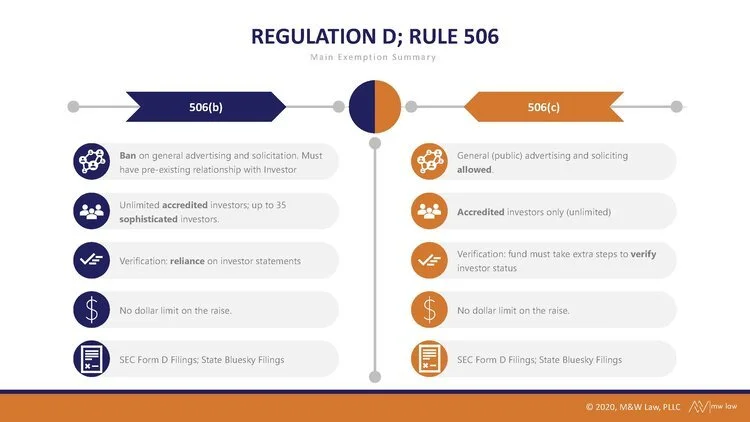
Let's break down the trade-offs:
| Feature | Rule 506(b) - The "Traditional" Private Placement | Rule 506(c) - The "Public" Private Placement |
|---|---|---|
| Advertising | No general solicitation or advertising allowed. You must rely on pre-existing relationships (e.g., your network). | General solicitation is permitted. You can advertise your offering publicly on websites, social media, etc. |
| Who Can Invest? | Unlimited accredited investors AND up to 35 non-accredited (but "sophisticated") investors. | Accredited investors ONLY. No non-accredited investors are allowed. |
| Investor Verification | You can rely on an investor's self-certification of their accredited status (e.g., they check a box on a questionnaire). | You must take "reasonable steps" to verify that all investors are accredited (e.g., by reviewing tax returns or bank statements). |
| Disclosure | If only accredited investors participate, there are no specific SEC-mandated disclosures. If any non-accredited investors are included, you must provide them with extensive information similar to a public offering. | Because all investors must be accredited, there are no specific SEC-mandated disclosures (though you must provide enough info to avoid fraud). |
The choice is fundamental:
- Do you want the flexibility to include a few key, non-accredited people (like knowledgeable friends or early employees)? Use Rule 506(b), but you must keep the offering quiet.
- Do you want to cast a wide net and advertise to find investors? Use Rule 506(c), but you can only accept money from verified accredited investors.
To solidify your understanding of these two critical rules, please read the following article which details their advantages, limitations, and differences.
Comparing 506b vs 506c for Private Fundraising
This article from Qapita, titled 'Comparing 506b vs 506c for Private Fundraising', provides an excellent textual summary of the concepts we've just covered.
Please read the sections 'Overview of Rule 506(b)', 'Overview of Rule 506(c)', and 'Key differences between 506(b) and 506(c)'. This will reinforce the pros, cons, and trade-offs of each approach.
4. The Private Placement Memorandum (PPM)
You might have noticed that in many exempt offerings (like a 506(b) or 506(c) with only accredited investors), there is no required disclosure document to file with the SEC. So, how do companies provide information to potential investors and protect themselves from liability?
The answer is the Private Placement Memorandum (PPM).
Even when not technically required, a PPM is a critical best practice. It is a comprehensive document that functions as both a business plan and a legal disclosure document. Its purpose is twofold:
- To Inform Investors: It provides detailed information about the business, the management team, the financial projections, and the terms of the investment.
- To Protect the Issuer: It serves as a record of what was disclosed to investors. By thoroughly outlining the risk factors associated with the investment, it helps defend the company against future claims of fraud or misrepresentation. Remember, even exempt offerings are subject to the anti-fraud rules!
The following video explains what a PPM is and what it contains from a lawyer's perspective.
Private Placement Memorandums Explained - What is a PPM & When Do You Use it?
This video from business lawyer Brett Cenkus explains the purpose and contents of a Private Placement Memorandum.
Please watch from 01:32 to 12:00. Focus on why a PPM is used (as a risk mitigation tool) and its key components, especially the importance of 'risk factors'.
Test your understanding!

Imagine you are the lawyer advising E-B Corp. The investment banker has found 25 potential investors. Twenty of them are verified accredited investors. The other five are long-time employees who know the business inside-out but do not meet the income or net worth tests to be accredited.
- Which exemption, Rule 506(b) or Rule 506(c), must E-B Corp use for this offering? Why?
- What are the company's obligations regarding advertising the offering?
- What are the company's obligations regarding information disclosure to the five non-accredited employees?
Show answer
-
E-B Corp must use Rule 506(b). Rule 506(c) strictly forbids accepting investments from any non-accredited investors. Since five of the potential investors are non-accredited, Rule 506(b) is the only option, as it allows for up to 35 non-accredited (but sophisticated) investors.
-
Under Rule 506(b), the company is prohibited from engaging in general solicitation or advertising. They cannot post about the offering on social media, issue a press release, or run ads. They must rely on direct, private outreach to their potential investors.
-
Because the offering includes non-accredited investors, E-B Corp is required to provide them with specific disclosure documents that are similar in scope to what would be required in a registered offering. This would typically take the form of a detailed Private Placement Memorandum (PPM) containing financial statements, a description of the business, risk factors, etc. They must also give these investors an opportunity to ask questions of management.
Conclusion
Today, we've navigated the essential landscape of private placements, the engine of capital formation for most non-public companies. We've seen that the burdensome registration process of the '33 Act has a necessary and widely used alternative: exempt offerings.
Key Takeaways:
- The '33 Act allows for exemptions from registration, with private placements under Section 4(a)(2) being the most significant.
- Regulation D provides a safe harbor for private placements, and Rule 506 is the most powerful tool because it preempts state blue sky laws.
- The concept of the accredited investor is central to Regulation D, separating investors who are presumed to be able to "fend for themselves."
- The choice between Rule 506(b) and Rule 506(c) involves a crucial trade-off: Rule 506(b) allows a limited number of non-accredited investors but no advertising, while Rule 506(c) allows advertising but only to accredited investors.
- Even in an exempt offering, companies must avoid fraud. The Private Placement Memorandum (PPM) is the key document used to provide disclosure and mitigate legal risk.
In our last lesson on the '33 Act, we covered the birth of a public security through registration. Today, we saw the birth of a private one through exemption. But what happens after these securities are out in the world, being traded among investors? That is the domain of our next topic: the Securities Exchange Act of 1934 and its rules for ongoing public company disclosure.