Hello! Welcome to the fourth lesson in our module on Securities Regulation.
In our last two lessons, we focused on the Securities Act of 1933, which governs the initial issuance of securities. We covered both the extensive process of a registered public offering and the critical exemptions, like Regulation D, that allow companies to raise capital privately.
Now, we shift our focus from the birth of a security to its life in the public markets. What happens after a company goes public or grows large enough to have its securities widely traded? This is the domain of the Securities Exchange Act of 1934.
Your learning outcome for this lesson is to: Describe the purpose of the Securities Exchange Act of 1934 and identify key periodic reporting requirements.
For a future corporate lawyer, understanding the '34 Act is non-negotiable. A significant part of your work for public company clients will involve ensuring they comply with the ongoing disclosure obligations we're about to discuss.
1. From a Single Snapshot to a Continuous Film
Think of the '33 Act as providing a detailed snapshot of a company at a single point in time—the moment it sells securities to the public. The goal is to give investors all the necessary information to make an initial investment decision.
The '34 Act, by contrast, requires a continuous film. It recognizes that a company's financial health and prospects are constantly changing. To ensure that the market has access to current and accurate information, the '34 Act established a system of ongoing disclosure for public companies.
This shift in focus was a direct response to the 1929 stock market crash. To understand why this law was so crucial, let's watch a brief video explaining its historical context and purpose.
Overview of Securities Law: Module 1 of 5
This video from LawShelf explains the background of the 1934 Act and its primary goals.
Please watch from 03:11 to 04:23 and then from 05:58 to 07:40. Focus on the problems the Act was designed to solve and its two primary purposes: uniform regulation and fostering transparent, fair markets.
As the video highlights, the '34 Act had two monumental effects:
- It created the Securities and Exchange Commission (SEC), the federal agency responsible for enforcing securities laws.
- It mandated a system of periodic reporting, forcing public companies to keep investors updated about their business and financial condition.
To get a more detailed look at the Act's purpose and how it differs from the '33 Act, please review the introduction to this article.
Securities Exchange Act of 1934 Explained: Summary and ...
The article 'Securities Exchange Act of 1934 Explained' from InnReg provides a clear summary of the Act's role in regulating the secondary market.
Read the first two sections under the 'Overview of the Securities Exchange Act of 1934' heading: 'What Is the Securities Exchange Act?' and 'Why Was the Securities Exchange Act of 1934 Enacted?'.
2. The Core of Continuous Disclosure: Key Periodic Reports
The '34 Act's goal of transparency is achieved primarily through a set of required filings. Companies that are subject to these rules are known as "reporting companies." This generally includes companies whose securities are traded on a national exchange (like the NYSE or NASDAQ) or that meet certain size requirements (over $10 million in assets and a certain number of shareholders).
These companies must file three main types of reports with the SEC, all of which are publicly available through the SEC's EDGAR (Electronic Data Gathering, Analysis, and Retrieval) database.
Let's explore each one. The following video provides an excellent and practical breakdown of these reports.
The Securities Act of 1933 and the Securities Exchange Act of 1934
This video from Edspira clearly explains the 'Big Three' periodic reports: the 10-K, 10-Q, and 8-K.
Please watch from 02:19 to 07:26. As you watch, focus on the purpose, timing, and level of detail for each report.
Let's summarize the key characteristics of each report, using a few analogies to help make the distinctions clear.
Form 10-K: The Annual Physical
- What it is: A comprehensive annual report covering the company's entire fiscal year. It is the most detailed disclosure document.
- Key Contents:
- Audited financial statements (income statement, balance sheet, cash flow statement).
- Management's Discussion and Analysis (MD&A): The management team's narrative explaining the company's performance and future outlook.
- A detailed description of the business, its products, and markets.
- Risk Factors: A crucial section for lawyers, outlining the key risks facing the company.
- Information about the company's executives and directors.
- Timing: Filed annually, typically 60-90 days after the company's fiscal year ends.
The 10-K is the bedrock of a company's public disclosure. It's the deep-dive document that analysts and serious investors use to understand the company inside and out.
Form 10-Q: The Quarterly Check-up
- What it is: A quarterly report that updates the information from the last 10-K.
- Key Contents:
- Unaudited (but reviewed by accountants) financial statements for the quarter.
- An updated MD&A discussing the quarter's results.
- Updates on any material changes or events since the last filing.
- Timing: Filed three times a year, typically 40-45 days after the end of each of the first three fiscal quarters. (The fourth quarter's results are covered in the 10-K).
The 10-Q ensures that investors don't have to wait a full year for updates on the company's performance.
Form 8-K: The Emergency Room Visit
- What it is: A "current report" that is not filed on a regular schedule. Instead, it is triggered by the occurrence of a specific, significant corporate event.
- Key Triggers (Examples):
- Entering into a material definitive agreement (a major contract).
- Bankruptcy or receivership.
- Completion of a major acquisition or disposition of assets.
- Changes in the company's directors or principal officers (e.g., CEO resignation).
- A change in the company's certifying accountant.
- Timing: Must be filed very promptly, typically within four business days of the triggering event.
The purpose of the 8-K is to prevent companies from withholding major news from the market until the next 10-Q or 10-K. It ensures timely disclosure of information that a reasonable investor would consider important.
Test your understanding!
Imagine you are a junior lawyer at a firm that represents a publicly traded technology company, Innovate Corp.
- A financial analyst calls you asking for the most comprehensive, audited overview of Innovate Corp.'s financial health and business strategy for the previous year. Which report do you direct them to?
- Two months later, the board of directors of Innovate Corp. unexpectedly fires the CEO. The general counsel asks you what the company's immediate SEC filing obligation is. What do you tell them?
Show answer
- You should direct the analyst to the company's most recent Form 10-K. The 10-K is the annual report that contains audited financial statements and a comprehensive discussion of the company's business and performance for the full year.
- The unexpected departure of a CEO is a significant event that must be disclosed to the market promptly. You would advise the general counsel that the company must file a Form 8-K, typically within four business days, to report the change in a principal officer.
3. The Regulatory Ecosystem
The '34 Act didn't just create rules; it created a system of oversight to enforce them. At the center is the SEC, but it doesn't act alone. This image provides a great visual summary of the regulatory structure.
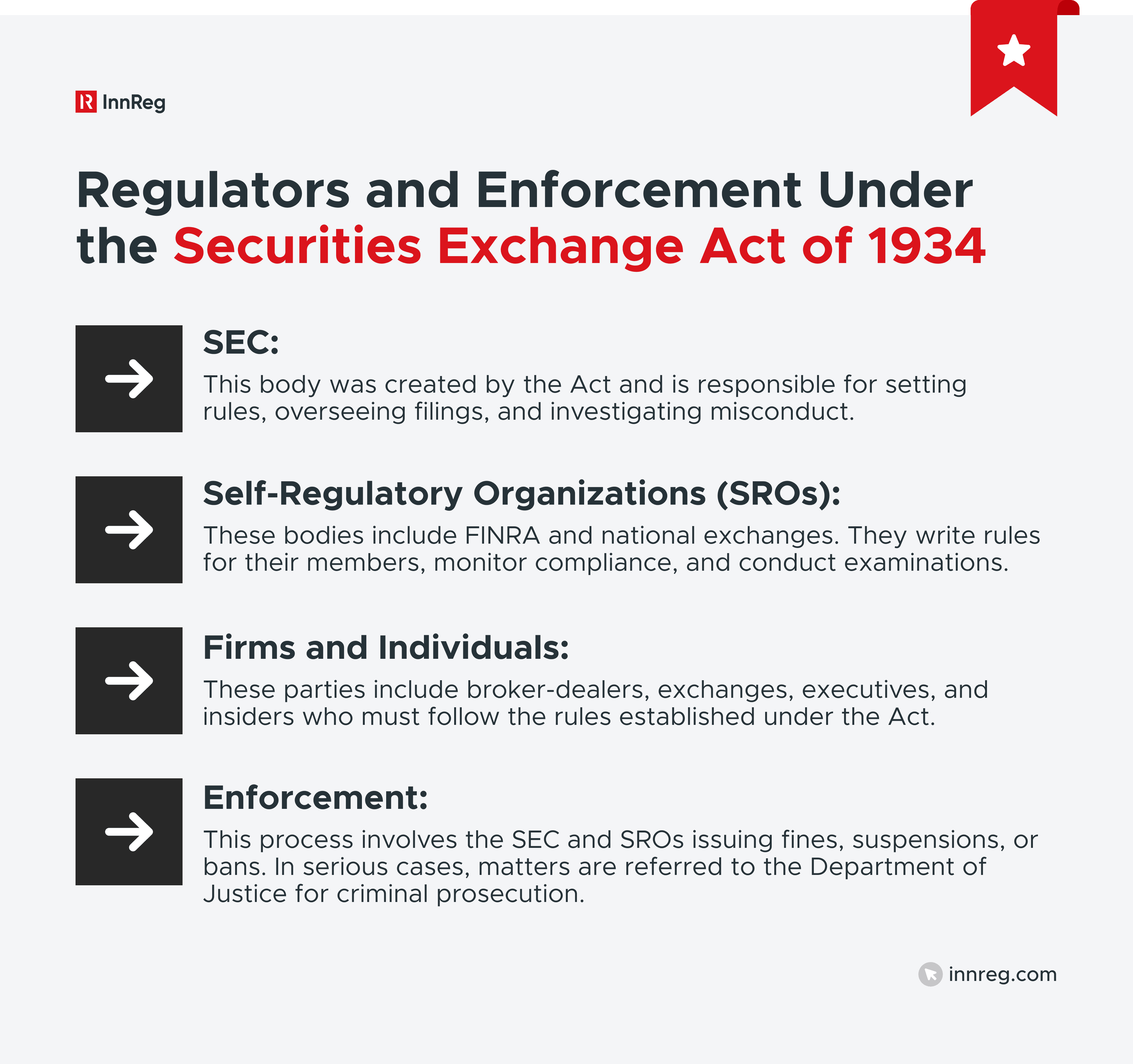
As you can see, the SEC has broad authority to write rules, review filings (like the 10-K, 10-Q, and 8-K), and investigate misconduct. Failure to file these reports accurately and on time can lead to serious SEC enforcement actions against both the company and its leadership.
For a final, concise legal summary of the Act and its reporting requirements, you can refer to this entry from Cornell Law School's Legal Information Institute.
Securities Exchange Act of 1934 | Wex - Cornell Law School
This legal summary from Cornell's Wex provides a dense but precise overview of the 1934 Act's key provisions, including the reporting requirements under Section 13(a).
Please read the section titled 'Reporting Requirements'. Notice how it formally describes the 10-K, 10-Q, and 8-K reports we've just discussed.
Conclusion
Today we've shifted our focus from the one-time event of a securities offering to the ongoing life of a public company. The Securities Exchange Act of 1934 fundamentally reshaped our financial markets by mandating transparency and creating a powerful regulator to enforce it.
Key Takeaways:
- The Securities Exchange Act of 1934 regulates securities trading in the secondary market and establishes continuous disclosure obligations for public companies.
- Its primary purpose was to restore investor confidence after the 1929 crash by creating fair, orderly, and transparent markets.
- A key achievement of the '34 Act was the creation of the Securities and Exchange Commission (SEC).
- "Reporting companies" must file periodic reports with the SEC, which are available to the public on the EDGAR system.
- The three key periodic reports are:
- Form 10-K: A comprehensive, audited annual report.
- Form 10-Q: A less detailed, unaudited quarterly update.
- Form 8-K: A current report filed promptly after a significant corporate event.
We have now learned what the key reports are and when they are filed. But this raises a deeper question: what information is considered important enough that it must be included in these reports? How does a lawyer advise a company on what to disclose? The answer lies in the legal concept of materiality. In our next lesson, we will dissect this crucial standard, which is the cornerstone of all securities disclosure.