Hello! Welcome to the first lesson in our new module on Securities Regulation.
In our last module, we explored how parties use contracts to define their own rules for commercial transactions. Now, we shift to an area where the government imposes a complex and mandatory set of rules to protect investors: the regulation of securities.
As we discussed at the end of our last lesson, the entire field of securities law hinges on a single, fundamental question: What exactly is a "security"? The answer determines whether a company raising money must comply with the extensive and costly regulations enforced by the U.S. Securities and Exchange Commission (SEC). Today, our goal is to answer that question by mastering a famous legal standard.
Your learning outcome for this lesson is to: Apply the Howey test to determine whether an investment constitutes a 'security'.
1. The "Investment Contract": A Gateway to Regulation
The primary federal laws governing securities are the Securities Act of 1933 and the Securities Exchange Act of 1934. Both statutes provide a definition of a "security." These definitions list obvious instruments like stocks, bonds, and notes. However, Congress wisely included a flexible, catch-all term to prevent promoters from avoiding regulation by simply creating novel investment schemes and giving them new names. That term is "investment contract."
This flexible phrase is the key. The central question in many securities law disputes is whether a particular arrangement, regardless of what it's called, is functioning as an investment contract. To understand this foundational concept, let's watch a short clip from a Stanford Online course.
Defining a Security: The Howey Test | Blockchain and Cryptocurrency: What You Need to Know | 2019
This video, featuring Professor Joseph Grundfest, explains why the term 'investment contract' is so important and sets the stage for the case that defined it.
Please watch the video from the beginning until 01:40. Focus on what the professor calls the 'rubber phrase' and why it was necessary.
As the video highlights, the courts needed to create a test to determine what exactly qualifies as an "investment contract." That test came from a landmark 1946 Supreme Court case: SEC v. W.J. Howey Co.
2. The Case of the Florida Orange Groves
The story behind the test is crucial to understanding its logic. The W.J. Howey Company owned large tracts of citrus groves in Florida. To finance its operations, it sold small parcels of these groves to investors, many of whom were tourists with no experience or interest in farming.
Crucially, the land sale was coupled with an optional "service contract." Under this contract, another of Howey's companies would manage the groves, harvest the oranges, and market the fruit, pooling the revenue and returning a share of the net profits to the investors. The investors were entirely passive; they were simply putting up money in the hopes of earning a return managed by the Howey company.
The SEC argued that this "package deal"—the land sale plus the service contract—was an investment contract and therefore a security that should have been registered. The Supreme Court agreed. It looked past the form of the transaction (a sale of real estate) and focused on its economic reality: people were investing money in a common business with the expectation of earning profits through the efforts of the promoters.
This reasoning gave birth to the legal standard we still use today: the Howey Test.
3. The Four Prongs of the Howey Test
The Howey test is a four-part framework. For a transaction to be classified as an investment contract (and thus a security), it must satisfy all four of these criteria.
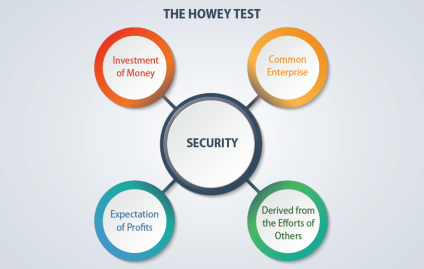
To get a precise legal definition of these prongs, please read the following brief explanation from Cornell Law School's Legal Information Institute.
Howey test | Wex | US Law | LII / Legal Information Institute
This resource provides a concise and authoritative summary of the four elements of the Howey test.
Please read the numbered list (points 1-4) that outlines the four required elements.
Let's break down each prong with a bit more detail:
-
An Investment of Money:
- This is the most straightforward prong. An investor contributes capital to the venture.
- While the test says "money," courts have interpreted this broadly to include other assets like cryptocurrency, goods, or services.
-
In a Common Enterprise:
- The investor's fortunes must be linked to the fortunes of other investors and/or the promoter.
- This is often called "horizontal commonality" (investors pool their assets together) or "vertical commonality" (the investors' success is tied to the promoter's expertise and success). The key idea is that the investors are in the same boat, relying on a shared venture.
-
With a Reasonable Expectation of Profits:
- The primary motivation for the investment is to earn a return, such as dividends, capital appreciation, or a share of the enterprise's earnings.
- This distinguishes an investment from purchasing something for personal use or consumption. For example, buying shares in a housing co-op just to get an apartment is not an investment for profit in the securities sense.
-
Derived Primarily from the Efforts of Others:
- This is often the most critical and contentious prong. The investor is largely passive, relying on the managerial or entrepreneurial efforts of the promoter or a third party to generate the profits.
- The original case used the word "solely," but courts have since clarified this to mean "primarily" or "predominantly." An investor can have some minimal involvement, but if the essential managerial efforts that affect the failure or success of the enterprise are provided by others, this prong is met.
4. Applying the Test: The Howey Test in the 21st Century
The beauty of the Howey test is its flexibility. A test designed for a 1940s citrus farm is now being applied to some of the most advanced financial technologies, most notably cryptocurrencies and digital assets.
Let's watch a video that first explains the original Howey case and then applies the test to a famous modern example: "The DAO," an early crypto project on the Ethereum blockchain.
This video from Liquid Loans first recaps the Howey story and then masterfully applies the four-part test to the 2017 case of The DAO, which the SEC determined was a security.
Please watch from 01:14 to 05:30. Pay close attention to how The DAO's token sale maps onto each of the four prongs of the Howey test.
As the video explains, the SEC found The DAO's token offering was a security because:
- Investment of Money: Investors sent Ether (a cryptocurrency) to purchase DAO tokens.
- Common Enterprise: The funds were pooled into a single venture to invest in projects. All token holders shared in the potential success or failure.
- Expectation of Profits: Investors purchased tokens with the clear expectation of receiving a return if the projects funded by The DAO were successful.
- Efforts of Others: The profits depended on the work of the project creators and the curators who vetted them, not the efforts of the individual token holders.
This demonstrates the enduring power of the Howey test to cut through new technology and complex labels to assess the economic reality of a transaction.
Test your understanding!
An art gallery owner decides to purchase a famous multi-million dollar sculpture. To fund the purchase, she sells 100 "digital art shares" for $30,000 each to various buyers. The share owners have no say in how the sculpture is managed, stored, or insured.
The gallery owner's plan is to market and display the sculpture for several years to increase its public profile and then sell it at a major auction. If the sculpture sells for a profit, the profit will be distributed to the digital art share owners in proportion to their ownership.
Is a "digital art share" likely a security under the Howey test? Analyze it using the four prongs.
Show answer
Yes, a "digital art share" is very likely a security under the Howey test.
- Investment of Money: Yes. Buyers pay $30,000 for each share.
- Common Enterprise: Yes. All the buyers' funds are pooled to purchase a single asset (the sculpture), and their financial outcome is tied together.
- Expectation of Profits: Yes. The buyers are not purchasing the shares to personally enjoy the art; they are buying them with the explicit expectation of receiving a share of the profits when the sculpture is later sold.
- Derived Primarily from the Efforts of Others: Yes. The share owners are completely passive. The potential for profit depends entirely on the gallery owner's expertise in marketing, managing, and ultimately selling the sculpture.
Since the arrangement satisfies all four prongs, it qualifies as an investment contract and thus a security.
Conclusion
Today we've unpacked the foundational question of securities law: what makes something a "security"? We've learned that while statutes list obvious examples, the flexible term "investment contract" allows the law to adapt to new and innovative financial schemes. The durable, four-part Howey test provides the analytical framework for making this critical determination by focusing on economic reality rather than labels.
Key Takeaways:
- The definition of a "security" is broad and includes the flexible category of an "investment contract."
- The Howey Test is the four-part legal standard used to determine if a transaction is an investment contract.
- The four prongs are: (1) an investment of money, (2) in a common enterprise, (3) with a reasonable expectation of profits, (4) to be derived primarily from the efforts of others.
- This nearly 80-year-old test remains highly relevant, serving as the primary tool for regulators analyzing new asset classes like cryptocurrencies.
Now that we understand how to identify a security, the logical next question is: what are the consequences? In our next lesson, we will begin to answer that by examining the purpose of the Securities Act of 1933 and the core process it mandates for the public sale of securities: registration.