Hello! Welcome to the final lesson in our module on Advanced Contract Law for Commerce.
In our last session, we discussed limitation of liability clauses, which are a way for parties to proactively allocate and cap financial risk before a problem occurs. Today, we'll look at a different kind of risk: what happens when an unexpected, external event makes it impossible or commercially nonsensical for a party to fulfill their contractual duties?
This brings us to our learning outcome: Analyze force majeure clauses and the commercial impracticability defense in contract disputes. We will explore both the default legal rules that can excuse performance and the specific contractual clauses that lawyers draft to manage these "acts of God" and other unforeseen disruptions.
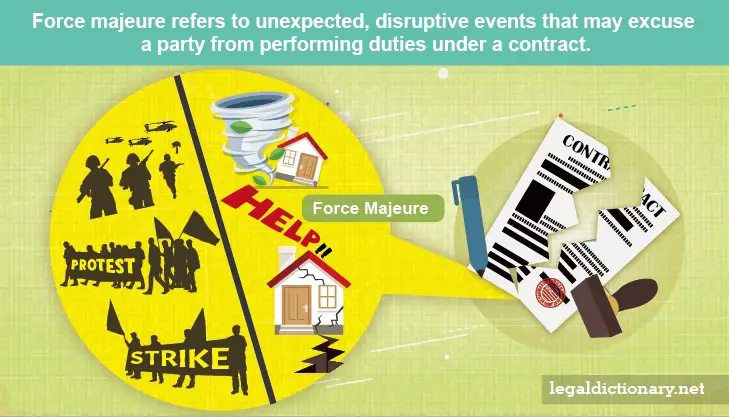
1. The Law's "Escape Hatches": Impossibility and Impracticability
Before we examine specific contract language, it's important to understand the background legal principles that apply when a contract is silent on the matter. Common law and the Uniform Commercial Code (UCC) provide doctrines that can excuse a party's non-performance when something truly unexpected happens.
To get a clear overview of these related concepts, let's watch a short video.
Performance and Breach: Module 5 of 5
This video from LawShelf clearly explains three key defenses to contract performance: impossibility, impracticability, and frustration of purpose. Pay close attention to the distinct example given for each.
Please watch from 4:00 to 6:12.
As the video explains:
- Impossibility: Performance is literally impossible (e.g., the unique good being sold is destroyed in a fire).
- Frustration of Purpose: Performance is still possible, but the fundamental reason for the contract has been destroyed for one party (e.g., the canceled Royal Wedding viewing party).
- Commercial Impracticability: This is the most common defense in a business context. Performance is not literally impossible, but an unforeseen event has made it extraordinarily difficult, dangerous, or expensive—far beyond what the parties originally assumed.
The Commercial Impracticability Defense under the UCC
For contracts involving the sale of goods, this doctrine is codified in UCC § 2-615. A seller can use it as a defense if their failure to deliver goods was caused by an unexpected event. However, courts set a high bar for this defense. The following article details the legal test and provides excellent case summaries.
This article from the Michigan Bar Journal, 'Commercial Impracticability,' focuses specifically on the UCC defense. It outlines the test courts use and illustrates it with real-world cases.
Please read the section titled 'Statutory Authority' and the section just below it titled 'Generally'. Focus on the three-part test and the critical role of 'foreseeability'.
As the article explains, for the defense to succeed, a seller must generally prove three things:
- They did not contractually assume the risk of the event happening.
- The non-occurrence of the event was a basic assumption of the contract.
- The event's occurrence made performance commercially impracticable.
The key factor is foreseeability. If an event was reasonably foreseeable (e.g., a normal price increase, seasonal weather), a court will likely rule that the seller assumed the risk by not addressing it in the contract.
2. The Contractual Solution: The Force Majeure Clause
As you can imagine, relying on a court to agree that something was "unforeseeable" or "impracticable" is a risky strategy. This is why lawyers prefer to spell out the rules in the contract itself using a force majeure clause. The term is French for "superior force."
This short animated video provides a great high-level introduction to the concept.
Force Majeure in Contracts explained | International Law | Lex Animata by Hesham Elrafei
This video from Lex Animata gives a concise visual explanation of the concept of force majeure, including its historical origins and the three core elements that define such an event.
Watch the entire video (up to 02:04). It quickly covers the essential conditions: irresistibility, unpredictability, and externality.
A force majeure clause gives parties control by allowing them to define in advance what events will excuse performance and what the consequences will be. To understand how these clauses are structured and how they differ from the default legal doctrines, we will turn to a detailed guide.
Force majeure - Knowledge Deepening and Sharing
The document 'Force majeure - Knowledge Deepening and Sharing' from the Government of Canada is an excellent, in-depth guide. It clearly contrasts the contractual clause with the common law doctrine of frustration (which is very similar to impracticability).
First, read section '2.1 Force majeure clause compared to the doctrine of frustration' and look at the comparison table in 'Appendix 1'. Focus on the key differences in origin (contract vs. common law) and remedies (flexible vs. termination only).
The most significant advantage of a force majeure clause is control. Instead of relying on a court, the parties can pre-select:
- The specific triggering events.
- The required impact on performance.
- The remedies or consequences (e.g., suspending work, extending a deadline, or terminating the contract).
The Anatomy of a Force Majeure Clause
A well-drafted clause should answer three questions. Let's dig into the anatomy of these provisions.
Force majeure - Knowledge Deepening and Sharing
Let's return to the same resource to dissect the components of a typical force majeure clause.
Please read section '4.0 Interpretation and anatomy of a force majeure clause'. Pay close attention to the three core questions it poses and the discussion of how triggering events are defined (specific lists vs. general catch-alls).
To summarize that excellent reading, a comprehensive force majeure clause specifies:
- What constitutes a triggering event? This is often a list of specific events ("fire, flood, earthquake, war, strikes, acts of government...") sometimes followed by a general catch-all phrase like "...or any other cause beyond the reasonable control of the parties."
- What impact must the event have? The clause will state that the event must "prevent," "hinder," or "delay" performance. The specific wording is critical.
- What is the effect of invoking the clause? Unlike the all-or-nothing outcome of impracticability (which terminates the contract), a force majeure clause often allows for more flexible outcomes, like suspending obligations for the duration of the event or providing an extension of time.
Invoking the Clause: Notice and Mitigation
Finally, simply experiencing a force majeure event isn't enough. The contract will almost always impose procedural requirements on the party seeking relief.
Force majeure - Knowledge Deepening and Sharing
Let's look at the practical steps involved when a party needs to rely on the clause.
Read section '4.4 Additional considerations when invoking a force majeure clause'. Focus on the requirements for giving notice and the 'duty to mitigate'.
Two critical takeaways from this section are:
- Notice: The affected party must promptly notify the other party of the event and how it impacts performance. Failing to give timely notice can void the right to rely on the clause.
- Duty to Mitigate: The party seeking to be excused must take reasonable steps to minimize the disruption. For example, if a supplier's usual shipping route is blocked by a strike, they may be expected to find an alternative route, even if it's more expensive. A court won't excuse a party who could have reasonably worked around the problem.

Test your understanding!
A construction company has a contract to build an office tower. The contract includes a force majeure clause that lists "unavailability of materials" as a triggering event. A global steel shortage causes the price of steel beams to double, making the project unprofitable for the construction company.
Can the company successfully invoke the force majeure clause to be excused from the contract? Why or why not?
Show answer
Probably not. While "unavailability of materials" is listed, the steel is not truly unavailable—it is just much more expensive. Courts generally interpret force majeure clauses narrowly and distinguish between events that make performance impossible and those that simply make it less profitable.
A mere increase in cost, even a substantial one, is usually considered a normal business risk that a party assumes when signing a fixed-price contract. To be excused, the company would likely have to show that steel was physically unobtainable at any price, not just that it erased their profit margin.
Conclusion
Today, we've examined the critical tools for dealing with unforeseen events that disrupt contractual performance. We've seen that while the law provides default doctrines like commercial impracticability, savvy business lawyers prefer the certainty and control offered by a well-drafted force majeure clause. Understanding the interplay between these concepts is essential for advising clients on how to manage risk in a volatile world.
Key Takeaways:
- Commercial Impracticability (UCC § 2-615) is a default legal defense that may excuse non-performance if an unforeseen event makes performance extraordinarily difficult. The bar is high, and foreseeability is a key factor.
- A Force Majeure Clause is a contractual provision that replaces the default legal rules. It gives parties control by defining the triggering events, the required impact, and the specific consequences.
- A well-drafted clause is specific, including a list of events tailored to the contract's context.
- Invoking the clause requires adherence to procedural steps, most importantly providing timely notice and satisfying the duty to mitigate the disruption.
This lesson concludes our module on Advanced Contract Law for Commerce. We've covered key aspects of how sophisticated parties shape their rights and obligations.
Next, we will shift our focus to a highly specialized and regulated area of corporate law: Securities Regulation. In our first lesson of the new module, we'll tackle the fundamental question that underpins this entire field: what exactly is a "security"? We will explore the famous Howey test, which courts have used for decades to make this crucial determination.