Hello! Welcome back to our module on Mergers and Acquisitions.
In our last lesson, you learned to distinguish between the three fundamental M&A structures: asset purchases, stock purchases, and mergers. We established the general rule of thumb: buyers often prefer asset deals to "cherry-pick" assets and avoid unwanted liabilities, while sellers prefer stock deals for a cleaner exit and better tax treatment.
Today, we will build directly on that foundation by focusing on one of the most critical factors in any M&A negotiation: risk. As a corporate lawyer, your primary role is often to help your client identify, understand, and allocate risk. In M&A, the most significant risk is often the seller's liabilities.
Your learning outcome for this lesson is to: Evaluate the liability implications of choosing a merger, asset purchase, or stock purchase structure.
We will dissect how liabilities are treated in each deal structure, moving beyond the general rule to explore important legal exceptions that can surprise an unprepared buyer. Understanding these nuances is essential for providing sound legal advice.
1. Liability in Stock Purchases and Mergers: Taking It All
Let's begin with the most straightforward scenarios regarding liability: stock purchases and mergers.
As we discussed, in a stock purchase, the buyer acquires ownership of the target company itself. The target company continues its legal existence, just with a new owner. Consequently, the company retains all of its assets and, crucially, all of its liabilities—whether they are known, unknown, or contingent. The buyer inherits the company's entire history, for better or worse.
A merger works similarly. When two companies merge, the surviving entity assumes all the assets, rights, and liabilities of the disappearing entity by operation of law. This transfer is automatic and absolute.
To understand the practical implications, let's explore these structures in more detail.
Choosing the proper transaction structure: asset vs. stock vs. merger
The following article from the law firm Ballard Spahr LLP clearly explains how liabilities are treated in stock purchases and mergers. It also introduces an important structural tool—the triangular merger—used to shield the ultimate parent company.
Please read the sections titled 'Stock Purchases' and 'Mergers'. As you read, focus on these key points: In a stock purchase, how does the target company's legal status relate to the transfer of liabilities? In a merger, what does 'by operation of law' mean for liability transfer? Pay close attention to the description of a 'triangular merger.' How does it help a buyer shield itself from the target's liabilities?
Key Concepts of Inherited Liability
- Known vs. Unknown Liabilities: Inherited liabilities include not only the debts listed on a balance sheet but also "unknown" or "contingent" liabilities. A known liability might be a bank loan. An unknown liability could be a future product liability lawsuit for a product sold years before the acquisition, or an undiscovered environmental contamination issue.
- Buyer's Shield in a Triangular Merger: As the reading highlights, a triangular merger is a clever structural device. The buyer forms a new subsidiary, and that subsidiary merges with the target. The target's liabilities flow into the subsidiary, but they are contained there. This prevents the liabilities from directly attaching to the buyer's parent company, protecting its own assets. However, the acquired business itself (now housed in the subsidiary) is still saddled with all its original liabilities.
- Mitigation: The primary way a buyer protects itself in these structures is through due diligence (the topic of our next lesson) and by negotiating strong contractual protections in the purchase agreement, such as representations and warranties from the seller about the state of the business and indemnification clauses that require the seller to pay for any pre-closing liabilities that may arise after the deal is done.
2. Liability in Asset Purchases: The "Clean" Deal and its Dirty Secret
Buyers prefer asset purchases precisely to avoid the scenario described above. In an asset purchase, the general rule is that the buyer only takes on the liabilities it explicitly agrees to assume in the Asset Purchase Agreement (APA). The seller's corporate entity is left behind, along with all its other liabilities.
This allows a buyer to surgically acquire a business division or specific assets—like IBM acquiring The Weather Company's digital assets—without taking on unwanted historical baggage.
However, this liability shield is not absolute. Courts have developed a doctrine known as successor liability, which can, under certain circumstances, impose a seller's liabilities on the buyer, even in a clear asset deal. This is the "dirty secret" that every M&A lawyer must know.
Let's watch a quick video to reinforce the buyer's motivation and hear the first mention of this critical exception.
Merger & Acquistion (M&A) Deal Structures Explained
In this clip from a previous video, business lawyer Brett Cenkus explains why buyers prefer asset deals from a liability perspective and introduces the concept of successor liability.
Watch from 03:38 to 04:20. Listen for the distinction between taking 'the whole thing - the good and the bad' in a stock sale versus 'cherry-picking the assets' in an asset sale. Note his specific mention of the 'successor liability' exception.
The Four Main Exceptions: When Successor Liability Applies
A buyer in an asset sale can be held liable for the seller's obligations if one of the following exceptions is met:
-
Express or Implied Assumption: This is the most obvious case. The buyer is liable if the purchase agreement explicitly states it will assume certain liabilities, or if its post-closing conduct implies assumption (e.g., by continuing to make payments on a seller's debt).
-
De Facto Merger: A transaction might be labeled an "asset purchase," but if it looks and acts like a merger, a court may treat it as one. Courts look for continuity of ownership (seller's shareholders get stock in the buyer), continuity of management and personnel, the seller ceasing operations, and the buyer assuming the obligations necessary for the uninterrupted continuation of the business.
-
Mere Continuation: This is a narrower version of the de facto merger doctrine. The focus is on the identity of the corporate entity. A court will find mere continuation if there is a common identity of officers, directors, and stockholders between the selling and purchasing corporations. Essentially, the buyer is just the seller in a new hat.
-
Fraudulent Transfer of Assets: This exception applies if the sale was structured to fraudulently escape liabilities. For example, if a seller facing a large lawsuit sells its assets to a friendly party for a price far below fair market value, leaving the seller as an empty shell with no assets to pay its creditors, a court can void the transfer or hold the buyer responsible.
These exceptions prevent companies from using asset sales as a loophole to evade legitimate obligations to creditors, tort victims, or employees.
3. Comparing the Liability Profiles
Now that we understand the rules and exceptions, let's consolidate the comparison. The choice of structure creates a spectrum of liability risk for the buyer.
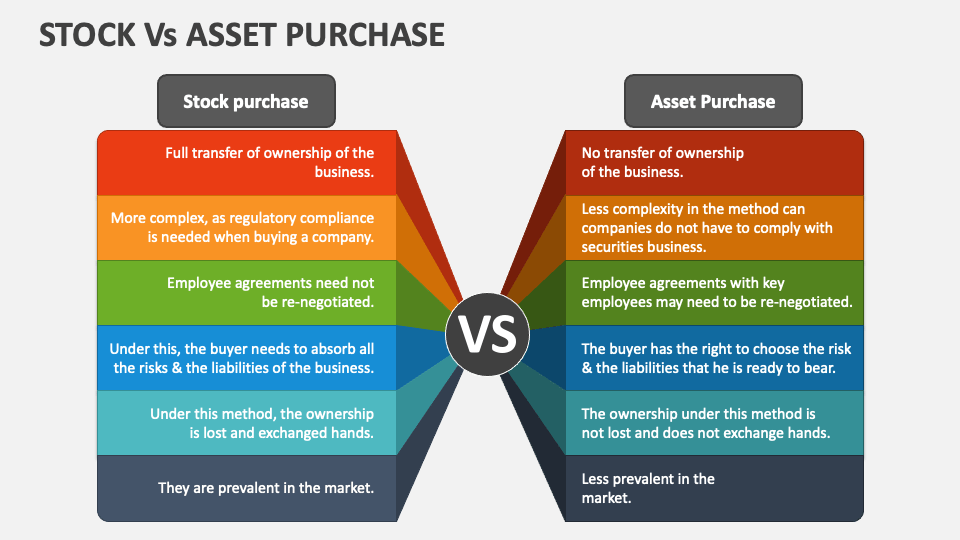
The following reading offers a more detailed comparison from both the buyer's and seller's perspectives, helping to clarify the strategic thinking that drives these decisions.
Differences between asset and stock acquisitions in M&A
This article from M&A Community provides an excellent breakdown of the competing perspectives on liability and risk.
Please read the following sections: The comparison table under 'Asset acquisition vs stock acquisition: Key differences'. Focus on the 'Liability considerations' row. The section 'Buyer’s perspective,' focusing on 'Risk management.' The section 'Seller’s perspective,' focusing on 'Post-sale liabilities.' This will help you understand how the legal rules we've discussed translate into strategic preferences for each party.
Test your understanding!
A company called "CleanUp Inc." manufactures industrial solvents. It is being acquired by "Global Chemical Corp." CleanUp has a history of environmental issues and is facing potential government fines for soil contamination at its old factory site, which it sold five years ago. Global Chemical wants CleanUp's patented solvent formulas and its customer contracts but is terrified of the environmental liability.
- What deal structure will Global Chemical's lawyers demand? Why?
- Even with this structure, what is the key risk Global Chemical's lawyers must advise their client about?
- If Global Chemical buys the assets, fires all of CleanUp's employees, and moves the operations to a new facility, does this increase or decrease the risk of successor liability? Why?
Show answer
- Global Chemical's lawyers will demand an asset purchase. This allows them to acquire the valuable assets (patents, contracts) while explicitly excluding the environmental liabilities associated with past operations.
- The key risk is successor liability. Specifically, in areas with strong public policy concerns like environmental law (e.g., CERCLA/Superfund in the U.S.), courts are more likely to impose liability on a successor corporation to ensure cleanup costs are paid. The lawyers must advise that the asset purchase is not a guaranteed shield.
- This decreases the risk of successor liability. By breaking the continuity of management, personnel, physical location, and assets, Global Chemical makes it much harder for a court to argue that it is a "mere continuation" or "de facto merger" of CleanUp Inc. It is clearly operating a different business that simply uses some of CleanUp's old assets.
4. The Corporate Lawyer's Role in Managing Liability
Your future role as a corporate lawyer is to navigate these complex issues. It isn't just about knowing the rules; it's about using them to protect your client. This involves advising on deal structure, conducting diligence to find hidden risks, and drafting agreements to allocate those risks.
Mergers and Acquisitions Explained: A Crash Course on M&A
To conclude, let's hear again from corporate lawyer Brett Cenkus as he describes his role in an M&A deal, with a specific focus on managing liability through the purchase agreement.
Please watch from 09:17 to 10:26. Pay attention to how he describes the lawyer's role in drafting the purchase agreement to address 'liabilities and risk' and what happens if something goes wrong after the sale.
As he explains, a significant portion of the M&A lawyer's work involves negotiating and drafting the contractual provisions—representations, warranties, covenants, and indemnities—that serve as a private, negotiated solution to the liability risks inherent in the deal structure.
Conclusion
In this lesson, you have moved from a general understanding of M&A structures to a nuanced evaluation of their liability implications. This is a crucial step toward thinking like a corporate lawyer, whose value lies in identifying and mitigating risk for clients.
Key Takeaways:
- Stock Purchases & Mergers: The buyer or surviving entity inherits all of the target’s liabilities by default, both known and unknown. Mitigation relies heavily on due diligence and strong contractual protections.
- Asset Purchases: The buyer generally assumes only specifically identified liabilities. This provides a strong liability shield, but it is not absolute.
- Successor Liability: This legal doctrine is the critical exception to the rule in asset sales. A buyer can still be held responsible for a seller's liabilities if the transaction is deemed a de facto merger, a mere continuation, or fraudulent.
- The Lawyer's Role: Advising on the optimal structure and then drafting the purchase agreement to allocate risk is a core function of an M&A lawyer.
We repeatedly mentioned that the best way to manage liability risk is to first identify it. This process of investigation is called due diligence. In our next lesson, we will describe the purpose and overall scope of due diligence in M&A transactions, showing you how lawyers "kick the tires" before their client buys the car.