Hello! Welcome to the first lesson in our module on Mergers and Acquisitions (M&A).
In our last module on Securities Regulation, you mastered the rules governing how companies raise capital and communicate with investors. We concluded by examining Rule 10b-5 and its application to insider trading, a topic that highlights the critical importance of confidential information.
The world of M&A is where these principles are put to the ultimate test. When one company acquires another, it's a high-stakes event involving massive financial transactions, complex negotiations, and a great deal of material non-public information. As a corporate lawyer, your role is to guide clients through this process, and the very first—and most fundamental—decision is choosing the deal structure.
Your learning outcome for this lesson is to: Distinguish between mergers, asset purchases, and stock purchases as acquisition structures.
By the end of this lesson, you will understand the three primary ways to structure an M&A transaction and be able to analyze the core legal and strategic differences between them. This is the foundational building block for all M&A legal work.
1. The Three Paths to an Acquisition
When one company buys another, what is actually being bought? Is it a collection of physical items and contracts? Is it the legal entity itself? Or is it a combination of two companies into one? The answer depends on the deal structure.
There are three basic ways to structure the sale of a business. Let's start with a high-level overview to get the core concepts down.
Mergers and Acquisitions Explained: A Crash Course on M&A
This video, 'Mergers and Acquisitions Explained: A Crash Course on M&A' from business lawyer Brett Cenkus, provides a fantastic introduction to the three fundamental ways to buy or sell a business.
Please watch from 00:41 to 03:03. Pay close attention to how the speaker describes what is being transferred in an asset sale, a stock sale (using the 'container' analogy), and a merger (a 'magical thing that happens by operation of law').
As the video explains, the three primary structures are:
- Asset Purchase: The buyer purchases specific assets and potentially assumes specific liabilities from the seller's company.
- Stock (or Equity) Purchase: The buyer purchases the ownership interests (e.g., stock in a corporation, membership interests in an LLC) from the target company's owners. The company itself remains intact, now under new ownership.
- Merger: Two companies are combined into one surviving entity through a statutory process. One company is absorbed by the other, and all its assets and liabilities transfer automatically.
The choice between these three structures is not a mere formality; it has profound consequences for liability, taxes, operational integration, and the complexity of the transaction itself.
2. A Side-by-Side Comparison
To truly grasp the differences, it's helpful to see the structures compared directly across key features. The following reading provides an excellent framework for this comparison.
Asset Purchase vs. Stock Purchase vs. Merger Deal Structures: A Legal and Strategic Comparison
Now that you have the conceptual overview, let's dive into the legal and strategic details. The law firm Linden Law Partners has published a clear and concise article that provides a side-by-side comparison.
Please read the 'Overview' section and then study the 'Comparison of Deal Structures' table carefully. This table is the centerpiece of today's lesson. Focus on the first four rows: 'What is Acquired', 'Liabilities Assumed', 'Tax Treatment' (at a high level for now), and 'Third-Party Consents'.
This table is your cheat sheet for understanding the core trade-offs. Now, let's look at each structure in more detail.
3. Deconstructing the Deal Structures
A. The Asset Purchase: A Surgical Approach
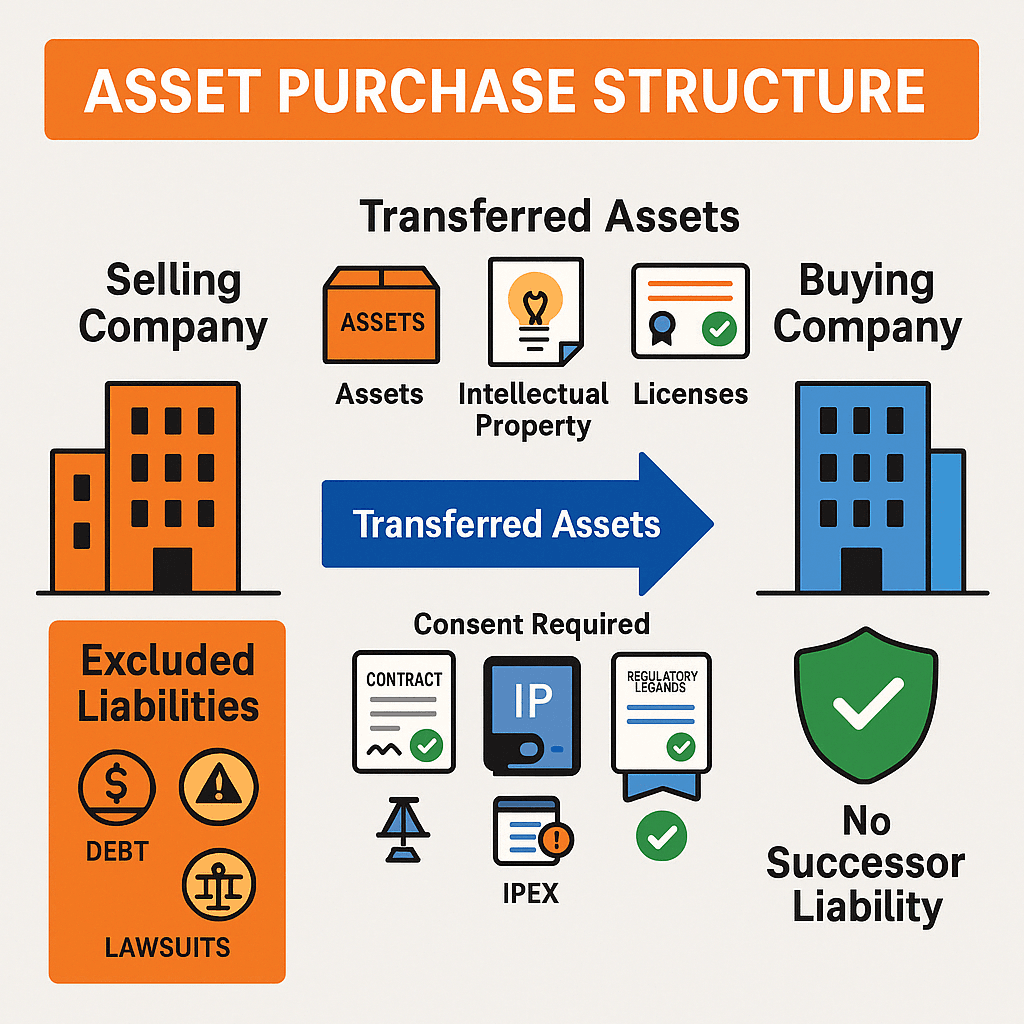
In an asset purchase, the buyer can "cherry-pick" the assets it wants and leave unwanted liabilities behind. The parties create a detailed list in the Asset Purchase Agreement that specifies exactly which assets are included (e.g., equipment, inventory, intellectual property, key contracts) and which are excluded.
Key Characteristics:
- Liability Shield: This is the primary advantage for a buyer. The buyer generally does not inherit the seller's past liabilities (like lawsuits or debts) unless they are explicitly listed as "Assumed Liabilities." We'll discuss exceptions to this rule in the next lesson.
- Transactional Complexity: The big disadvantage is complexity. Each asset must be legally transferred. This can be a painstaking process, especially for contracts, leases, and permits that may have "anti-assignment" clauses requiring the consent of the other party (the third party) before the transfer can occur.
- Use Cases: Often used for distressed sales (where the seller has significant liabilities), corporate "carve-outs" (selling just one division of a larger company), or when the buyer is only interested in specific assets, like a patent portfolio.
B. The Stock Purchase: Taking the Whole "Container"
In a stock purchase, the buyer doesn't buy assets from the company; it buys the company itself from its owners (the shareholders). The target company continues to exist as a legal entity, just with a new owner. All of its assets, liabilities, contracts, and permits remain with the company.
Key Characteristics:
- Continuity and Simplicity: From a transactional standpoint, this is often simpler than an asset deal. Since the company itself doesn't change, its contracts and permits generally remain in place without the need for third-party consent (unless a contract has a specific "change of control" clause).
- Liability Inheritance: This is the major risk for the buyer. The buyer acquires the company "as is," including all of its history and liabilities—both known and unknown. Thorough due diligence is absolutely critical to uncover any hidden risks before the deal closes.
- Use Cases: Very common for the acquisition of healthy, privately-held businesses where the goal is a clean transfer of the entire ongoing operation.
C. The Merger: A Statutory Union
A merger is a formal, statutory process where two companies are legally combined into one. State corporate law governs how this happens. In the simplest form, one company (the "disappearing" corporation) merges into the other (the "surviving" corporation). By operation of law, all the assets and liabilities of the disappearing company are automatically vested in the surviving company.
Key Characteristics:
- Automatic Transfer: No need to transfer individual assets or assign contracts. The transfer happens automatically by law upon filing the merger documents, making it very efficient for combining two large, complex organizations.
- Shareholder Approval: Mergers typically require formal approval from the shareholders of one or both companies. This can sometimes be a hurdle, though state laws often only require a majority vote, which can overcome opposition from minority shareholders.
- Liability Transfer: Like a stock purchase, the surviving corporation inherits all liabilities of the disappearing corporation.
- Use Cases: Common in deals involving public companies, strategic "roll-ups" (where one company acquires many smaller ones), or when the payment will be made with the buyer's own stock.
4. Buyer vs. Seller: The Strategic Tension
Understanding these structures requires recognizing the often-competing interests of the buyer and seller. Their preferences are typically driven by two key factors: liability and taxes.
Merger & Acquistion (M&A) Deal Structures Explained
Let's return to Brett Cenkus's channel for a concise explanation of why buyers and sellers typically prefer different structures.
Please watch from 02:14 to 04:20. Focus on how liability and tax considerations create a natural tension between the buyer's and seller's preferred deal structure.
As the video explains, the general rule of thumb is:
- Buyers prefer asset purchases. This allows them to avoid inheriting unknown liabilities and often provides a tax advantage by letting them "step-up" the basis of the acquired assets for future depreciation.
- Sellers prefer stock purchases. This provides a cleaner exit (the seller is left with cash, not a corporate shell with leftover liabilities) and generally results in more favorable capital gains tax treatment.
This tension is a central part of M&A negotiations, and a lawyer's job is often to find a compromise, using the purchase agreement to bridge the gap (for example, by having the seller agree to indemnify the buyer for certain pre-closing liabilities in a stock deal).
Test your understanding!
Imagine you are advising a large pharmaceutical company, "PharmaCo," that wants to acquire a small biotech startup, "BioGen." BioGen has a revolutionary new drug patent, which is extremely valuable. However, BioGen also has a pending lawsuit from a former employee and several expensive, long-term office leases that PharmaCo does not want.
- What deal structure would you, as PharmaCo's lawyer, strongly recommend? Why?
- What structure would BioGen's founders likely prefer? Why?
Show answer
-
As PharmaCo's (the buyer's) lawyer, you would strongly recommend an asset purchase. This would allow PharmaCo to acquire the specific asset it wants (the drug patent) while explicitly excluding the unwanted liabilities (the lawsuit) and obligations (the office leases). PharmaCo could "cherry-pick" the good and leave the bad behind.
-
BioGen's founders (the sellers) would likely prefer a stock purchase. This would allow them to sell their entire ownership in the company and walk away with cash, leaving the corporate entity—and its associated lawsuit and leases—in the hands of the new owner, PharmaCo. It provides a cleaner and more complete exit for them.
Conclusion
You have now analyzed the three fundamental structures that form the blueprint for any M&A deal. Understanding their differences is not just an academic exercise; it is the first and most critical strategic decision in any acquisition, driving everything from negotiation to risk allocation.
Key Takeaways:
- Asset Purchase: The buyer acquires specific assets and avoids most liabilities. This is preferred by buyers but is transactionally complex.
- Stock Purchase: The buyer acquires the entire company, including all assets and liabilities (known and unknown). This is preferred by sellers and is often simpler to execute.
- Merger: Two companies are combined by law, with all assets and liabilities transferring automatically to the surviving entity. This is efficient for large, complex combinations.
- The choice of structure is driven by a strategic negotiation between the buyer and seller, centering on the allocation of risk (liability) and tax consequences.
In our next lesson, we will build directly on this foundation by examining the liability implications of each structure in greater detail. We will explore the concept of "successor liability" and see how, even in an asset deal, a buyer can sometimes be held responsible for the seller's old liabilities.