Hello! Welcome back to our module on Mergers and Acquisitions.
In our last lesson, we evaluated how the choice of deal structure—asset purchase, stock purchase, or merger—profoundly impacts who bears the risk of the target company's liabilities. We concluded that in stock deals and mergers, the buyer inherits all liabilities by default, whereas in an asset deal, the buyer can theoretically leave them behind. However, we also saw that this protection isn't absolute due to the doctrine of successor liability.
A crucial takeaway was that managing these risks, regardless of structure, requires first identifying them. This brings us directly to today's topic. How do buyers find these potential liabilities and verify that the business they are buying is everything the seller claims it is? This process of investigation is called due diligence.
Your learning outcome for this lesson is to: Describe the purpose and overall scope of due diligence in M&A transactions.
We will explore what due diligence is, why it is a non-negotiable step in any M&A deal, and what key areas of a business are placed under the microscope.
1. What is Due Diligence? The "Kicking the Tires" Phase
At its core, due diligence is a comprehensive investigation or audit of a target company conducted by a prospective buyer. The most common analogy is "kicking the tires" before buying a car. You wouldn't buy a used car based solely on the seller's assurances; you'd look under the hood, check the service history, and take it for a test drive. Due diligence is the corporate equivalent of this, but far more extensive.
Let's begin with a video that introduces the concept in the M&A context.
Mergers and Acquisitions Due Diligence Explained
This short clip from business attorney Brett Cenkus provides a clear, high-level introduction to due diligence, explaining what it is and why a buyer performs it.
Please watch the first minute of the video (0:00 - 1:03). Focus on the core definition of due diligence and the analogy used to describe it.
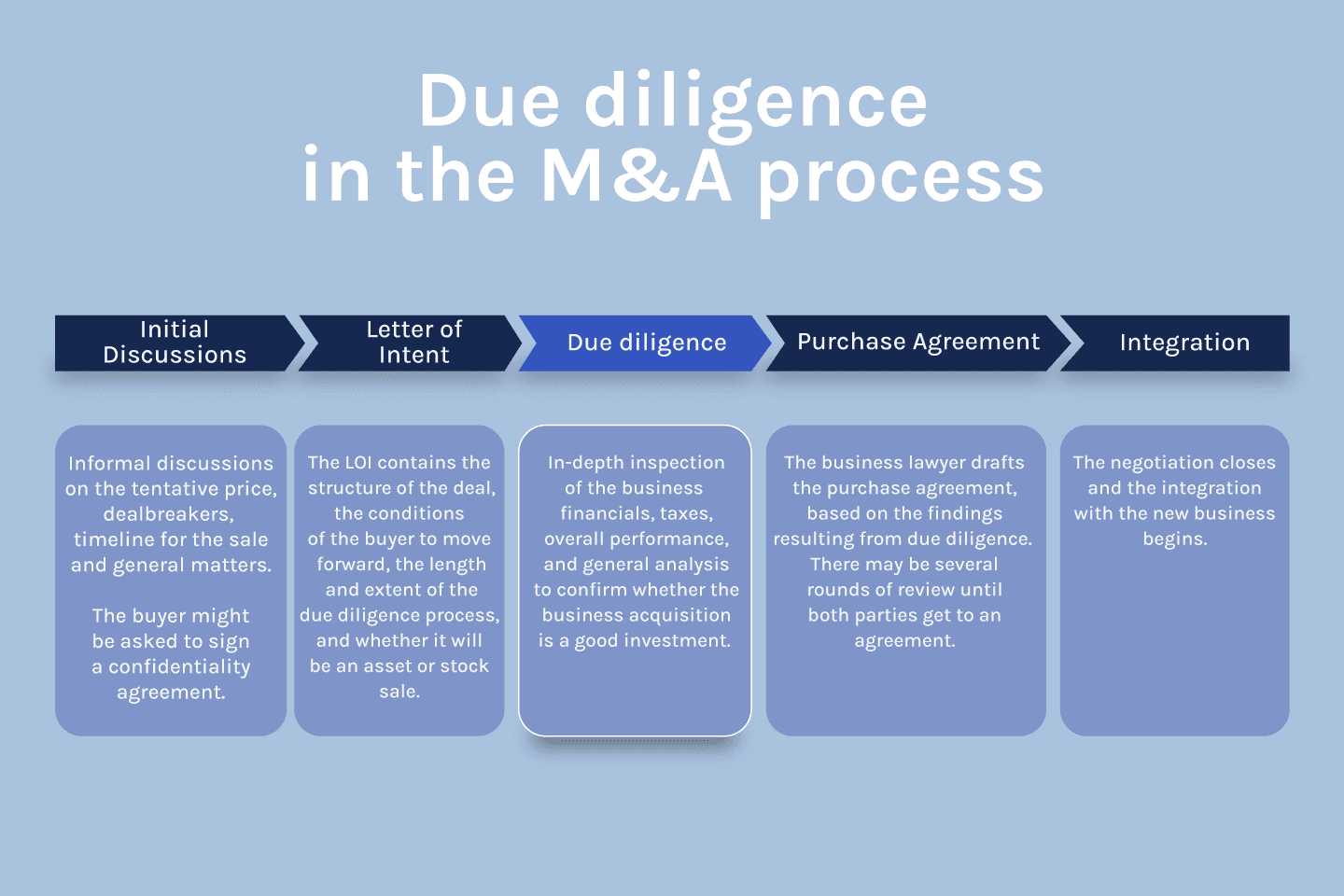
As the video explains, due diligence is the process of verifying that what you're buying is what you think you're buying. It's a critical phase that occurs after initial interest is established but before the deal is finalized.
2. The Purpose of Due Diligence
While "kicking the tires" is a helpful analogy, the legal and commercial purposes of due diligence are more specific. A thorough investigation serves three main objectives.
Let's read a formal definition and breakdown of these objectives.
Due Diligence: The Purpose, the Procedure and Pitfalls
The following paper from the law firm McMillan LLP, titled 'Due Diligence: The Purpose, the Procedure and Pitfalls,' provides a concise, principle-based explanation of the core goals of a due diligence review.
Please read the section titled 'The Purpose' on page 2, starting from 'What is Due Diligence?' and ending just before 'The Procedure' on page 4. Pay attention to the three main objectives discussed: Full Disclosure: How does diligence ensure representations and warranties are accurate? Transaction Evaluation: How does it help the buyer make an informed business decision? Limitation of Professional Liability: Why is a well-documented diligence process important for the lawyers and advisors themselves?
To summarize and expand on the reading, the key purposes of due diligence are:
- To Confirm and Verify Information: It allows the buyer to test the accuracy of the seller's representations about the company. This includes everything from financial performance to ownership of key assets.
- To Identify Risks and "Deal-Breakers": This is arguably the most critical function. Due diligence uncovers potential liabilities and problems that may not be immediately apparent. This could be pending litigation, environmental hazards, unsigned contracts, or tax issues—the very risks we discussed in our last lesson.
- To Inform Valuation and Negotiation: The findings from due diligence directly impact the deal's price and terms. If a significant problem is found, the buyer may:
- Walk away from the deal entirely.
- Negotiate a lower purchase price.
- Require the seller to fix the problem before closing.
- Demand specific contractual protections, such as an indemnity where the seller agrees to cover the costs of a specific known risk.
- To Facilitate Post-Closing Integration: By understanding the target's operations, contracts, and systems, the buyer can better plan for a smooth integration of the two companies after the deal is completed.
3. The Scope of Due Diligence: What Gets Investigated?
Now that we understand why due diligence is done, let's look at what is investigated. The scope is broad, covering every major function of the business. The investigation is typically divided into several streams, each handled by different experts (lawyers, accountants, consultants).
The main areas of due diligence include:
- Financial Diligence: Conducted by accountants to verify the company's financial health. They scrutinize historical financial statements, quality of earnings, projections, and tax compliance.
- Commercial/Operational Diligence: Examines the business itself—its market position, customer base, supply chain, and technology.
- Legal Diligence: Conducted by lawyers to assess the target’s legal risks and obligations. This is the area you will be most involved in as a corporate lawyer.
The following image gives a great overview of the typical workstreams within legal due diligence.

To get a more practical feel for the scope, let's return to the Brett Cenkus video, where he describes the documents a buyer typically requests.
Mergers and Acquisitions Due Diligence Explained
In this segment, Brett Cenkus lists some of the common items on a due diligence request list, giving a tangible sense of the breadth of the investigation.
Watch from 00:41 to 02:13. As you watch, make a mental list of the different types of documents requested (e.g., financials, contracts, HR records). Notice how these requests cover nearly every aspect of the company's operations.
Tailoring the Scope to the Deal
It's important to understand that due diligence is not a one-size-fits-all process. The depth and focus of the investigation should be tailored to the specifics of the transaction. The buyer’s strategic motivation for the deal is the most important factor.
Legal due diligence - understanding the drivers behind the transaction
This article from Deloitte, 'Legal due diligence - understanding the drivers behind the transaction,' explains how the buyer's goals shape the diligence process. This connects the 'what' of diligence back to the 'why'.
Please read the section titled '2. Aligning due diligence with strategic objectives.' Focus on how the diligence priorities would change depending on whether the buyer's main goal is acquiring IP, expanding market share, or entering a new geographic market.
As the article explains, if a tech company is being acquired for its innovative software, the buyer's lawyers will spend an enormous amount of time on intellectual property diligence—ensuring the company truly owns its code and that all employees have assigned their IP rights. In contrast, if the acquisition is about gaining market share in the retail sector, the focus might shift to analyzing real estate leases and key supplier contracts.
Test your understanding!
A large pharmaceutical company, "PharmaGiant," wants to acquire "BioStart," a small biotech firm whose only significant asset is a promising new drug candidate currently in clinical trials. BioStart has five employees (all scientists) and minimal revenue.
What are the top 2-3 areas that PharmaGiant's legal due diligence team should focus on, and why?
Show answer
The legal due diligence team should focus intensely on:
- Intellectual Property (IP): This is the single most important area. PharmaGiant must confirm that BioStart has clear and undisputed ownership of the patents covering the drug candidate. They need to ensure there are no competing claims or potential infringement issues.
- Employee and Founder Agreements: The team must verify that all employees and founders have signed agreements that unequivocally assign all intellectual property they created to BioStart. If a key scientist didn't sign an IP assignment, they might personally own a piece of the technology, which would be a catastrophic problem for the buyer.
- Regulatory Compliance: Since the asset is a drug in clinical trials, diligence must confirm that all trials have been conducted in compliance with regulations from bodies like the FDA. Any compliance failure could jeopardize the drug's future approval.
Financials and commercial contracts are less critical here, as the company's value is almost entirely tied to the potential of its IP.
4. Due Diligence in Practice: Process and Outcomes
So, how does this all work?
- The Request List: The buyer's legal and financial advisors prepare a comprehensive due diligence request list and send it to the seller.
- The Data Room: The seller gathers the requested documents and uploads them to a secure virtual data room (VDR). In the past, this was a physical "war room" filled with boxes of paper.
- Review and Q&A: The buyer's team reviews the documents in the VDR and submits follow-up questions to the seller. This can involve multiple rounds of Q&A.
- Diligence Report: The buyer’s advisors compile their findings into a diligence report, summarizing key issues and red flags for the buyer.
It is a common misconception that finding a problem during due diligence automatically kills the deal. More often, it simply provides crucial information that shapes the final terms.
[VC Unlocked] The Basics of Due Diligence
This clip from a video by 500 Global, a venture capital firm, explains the mindset behind due diligence. Although it's from an investor's perspective, the principle is identical in M&A.
Please watch from 02:22 to 03:30. Listen for the speaker's point that due diligence is not about discovering that everything is perfect, but about making sure you are not taking on more risk than you are aware of.
As the video notes, the discovery of an issue doesn't mean the deal dies. It means the process has worked as intended. The buyer is now aware of the risk and can make an informed decision about how to proceed.
Conclusion
In this lesson, we have defined the essential role of due diligence in any M&A transaction. It is the bridge between a preliminary agreement and a binding contract, allowing the buyer to look "under the hood" of the target company.
Key Takeaways:
- Purpose: Due diligence is a systematic investigation to verify the seller's claims, identify risks and liabilities, and provide information to help value the company and negotiate the final deal terms.
- Scope: The scope is comprehensive, covering financial, operational, and legal aspects of the business. The specific focus is tailored to the strategic drivers of the transaction.
- Process: It typically involves a formal request list from the buyer and the seller providing documents in a virtual data room.
- Outcome: The findings rarely result in a simple pass/fail. Instead, they inform negotiation, leading to price adjustments, specific contractual protections, or, in serious cases, the termination of the deal.
In our previous lesson, you learned about the legal risks. Today, you've learned about the process used to find them. In our next lesson, we will combine these two topics and dive deeper into the key areas of legal due diligence that a corporate lawyer scrutinizes in a typical acquisition.