Hello! Welcome to the next lesson in our module on choosing the right business structure.
In our last lesson, we analyzed the limited partnership (LP), a structure that offers limited liability to passive investors but leaves the managing general partners with unlimited personal liability. This raised a natural question: what if you want limited liability protection for everyone involved in the business, including those who run it day-to-day?
Today, we'll answer that by exploring the two most popular business entities in modern commerce: the Limited Liability Company (LLC) and the Corporation. Both structures solve the liability problem of the partnership, but they do so in very different ways, creating a crucial set of trade-offs for founders and their legal advisors. Our goal is to evaluate the advantages and disadvantages of an LLC versus a corporation, moving beyond a simple checklist to a strategic analysis that a future corporate lawyer would undertake.
1. Fundamental Legal Differences: Flexibility vs. Formality
At their core, both LLCs and corporations are "creatures of statute"—legal entities created by filing documents with the state, which grants their owners a shield of limited personal liability. However, the legal frameworks governing them create a primary distinction: LLCs are defined by flexibility, while corporations are defined by formal structure.
To understand these foundational differences, let's turn to a professional legal resource.
The Corporation vs. the LLC: A comparison of entities and ...
The following article from Wolters Kluwer, a major legal information provider, systematically compares corporations and LLCs across key legal characteristics. This will provide the formal framework for our analysis.
Please read the first four sections of the article, covering: (1) Characteristics of corporations and LLCs, (2) Formation, (3) Management, and (4) Shareholders vs. members. Focus on how the 'default rules' for each entity type differ regarding control, ownership transfer, and internal governance.
Based on that reading, let's distill the key structural distinctions:
-
Governance & Management:
- Corporation: A rigid, three-tier hierarchy is mandated by law: Shareholders own the company, they elect a Board of Directors to oversee major policies, and the Board appoints Officers (CEO, CFO, etc.) to manage daily operations.
- LLC: Offers tremendous flexibility. It can be member-managed, where all owners (members) participate in management, much like a partnership. Alternatively, it can be manager-managed, where members appoint a manager or a group of managers (who can be members or outsiders) to run the business, similar to a corporation's board.
-
Governing Documents:
- Corporation: Governed by Articles of Incorporation (the public filing) and Bylaws (the internal rulebook for operations, meetings, etc.). The law often has mandatory provisions that cannot be changed.
- LLC: Governed by Articles of Organization (the public filing) and an Operating Agreement. The operating agreement is a powerful and highly customizable internal contract among members that dictates almost every aspect of the LLC's governance, profit distribution, and ownership rules.
-
Transfer of Ownership:
- Corporation: Ownership is represented by shares of stock, which are generally freely transferable (unless restricted by a shareholders' agreement). This makes it easy to bring in new investors.
- LLC: Ownership is held in "membership interests." By default, only the financial rights (the right to receive profits) can be freely transferred. Transferring the management and voting rights typically requires the consent of the other members, as specified in the operating agreement.
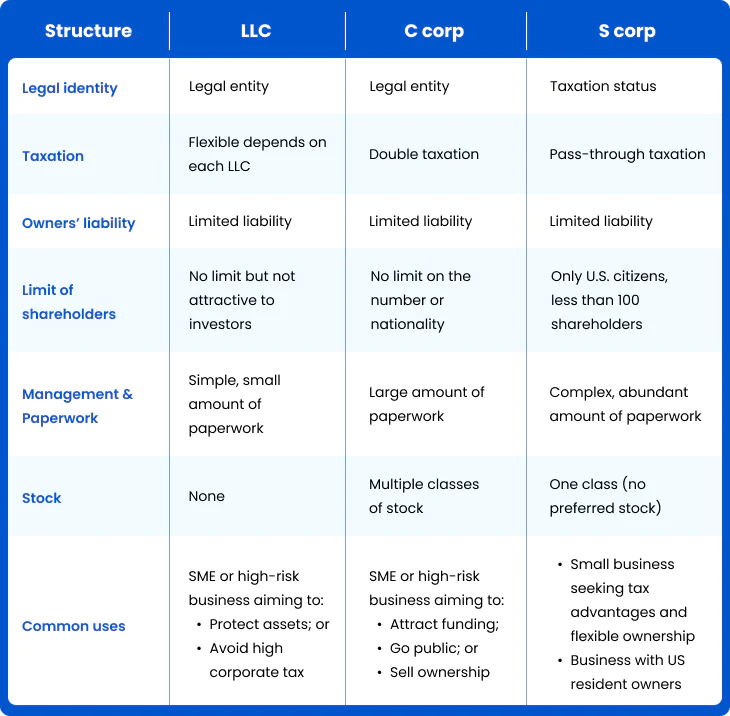
The following table provides a useful visual summary of these and other differences.
2. The Critical Distinction: Legal Form vs. Tax Treatment
One of the most common points of confusion—and one of the most important for a lawyer to master—is the difference between an entity's legal structure and its tax status. They are not the same thing. An LLC or a Corporation is what your business is legally. How the IRS taxes it is a separate election.
Let's watch a short clip that explains this crucial concept very clearly.
LLC vs S Corp vs C Corp | Which Business Entity Should I Choose
Attorney Elizabeth Potts Weinstein provides a concise explanation of the difference between legal entities (LLC, Corporation) and tax classifications (S Corp, C Corp).
Please watch the segment from 00:20 to 01:44. Focus on the central idea that legal formation and tax status are two different choices.
Here's the takeaway:
- A Corporation is a legal entity. By default, it is taxed as a C Corporation (the entity pays taxes on its profits). It can, if it meets certain criteria, file an election with the IRS to be taxed as an S Corporation (a pass-through entity where profits "pass through" to be taxed on shareholders' personal returns).
- An LLC is a legal entity. By default, it is a pass-through entity for tax purposes (like a partnership or sole proprietorship). However, an LLC has the unique flexibility to elect to be taxed as either a C Corporation or an S Corporation.
This tax flexibility is a major advantage of the LLC structure. However, as we're about to see, the perceived simplicity of pass-through taxation isn't always the best strategic choice.
3. A Strategic Evaluation for the Corporate Advisor
Choosing between an LLC and a corporation goes far beyond the legal formalities. A good lawyer advises their client based on the business's long-term goals, financial situation, and exit strategy. The video below, from an attorney specializing in asset protection, provides a masterclass in this type of strategic thinking. He outlines four critical factors to consider.
We will go through his points one by one.
Factor 1: Startup Expenses & Business Failure Risk
Imagine a founder pouring their life savings into a new, high-risk venture. What happens if the business fails? The choice of entity can dramatically change the financial outcome for the founder.
LLC vs S-Corp vs C-Corp | Which Business Entity Should You Choose From A Tax Standpoint?
Let's analyze the first factor: how the entity choice affects the tax treatment of losses if the business fails. This involves a specific provision of the tax code, Section 1244.
Watch the segment from 04:03 to 12:34. The key concept here is '1244 stock loss treatment' and why it's only available to corporations, not LLCs.
Key Takeaway: For a business with high startup costs and a significant risk of failure, a Corporation may be preferable. Under IRC §1244, if the business fails, shareholders of a corporation can deduct a large portion of their investment loss (up to $50,000 for an individual or $100,000 for a married couple) directly against their ordinary income in a single year. An LLC owner who loses their investment is typically limited to a much smaller capital loss deduction of only $3,000 per year.
Factor 2: Business Growth & Reinvestment of Profits
Now consider a successful business that needs to retain its profits to fund growth (e.g., R&D, expansion). The tax implications of the entity choice are paramount.
LLC vs S-Corp vs C-Corp | Which Business Entity Should You Choose From A Tax Standpoint?
The next factor compares how S-Corps (and pass-through LLCs) and C-Corps are taxed when profits are kept inside the business.
Watch from 12:34 to 18:12. Focus on the comparison between a pass-through entity taxed at a high personal rate versus a C-Corp taxed at the flat 21% corporate rate.
Key Takeaway: If a business owner is in a high personal tax bracket (e.g., over 21%) and plans to reinvest profits back into the company, a C Corporation can be more tax-efficient. The C-Corp pays tax on its profit at the flat 21% rate, leaving more after-tax capital available for reinvestment. In a pass-through LLC or S-Corp, that same profit is taxed at the owner's higher personal income tax rate, even if the money is never taken out of the business.
Factor 3: The Owner's "Outside Interests" & Loan Qualification
A business owner's life doesn't exist in a vacuum. They may want to buy a house or invest in real estate, for which they'll need to qualify for a personal loan. The business entity can have a surprising impact on this.
LLC vs S-Corp vs C-Corp | Which Business Entity Should You Choose From A Tax Standpoint?
This section reveals how a business's financial performance can 'bleed over' onto an owner's personal financial profile, affecting their ability to borrow money.
Watch from 18:12 to 26:47. Note how the 'flow-through' nature of an S-Corp or LLC can hurt an owner's loan application, whereas the 'standalone' nature of a C-Corp protects it.
Key Takeaway: If a business (especially a startup) is likely to show losses in its early years, and the owner needs to maintain a strong personal income profile for borrowing, a C Corporation is advantageous. Because a C-Corp is a separate taxpayer, its business losses stay within the corporation and do not appear on the owner's personal tax return. In an LLC or S-Corp, those business losses "flow through" to the owner's return, reducing their reported income and potentially disqualifying them for a mortgage or other loans.
Factor 4: Future Plans & Selling the Business
For many entrepreneurs, the ultimate goal is to sell their company. This exit strategy should be considered from day one, as the initial entity choice can have multi-million dollar tax consequences down the road.
LLC vs S-Corp vs C-Corp | Which Business Entity Should You Choose From A Tax Standpoint?
The final factor discusses the massive tax benefits available when selling a business, but only if it was set up correctly from the very beginning.
Watch the final segment from 26:47 to 29:30. This explains the 'qualified small business stock' (QSBS) exclusion under IRC §1202.
Key Takeaway: If the founder's ambition is to eventually sell the business, starting it as a C Corporation from day one is critical. This structure may allow them to benefit from IRC §1202, which can exempt the first $10 million (or more) of capital gains from federal taxes upon the sale of the stock. This hugely valuable tax break is not available to businesses structured as LLCs or S-Corps.
Test your understanding!
A team of software engineers is creating a startup. They expect to have high initial costs for servers and development for the first two years, likely showing significant losses. Their ultimate goal is to grow the company rapidly and sell it to a major tech firm like Google or Microsoft in 5-7 years. One of the founders also plans to buy her first home in the next two years.
Based on the strategic factors we just reviewed, would you advise them to form an LLC or a C Corporation? Justify your answer by referencing at least two of the factors.
Show answer
A C Corporation would be the strongly recommended entity for this startup.
-
Future Plans (Selling the Business): Their primary goal is to sell the company. By forming as a C-Corp from the start, they position themselves to potentially qualify for the IRC §1202 (QSBS) exclusion, which could save them millions in taxes on the sale. This is arguably the most important factor given their stated goal.
-
Outside Interests (Loan Qualification): One founder wants to buy a home soon. The business is expected to have losses initially. If they formed an LLC, those losses would pass through to her personal tax return, lowering her income and making it difficult to qualify for a mortgage. As a C-Corp, the business losses are contained within the entity, protecting her personal borrowing power.
(An additional valid point would be related to Business Failure Risk. The high initial costs mean if the venture fails, the §1244 stock loss treatment available to a corporation would be far more beneficial than the minimal capital loss deduction from a failed LLC.)
Conclusion
As we've seen, the choice between an LLC and a corporation is one of the most consequential decisions a founder makes. While both provide the essential benefit of limited liability, they offer fundamentally different paths forward.
Key Takeaways:
- LLCs offer flexibility. Their internal governance can be tailored extensively through the operating agreement, and they have flexible tax options. They are simpler to maintain, with fewer required formalities.
- Corporations offer structure. Their rigid management hierarchy and freely transferable stock make them the preferred entity for attracting outside investment, particularly from venture capitalists.
- Strategic goals are paramount. While an LLC might seem simpler for a small business, a C Corporation often provides significant long-term advantages related to reinvesting profits, protecting personal credit, mitigating failure risk, and, most importantly, achieving a tax-efficient exit.
- The conventional wisdom to "just form an LLC" is often poor advice for an ambitious startup. A forward-looking legal analysis is critical.
In this lesson, we've repeatedly touched on the idea that these entities are "separate" from their owners. In our next lesson, we will dive deep into what this foundational legal concept of separate legal personality truly means, and explore its profound consequences for corporate liability.