Hello! Welcome to your next lesson.
In our last session, we compared LLCs and corporations, noting that a primary reason for choosing either entity is to gain limited liability. We concluded that this protection exists because the law treats the business as being separate from its owners. Today, we will dive deep into this foundational concept.
Our learning outcome is to explain the concept of separate legal personality and its consequences for corporate liability. We will explore what it means for a company to be an "artificial person" in the eyes of the law, trace this idea to its origin in a landmark legal case, and analyze the profound effects this has on how corporations operate and who is responsible for their debts. This principle is arguably the single most important concept in all of corporate law.
1. The Core Principle: Separate Legal Personality
When a business is incorporated, the law creates something new: a legal entity with a personality of its own, entirely separate from the people who own and manage it. This is the doctrine of separate legal personality.
Lawyers often use the metaphor of a "corporate veil" to describe this separation. This imaginary veil is drawn between the company on one side, and its shareholders and directors on the other.
To get a formal introduction to this doctrine, let's turn to a clear, foundational video.
Company Law - Nature of Legal Personality
The video 'Company Law - Nature of Legal Personality' by The Law Simplified introduces the core concept of a company as a distinct legal person.
Please watch the first part of the video (00:00 - 02:16). Focus on how the narrator explains that a company, like an individual, can sue and be sued, and how this separates the company's actions from the actions of the individuals (like directors) who work for it.
As the video explains, because the company is its own person, it can:
- Enter into contracts.
- Own property.
- Sue others to enforce its rights.
- Be sued for its own wrongdoings.
The obligations belong to the company itself, not to the shareholders who own it or the directors who run it. This principle didn't appear out of thin air; it was cemented into law by a historic case involving a humble boot-maker.
2. The Landmark Case: Salomon v. Salomon & Co Ltd (1897)
To truly understand separate legal personality, we must understand the story of Aron Salomon. His case, decided by the UK's House of Lords over a century ago, remains the bedrock of modern corporate law worldwide. It illustrates the power and the sometimes counter-intuitive nature of the corporate veil.
The following video provides an excellent narrative of the case, its historical context, and its legal significance.
This video from the University of Galway School of Law, 'Salomon v Salomon (1897)', provides a detailed account of the facts, the legal battles, and the ultimate ruling that defined corporate law.
Please watch the entire video (approximately 7 minutes). As you watch, pay attention to these key points: The Facts: How did Mr. Salomon structure his company? Who were the shareholders? The Dispute: When the business failed, why did the company's liquidator sue Mr. Salomon personally? The Lower Courts' View: Why did the first two courts rule against Mr. Salomon, finding him liable for the company's debts? The House of Lords' Ruling: What was the final, decisive reasoning that reversed the lower courts' decisions and established the company as a separate person?
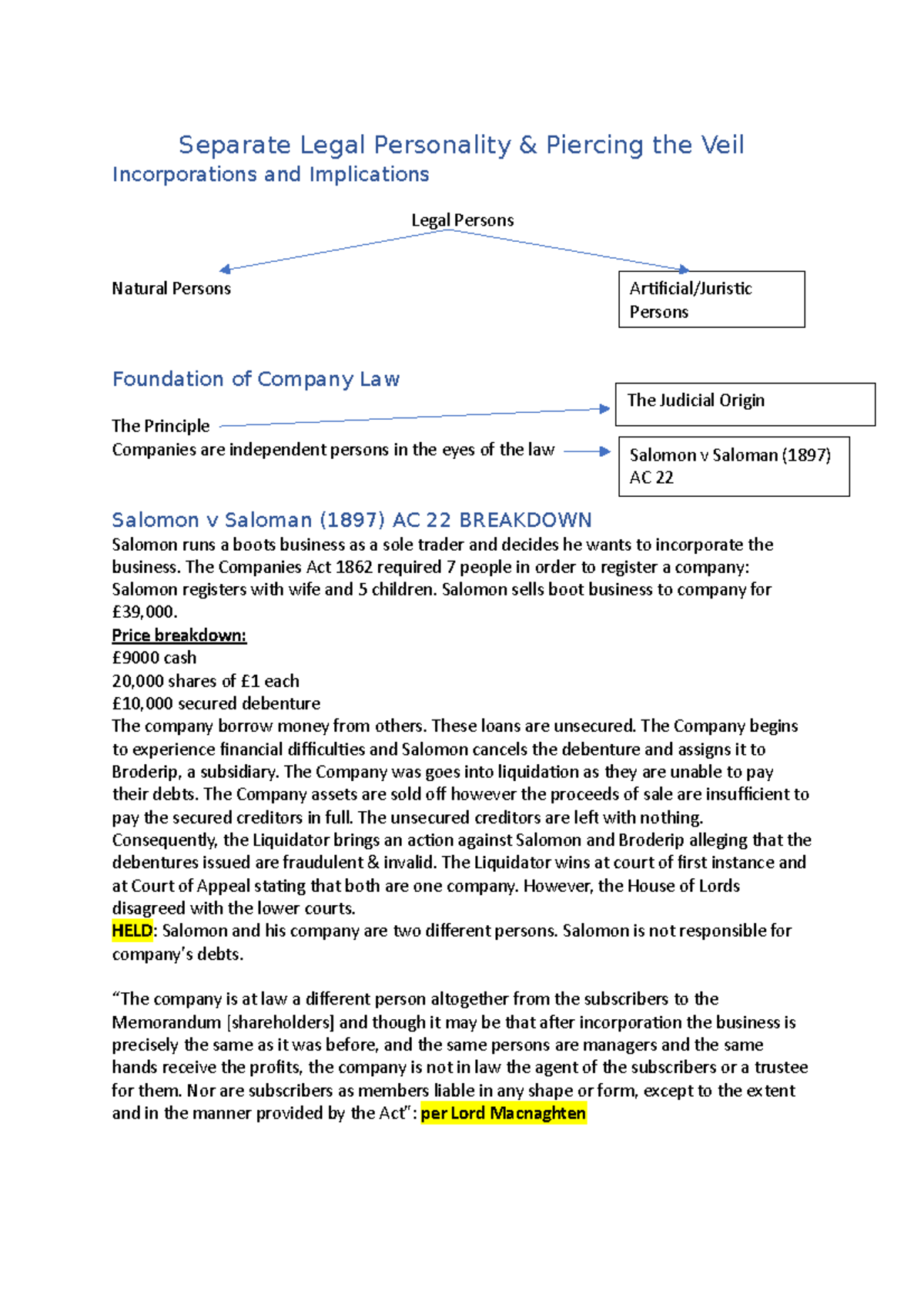
The House of Lords' decision was unequivocal: once a company is legally incorporated according to the rules, it is a separate legal person. The "motives of those who took part in the promotion of the company are absolutely irrelevant."
Even though Mr. Salomon owned almost all the shares and controlled the company completely, the company was not his agent or a sham. It was a distinct entity. Therefore, the debts belonged to the company, and Mr. Salomon, as a secured creditor, was entitled to be paid before the company's unsecured creditors.
This infographic provides a fantastic summary of the case and its core principle.
3. The Consequences of the Corporate Veil
The Salomon principle has several profound and practical consequences for corporate liability and operations. Let's explore the most important ones, using a foundational legal text as our guide.
Commercial Applications of Company Law
This chapter from 'Commercial Applications of Company Law' details the practical results of treating a company as a separate legal entity. It uses other key cases to illustrate these consequences.
Please read the section titled '[¶304] What are the consequences of treating the company as a separate legal entity?'. It starts on page 3 and continues to page 4. Focus on the five bolded consequences and the short case examples provided for each.
Let's summarize and reinforce those key consequences:
-
A company’s obligations and liabilities are its own. This is the direct link to the concept of limited liability. If the company incurs a debt or is found liable in a lawsuit, the company's assets are at risk. The personal assets of the shareholders are protected behind the corporate veil.
-
A company’s property is not the property of its participants. The case of Macaura v. Northern Assurance Co Ltd is the classic illustration. Mr. Macaura owned a company that owned timber. He insured the timber in his own name. When the timber was destroyed by fire, the insurance company refused to pay him. Why? Because he did not own the timber; the company did. He did not have an "insurable interest." This shows how strictly the law separates the company's property from the shareholder's.
-
A company can contract with its controlling participants. The case of Lee v. Lee’s Air Farming Ltd demonstrates this vividly. Mr. Lee was the sole owner, director, and chief pilot of his company. He was killed in a work-related plane crash. His widow sued the company for worker's compensation. The court agreed, ruling that it was possible for Mr. Lee, the person, to have an employment contract with Lee's Air Farming Ltd., the separate legal entity. One person can wear multiple hats: owner, director, and employee.
-
A company has perpetual succession. The company continues to exist even if its owners and managers change or die. Its existence is terminated only through a formal legal process (liquidation or dissolution).
-
A company can sue and be sued in its own name. If a third party breaches a contract with the company, the company itself is the plaintiff in the lawsuit, not its shareholders.
Test your understanding!
Sarah is the sole shareholder and director of "Innovate Inc.," a tech startup. The company signs a five-year lease for a large office space. Two years later, Innovate Inc. fails and has no assets left. The landlord sues Sarah personally for the remaining three years of rent, arguing that since she was the one who signed the lease on behalf of the company and was the sole owner, she should be responsible.
Based on the Salomon principle, is Sarah personally liable for the rent? Why or why not?
Show answer
No, Sarah is not personally liable. The lease was a contract between the landlord and Innovate Inc., which is a separate legal person. Following the precedent set in Salomon v. Salomon, the company's liabilities are its own, not its shareholders'. The corporate veil protects Sarah's personal assets from the company's creditors, including the landlord. The fact that she was the sole owner and signed the lease is irrelevant, as she was acting as an agent for the separate legal entity.
4. Separate Personality vs. Limited Liability
It's important to be precise with these two related terms. They are often used interchangeably, but for a lawyer, the distinction matters.
- Separate Legal Personality is the foundational principle that a company is a distinct legal person. This is the cause.
- Limited Liability is a primary consequence of separate legal personality. Because the company is a separate person that incurs its own debts, the liability of its shareholders is generally limited to the amount they invested in their shares.
Think of it this way: all properly formed companies have separate legal personality, but not all have limited liability (e.g., an "unlimited company" is a rare type where shareholders are liable, though the company is still a separate person). The video you watched earlier makes this distinction well.
Conclusion
Today, we've unpacked the single most important principle in corporate law. It is the legal fiction upon which the entire structure of modern business is built.
Key Takeaways:
- Separate Legal Personality: Upon incorporation, a company becomes a legal entity distinct from its shareholders and directors, often described as being separated by a "corporate veil."
- Salomon v. Salomon: This landmark case established that if a company is properly formed, the law will treat it as a separate person, regardless of who controls it or why it was formed.
- Key Consequences: This principle means a company owns its own property, is responsible for its own debts (which shields shareholders), has perpetual existence, and can sue, be sued, and contract in its own name—even with its own owners.
The corporate veil established in Salomon is strong, but it is not absolute. In certain exceptional circumstances, such as fraud or abuse, a court can choose to "pierce the corporate veil" and hold shareholders personally liable for the company's debts.
In our next lesson, we will explore this crucial exception. We will analyze the 'piercing the corporate veil' doctrine to understand when and why a court will disregard the separate personality of a corporation.