Hello! Welcome to your lesson on one of the most fascinating and consequential exceptions in corporate law.
In our last session, we established the core principle of separate legal personality, using the Salomon case to understand how the law creates a "corporate veil" between a company and its owners. This veil is the source of limited liability, shielding shareholders' personal assets from the company's debts.
Today, we'll examine the limits of that protection. Our learning outcome is to apply the 'piercing the corporate veil' doctrine to determine when shareholders may be held personally liable. We will investigate the rare but critical circumstances where a court will disregard the company's separate status and hold its owners accountable for its obligations. This doctrine acts as a crucial check on the abuse of the corporate form.
1. The Veil is Strong, but Not Absolute
The "corporate veil" provides a powerful shield for shareholders. However, this protection is a privilege granted by the law, not an absolute right. Courts reserve the power to "pierce" this veil when they see the corporate structure being used to perpetrate fraud, evade obligations, or achieve an unjust result.

When a court pierces the corporate veil, it sets aside the principle of separate legal personality and treats the shareholders and the corporation as one and the same, at least for the purpose of the specific liability in question. Let's watch a short introduction to this concept.
Piercing the Corporate Veil: Lesson 1 of 2 (Torts)
The video 'Piercing the Corporate Veil: Lesson 1 of 2' from Business Law Education provides an excellent metaphor for what it means to pierce the veil and explains why it's considered an 'equitable' doctrine.
Please watch the segment from 05:20 to 07:21. The instructor uses the 'Wizard of Oz' analogy to explain the concept and discusses the equitable purpose of the doctrine: to prevent fraud and achieve justice.
As the video explains, piercing the veil is an equitable remedy. This means it's not based on a rigid statute but on principles of fairness and justice applied by a judge. The court is essentially saying, "The way you used this corporation was unfair, so we will not allow you to hide behind its legal status."
2. The Factors for Piercing the Veil
Since this is an equitable doctrine, there is no single, universally accepted test. Different jurisdictions might phrase the test differently. However, judges across the board look for a common set of "red flags" that suggest the corporation is not a truly separate entity but is instead a mere "alter ego" or "instrumentality" of its owner.
The following resource from the law firm Jimerson & Cobb, P.A. provides a clear, practical summary of the most common factors courts consider.
The Five Most Common Ways to Pierce the Corporate Veil ...
The article 'The Five Most Common Ways to Pierce the Corporate Veil' clearly outlines the key factors courts look for when deciding whether to disregard the corporate entity. Reading this will give you a solid framework for analysis.
Please read the entire article. Focus on understanding the five main factors discussed: Fraud or wrongdoing Failure to maintain separate identities (between related companies) Failure to maintain separate identities (between company and owner) Inadequate capitalization Failure to follow corporate formalities Pay attention to the practical examples provided for each.
To reinforce and add depth to these points, let's turn back to our video lecture, where the instructor discusses these factors with illustrative examples.
Piercing the Corporate Veil: Lesson 1 of 2 (Torts)
This segment of the lecture details the main factors that lead to piercing, providing context and practical examples for each one.
Please watch from 07:21 to 17:08. The instructor covers the key factors, including the importance of the corporation being 'closely held', deceit, failure to observe formalities, commingling assets, and inadequate capitalization. He also references an empirical study showing which factors are most influential.
Let's synthesize what we've learned from these resources. While many factors are considered, they generally fall into two broad categories:
-
Unity of Interest (Alter Ego): Is the corporation truly separate from its owner? Or is it just a facade? Evidence of this includes:
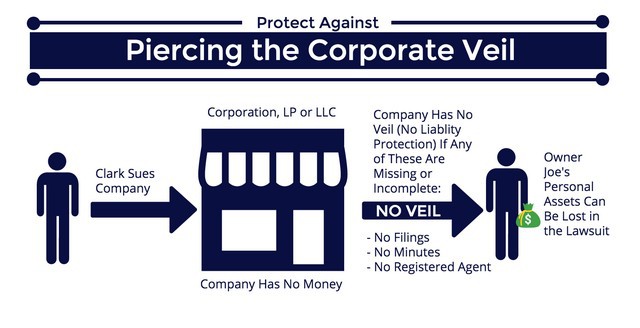
- Failure to follow corporate formalities: Not holding board meetings, not keeping minutes, not issuing stock.
- Commingling of assets: The owner uses the corporate bank account for personal expenses or vice-versa.
- Domination and control: The owner runs the company with no regard for the corporate structure, making all decisions unilaterally.
-
Injustice or Unfairness: Was the corporate form used to accomplish some wrongful purpose? This often involves:
- Fraud or deception: Using the corporation to mislead creditors or others.
- Inadequate capitalization: Intentionally funding the corporation with so little money that it could never meet its foreseeable debts. This is a crucial factor, especially in tort cases. The goal here isn't to punish business failure, but to prevent founders from deliberately externalizing the risks of their business onto the public.
Test your understanding!
A landscape gardener incorporates his business as "Gardens Ltd." He is the sole shareholder and director. He continues to use his personal truck for jobs, pays for company fuel with his personal credit card, and deposits checks from clients directly into his personal bank account. Gardens Ltd. has a formal corporate bank account, but it contains only $100. One day, while working, he negligently damages a client's rare statue, causing $50,000 in damages.
Which factors for piercing the corporate veil are present here?
Show answer
Several key factors are present:
- Commingling of assets: He uses his personal accounts for business transactions and vice versa.
- Inadequate capitalization: The company account has only $100, which is insufficient to cover potential liabilities for a landscaping business.
- Failure to maintain separate identity: By commingling funds and assets, he is not treating Gardens Ltd. as a separate entity. This points toward the company being his "alter ego."
3. Applying the Doctrine: Tort Cases and the "Alter Ego" Test
Theory is one thing; application is another. Let's examine how courts apply these factors in real-world scenarios. We'll focus on tort cases (like car accidents), as they often involve "involuntary creditors" who didn't choose to do business with an underfunded company. This will connect with your existing understanding of tort law.
A classic case in this area is Walkovszky v. Carlton, which involved a fleet of New York taxi cabs.
Piercing the Corporate Veil: Lesson 1 of 2 (Torts)
The video lecture now analyzes the famous Walkovszky case, where the court had to decide whether to pierce the veil of a taxi corporation that was part of a larger enterprise.
Please watch the segment from 32:25 to 40:38. Pay close attention to the court's reasoning. Why did the majority refuse to pierce the veil, even though each taxi corporation was minimally capitalized?
The key takeaway from Walkovszky is that undercapitalization alone is usually not enough. The owner, Carlton, had followed the corporate formalities for each of his ten companies. He met the minimum insurance requirements set by law. There was no evidence he was commingling assets or using the companies for personal business. The court found that if the legislatively-mandated insurance minimum was too low, the proper remedy was for the legislature to change the law, not for the court to disregard the corporate form.
To provide a more structured approach than just listing factors, many courts have adopted a formal "alter ego" test. Let's see how this works.
Piercing the Corporate Veil: Lesson 1 of 2 (Torts)
Finally, the instructor introduces a structured, three-part 'alter ego' test from another case, Radaszewski v. Telecom Corp. This provides a clear framework for you to apply in your own analysis.
Watch the segment from 45:21 to 56:56. Focus on the three-part test the court lays out. You'll want to write these three prongs down, as they are a very useful tool for analysis.
The three-part test for piercing the veil under the alter ego doctrine is:
- Control/Domination: The owner exercised "complete domination" over the corporation's finances, policy, and business practices, to the point that the corporation had "no separate mind, will, or existence of its own."
- Wrongful Use of Control: This control was used by the owner to commit fraud, a wrongful act, or to violate a legal duty.
- Proximate Cause: The owner's control and breach of duty must have proximately caused the injury or unjust loss complained of.
This test neatly combines the two categories we discussed earlier (Unity of Interest and Injustice). A plaintiff must prove all three prongs to succeed.
Conclusion
We've seen that the corporate veil, while foundational, is not sacred. It is an instrument of commerce, not a shield for injustice. The doctrine of piercing the corporate veil ensures that the privilege of limited liability is not abused.
Key Takeaways:
- Piercing the corporate veil is an equitable remedy where a court disregards a company's separate legal status to hold its shareholders personally liable.
- Courts look for key factors indicating the company is merely an "alter ego" of its owner, such as commingling of assets, failure to follow formalities, and domination and control.
- A second crucial element is often required: that the corporate form was used to perpetrate fraud, wrongdoing, or injustice, often evidenced by deliberate undercapitalization.
- The three-part alter ego test (Domination, Wrongful Use, Proximate Cause) provides a structured framework for applying these principles.
In our previous lesson, we saw the creation of the corporate shield. Today, we learned how it can be broken.
In our next lesson, we will shift our focus from liability to taxation and regulation. We will begin to explore the different types of corporations by distinguishing between C corporations and S corporations for U.S. federal tax purposes. This will be our first step into understanding how different corporate structures are treated under specific regulatory regimes.