In our last session, we refined your use of articles and determiners, focusing on the precision needed to elevate your writing from a Band 7 to a Band 8.5 level. We're continuing that journey today by concentrating on another grammatical feature that signals a high degree of control and sophistication: parallel structure.
This lesson is designed to help you master the learning outcome: Use parallel structure accurately in lists, comparisons, and paired constructions. Faulty parallelism can make complex sentences confusing or awkward, while correct parallelism adds clarity, rhythm, and elegance. For an IELTS examiner, consistent use of this structure is a clear indicator of an advanced writer.
What is Parallel Structure?
At its core, parallel structure—or parallelism—is about balance. It means using the same grammatical pattern for two or more ideas that have the same level of importance. This consistency makes your writing smoother and your ideas easier to understand.
A helpful analogy is setting a dining table. The video below uses this idea to explain why consistency is important not just for presentation, but for clarity.
Parallel Structure | A Quintilian Institute Special Presentation
In this short video from Writing with Andrew, pay attention to the analogy used to explain the concept.
Watch from the beginning to the end of the analogy to grasp the core principle of why consistency in structure is so important for the reader.
As the video suggests, just as a consistently set table prevents confusion, a consistently structured sentence ensures your reader understands the relationship between your ideas.
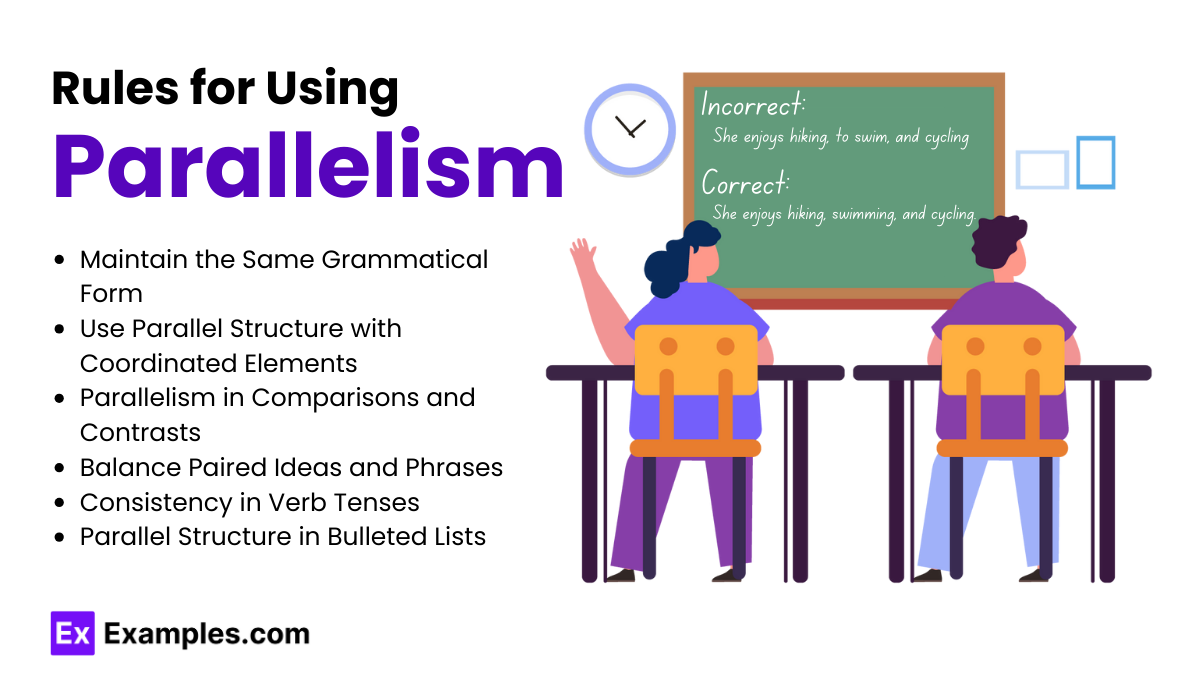
The image below provides a simple visual summary of the rules and an example of faulty vs. correct parallelism.
Parallelism in Lists and Series
The most common place you'll use parallel structure is in lists. The rule is simple: every item in the list must be in the same grammatical form.
- All nouns: The policy affects students, teachers, and administrators.
- All gerunds (-ing forms): The research involved interviewing subjects, collecting data, and analyzing the results.
- All infinitives (to + verb): The plan is to reduce waste, to promote recycling, and to raise awareness.
Notice how the repetition creates a clear, rhythmic, and easy-to-follow sentence.
The following resource provides a detailed breakdown of different ways to use parallel structure. We will focus on three key areas covered in this guide.
This guide from Towson University's Online Writing Support is a comprehensive academic resource on parallelism.
First, read the introductory section to understand the benefits of this structure: this initial explanation. Then, navigate down to point 2, "Use parallel structure with elements in lists or in a series," and read this part carefully.
To see this applied in a high-scoring IELTS context, notice how the sample passage from Preptical uses a parallel list of gerunds to outline a process.
15 Sentence Structures for Band 9 Writing in IELTS + Sample passage
This resource demonstrates various sentence structures in a Band 9 sample essay.
Find the sample passage under the heading "Sample band 9 passage with sentence structures." In the second paragraph, locate the sentence that begins with "The task of environmental conservation..." This is a perfect example of a parallel list within an IELTS Task 2 essay. The part to focus on is: the parallel list.
Parallelism in Comparisons and Paired Constructions
Beyond simple lists, parallelism is essential for clarity in more complex structures, such as comparisons and sentences using correlative conjunctions. This is an area where many candidates at the Band 7 level falter.
1. Comparisons
When you compare two things using words like than or as, the items being compared should have the same grammatical structure.
- Faulty: To study in a group is better than working alone.
- Correct: Studying in a group is better than working alone.
- Also Correct: To study in a group is better than to work alone.
2. Paired (Correlative) Conjunctions
These are pairs of conjunctions that connect two balanced clauses, phrases, or words. The key pairs to master for IELTS are:
- not only ... but also
- either ... or
- neither ... nor
- both ... and
The rule is that the grammatical structure following the first part of the pair must match the structure following the second part.
- Faulty: The new policy is not only a response to economic pressure but also it reflects a shift in political ideology. (Connects a noun phrase with a clause).
- Correct: The new policy not only responds to economic pressure but also reflects a shift in political ideology. (Connects two verb phrases).
Now, let's return to the Towson University guide to see detailed explanations and examples for these advanced structures.
We will now study the sections on comparisons and paired constructions.
Please read section 3, "on comparisons," and then section 5, "on correlative conjunctions." Pay close attention to the "before and after" examples showing how to repair faulty parallelism.
Identifying and Correcting Faulty Parallelism
The final step is to develop your ability to spot and fix these errors in your own writing. The next video provides an excellent interactive quiz to practice this skill.
Parallelism: The secret to great writing
This video from engVid offers clear examples and a practical exercise.
First, watch the instructor provide examples of correct parallel structures from this segment. Then, move on to the interactive quiz starting at this point. For each of the six sentences, I encourage you to pause the video and try to identify and correct the error yourself before listening to the explanation. This active practice is key to internalizing the concept.
Conclusion
In this lesson, we have explored the principle of parallel structure and its application in lists, comparisons, and paired constructions. Mastering parallelism is not just about following a grammatical rule; it is about bringing balance, clarity, and authority to your writing—qualities that are essential for achieving a Band 8.5 score.
Key Takeaways:
- Parallel structure means using the same grammatical form for related ideas to create balance and clarity.
- It is crucial in lists and series, ensuring all items are consistent (e.g., all nouns, all gerunds).
- In comparisons, the elements being compared must be grammatically parallel.
- With paired conjunctions like
not only...but also, the structure following each part of the pair must match.
In our next lesson, we will broaden our scope to cover the final step in the writing process: "Self-edit a piece of writing systematically to eliminate grammatical errors." The skill you've developed today—spotting and correcting faulty parallelism—will become a vital part of your personal editing checklist.